The project to build the Friendship House has become a textbook example for all of us, and we know it even better than it could seem.We can easily name all those who initiated this undertaking and stood at its roots, and in some case even their professions. Listing construction workers could be a little trickier but give yourself a moment, and you will remember all of them too. By the way, this was quite a motley crew, with most its members lacking construction skills. But they sure had a lot of enthusiasm and were extremely motivated to compensate for their professional shortcomings.There were no design, planning documents or sketches for this house, which used to be called a grab-and-go method back in the Soviet era – just get everything you need anywhere you can and go with it. So they looked around to find the construction materials they needed, which could have included some shady operations and a good dose of smooth-talk to tap brick reserves, get nails and paint. They also recruited volunteers and persuaded them to work for free, etc. No quotes, funding or reporting.But the outcome exceeded the boldest expectations.Well, maybe not exactly… The Friendship House never served its immediate purpose, but this could be even better since everyone involved in the project to build it became friends while working on it. They used to be dull and lonely, but this joint effort changed them. But don’t people who want to spend time together and have fun need a place to hang out, socialize and get to know each other better? This is how Friendship House evolved into a hobby club of sorts.Cheburashka Lonely Hearts ClubI know that our website attracts only knowledgeable and savvy readers, so by now they will have guessed that I am talking about the famous Friendship House as conceived by writer Eduard Uspensky and built by his characters: Gena the crocodile, Cheburashka – an enchanting of a creature, and Galya, a lead actress from a children’s theater. This hodgepodge of a troika undertook a major social mission to bring together lonely hearts from their neighborhood, starting with Chandra the lion and Tobi the dog. The two formed the first friendly couple, quite peculiar but nevertheless viable.Things got moving from this point, making it clear that Gena’s modest apartment was not fit for serving as a Friendship House. This, in turn, prompted the organizing committee to create a co-working space of sorts close to the kindergarten for matchmaking. The volunteer crew included those who decided to end their loneliness: Anyuta the giraffe, Maria Frantsevna – a monkey, Dima the F-student, and Marusya, a modest, well-educated girl and an A-plus student – God knows how she ended up in this company.Having succeeded in dealing with the scarcity of construction materials and overcoming red tape, as well as the dirty tricks played by the universal evil in the face of Old Lady Shapoklyak and Lariska, her pet rat, the team completed the project on time.The crocodile cut the ribbon with his teeth when it dawned on everyone that they already knew where their sympathies lay. Maria Frantsevna may be a monkey but even she became friends with Anyuta, the giraffe, and climbed on her neck. Dima may have been a slacker, but things turned out for the better for him too, since he could benefit from his friendship with Marusya who let him copy her homework. A good start for a love affair.Therefore, this was a Friends’ Club rather than a Friendship House. Feel the difference? It does exist though.Formed spontaneously, this group of like-minded characters wanted Cheburashka to take up residence in the building. He did not have a home, after all. But Cheburashka firmly refused. A no is a no.“Never,” said Cheburashka – or should we call him Che for his unwavering position? “It will be a club and nothing more, while you can send me to the kindergarten as a toy.” Not a bad choice indeed: a kindergarten means a job with teaching experience, as well as bed and board.This is to say that Cheburashka made a reasonable choice as a true leader. He may not be the best on strategic matters, but as far as tactics were concerned he did a descent job. Taking over the new building would have led to suspicion that he had a vested interest in the whole affair bordering on financial improprieties. But he made a good choice and deserves to be honored and respected for his posture.It is this calculated move that made Cheburashka a legend with his never-ending presence on cinema screens and on souvenirs. He went as far as become a mascot for the national Olympic team, which was no small feat considering that this meant competing against the 1980 Mishka the bear mascot. No small feat indeed.By the way, this year marks the 60thanniversary of the first Cheburashka book. It told the story of an undefined creature with a good heart. Several generations grew up in our country following his adventures and marveling at his credulous and somewhat distraught smile.This is to say that you now have all the elements there is to know about the most famous Friendship House in the post-Soviet space. In fact, you even remember the way Klara Rumyanova said, “We built and built, and finally we built it!” in her inimitable voice from the 1969 cartoon. Everything was fine and dandy, so time to move on.But wait, Cheburashka’s adventures must stay in our memory as a positive and instructive story. But it can hardly serve as a blueprint for action in today’s challenging, rapidly changing and high-tech environment. Who would launch a major construction project to build, say, a Friendship House, without understanding what kind of purpose it will serve, the risks and possible benefits. This would be too naïve even for Cheburashka.Today, we face an imperative to have a clear understanding who should be our friends, for what purpose and why. Knowing with whom to work to counter someone is even better. But this spills into the territory of sophisticated diplomacy and military doctrines. Of course, even Tobi would know that if you want to build a Friendship House it must be designed to last for centuries so that every detail is taken into account and included in the project and the whole world is blinded by its beauty.Guards on the high banks of the AmurRussia has recently, barely a year ago, opened a unique Friendship House. I am referring to the House of Russian-Chinese Friendship. It is located in the most logical place for it – Blagoveshchensk. There is no city in our country, let alone a regional center, located closer and more conveniently to China than the capital of the Amur Region.The distance to the closest Chinese city, Heihe, is barely 700 meters, as you can read on various signs located around Blagoveshchensk, including gift magnets. On the other hand, even without reminders, you’d have to go out of your way not to notice China’s proximity. The ultramodern city of Heihe, shining with lights at night on the other bank of the Amur, which has grown out of a shanty town over the past 40–45 years, is a phenomenon in itself.Russia and China have been through various situations, and far from all of them were positive. It sometimes came to open confrontation, and even hostilities. In such periods, the border location of Blagoveshchensk brought nothing to its residents except increased anxiety and the need to remain perpetually on high alert. The border pillar on the waterfront is more than just a symbol. It is a reminder that this the place where the invisible dashed line runs separating Russia from China. A state border is no child’s play.Standing on that waterfront is also an active border watchtower, in sharp contrast to the colorful crowd casually strolling by and the retirees busting a move to classic Soviet tunes and Russian folk melodies.“While ordinary life goes on below, the staff of the FSB Border Directorate for the Amur Region are on duty around the clock up above, protecting the state border. It is 86 steps up a spiral staircase to the observation post. Serving in this post is an honor and a great responsibility, for the whole of Russia is behind you,” reads a statement on the website of the Blagoveshchensk,” reads a statement on the website of the Blagoveshchensk Culture Center written in the blunt language of a poster.There are really border guards on that beautiful latticework, yet functional tower. It’s difficult to say what they are watching, because there must be much more advanced means of monitoring the border zone. On the other hand, even in this age of AI you can completely rely only on a real person, especially if they received border guard training.Moreover, a real border guard standing in a watchtower that is far from a museum piece is another reminder of a complicated past – as well as a warning against future incursions. It is much more interesting and pleasant to be friends, understanding and respecting each other, and building up mutual benefits.Knock on wood, Russia-China relationship, while not exactly all sunshine and rainbows, can at least be described as healthy and constructive cooperation and geostrategic partnership across various spheres. Therefore, if a reminder that our border is under lock and key stands on the waterfront of Blagoveshchensk, which serves as the showcase for all of Russia, at least in China’s eyes, there should also be a clear indication that borders are no barrier to true friends.In other words, the House of Russian-Chinese Friendship serves as such an indication, or even more so. The luminous sign of the Komsomolsk fur supermarket on the Chinese side is reciprocated by the RCF House, an abbreviation familiar to everyone in these latitudes. Isn’t it an open invitation to the Chinese comrades to be friends, with a great little spot saved up just for that?Winter is comingThe House of Russian-Chinese Friendship is much more than a place where you can talk friendship and cooperation. You may ask: what other purposes does this enormous 900-square-meter spacecraft-looking structure serve?Certainly, more than how Gena the Crocodile, Galya and Cheburashka entertained themselves according to children’s author Eduard Uspensky: “After work, they would get together at the crocodile’s to chat, drink coffee and play Tic-Tac-Toe.”So what exactly is the House of Russian-Chinese Friendship in Blagoveshchensk?Is it a museum, an exhibition hall, a multimedia platform, an art venue, or a leisure club? All of the above and more – and neither. When there is no equivalent and nothing to compare it with, try to show the core idea visually.The best way is to ask an expert. So, I spoke to Nadezhda Parkhunova, Director of the House of Russian-Chinese Friendship. She certainly knows her facility better than anyone.“Yes, it is a leisure center in a sense. It is also a place where we can discuss our regional points of growth, get together and talk,” Ms. Parkhunova explains patiently. “At the same time, there are aspects of the Russia-China relations that never get addressed by either government bodies or educational institutions or cultural organizations. But we can address them, in any format we see fit. We’ve been given a free hand, which is a great privilege. The only disadvantage is that we are too young.”“Is it really a disadvantage? It seems like a wonderful benefit,” I say, surprised.“Certainly. It is a disadvantage because we opened just recently, merely a year ago.”“The house opened in October 2025, didn’t it?”“Right. The first six months were spent on making finishing touches and adjustments. We started getting visitors, prompted to learn more about their interests. We could see what sections received a response and where people were less engaged even if we believed that a certain section was necessary. I don’t enjoy the first year of any project but I love the second.”“Congratulations, then. The second year – your prime era – is beginning. What makes the second year better?”“At this point, we already know how everything works, including visitor traffic fluctuations. Broadly speaking, we know more or less how to get through winter.”“I’ve never heard before that winter is such a specific stage in project development. But I have worked in milder climates for most of my life.”“In winter, we get temperatures as low as -40°C degrees. Have you noticed the square outside the House of Friendship?”“I loved it, it’s beautiful. There is a monument commemorating explorers, and gorgeous musical fountains.”“In winter, our visitors have to cross these 30 meters in the wind at -40°C degrees. It means they must be greeted with hot tea or coffee. So, we came up with a lounge area with cushions on windowsills.”“It looks cozy, by the way. Although I didn’t register this lounge area as a buffer between harsh cold and the warmth – in all respects – of the House of Friendship.”“But of course. It is a place for children to get warm. Now that we have clarified all – or many – aspects, we are starting the second round of work on this remarkable project. For instance, recently we met with a company that wants to organize a Chinese-Russian ethnic fashion show here and present a book by fashion legend Tatyana Smirnova. She is 95 years old and she remains a wonderful advocate for Russian traditions. Isn’t it worth seeing?”“Absolutely.”“Businesses approach us with their event ideas, of course. Knowing what hits the spot, we will be updating and improving our main halls soon. It is a space that is alive with action.”A tale of the pipa and the balalaikaAt the heart of this vibrant space – and that’s no exaggeration – are eight themed rooms housing a permanent exhibition. With remarkable ingenuity and an interactive approach, the exhibition does not set the various facets of Russian and Chinese life against one another; instead, it invites a thoughtful comparison between them.The cultural phenomena on display are so diverse that it’s almost too much to take in. Yet, without them, grasping the profound essence of our two civilizations would be daunting – if not impossible.After all, one wouldn’t exactly compare the contributions to world culture, or even just the sounds, of the Russian balalaika and the Chinese pipa at a formal governmental level, would one? (For those unfamiliar, the pipa is a lute-like instrument.) Both have wooden bodies, tuning pegs, and strings – three on the balalaika, four on the pipa. But what vastly different paths they’ve taken – and how distinct their sounds are!In a sense, the balalaika speaks in Russian, while the pipa speaks in Chinese. Visitors can hear these sounds, enjoy them, and let their imaginations roam—all without leaving the exhibit hall at the House of Russian-Chinese Friendship.In fact, you can hear these instruments in a very lifelike way, thanks to modern computer technology. You can even generate a rendition of a well-known Russian folk melody – on a Chinese guzheng, for instance. People have come up with all sorts of creative arrangements for Kalinka-Malinka.Pavel Karaush, the virtuoso guide who accompanied me through the exhibition, pointed out a particular detail that had never occurred to me before. Our instruments came out of the common people – from the folk itself, stretching back centuries. Chinese instruments, by contrast, trace their lineage back to the imperial chambers. An intriguing distinction, isn’t it?It’s true, when you think about it: it’s hard to imagine Tsar Ivan the Terrible blowing into a zhaleika(a traditional Russian folk reed pipe). Yet it’s quite easy to picture the musically gifted Emperor Huizong of the Song Dynasty plucking the delicate strings of a guqin – a seven-stringed instrument that bears a faint resemblance to our own gusli. The rulers lived in different eras, but that’s not the point; what matters is the unique, distinct path each culture has taken.Many Russian monarchs – though not all – were also musicians. Peter the Great, it is said, was a decent drummer and also had an affinity for the oboe and the bagpipes. Peter III, perhaps less successful as a ruler, compensated for his lackluster governing skills with a talent for the violin. Alexander I played the violin and the clarinet too – a fitting choice for his character. Nicholas I favored the flute and the French horn; Nicholas II played the piano; Alexander III, the trumpet…Yet these are instruments with a more universal, predominantly European character. Russian rulers may have taken to these instruments, but that didn’t stop ordinary people from playing their bayans(button accordions) with abandon at celebrations or pounding their tambourines with wild energy. China followed its own path – neither better nor worse, simply different.Incidentally, among the instruments from our neighbors on display at the House of Russian-Chinese Friendship, the one that left the deepest impression on me was the sheng. It is an ancient mouth organ – some three or even four thousand years old. The European harmonium and accordion both descended from it – though this happened quite recently, in the 18th century.On its stand, a sheng gleamed with nickel-plated pipes, looking like a model of an alien spacecraft – a far cry from its ancient ancestor, made from gourd and bamboo.Touching is strictly encouragedThe House of Russian-Chinese Friendship differs from most museums across the globe in one fundamental respect: strictly speaking, it isn’t a museum at all. And most importantly, nobody here follows visitors around or slaps their curious hands away when they reach out to touch an exhibit. Quite the contrary: the staff not only allow visitors to touch, operate, move, listen to, and even smell the exhibits, but actively encourage them to do so.That’s the whole idea: to immerse visitors completely in the experience. As it turns out, this is also a much more effective way of taking in information.Many of the exhibits are interactive, allowing visitors to pick up an item that appeals to them or, say, a block bearing a schematic image of some symbol and to place it in a designated spot, triggering a presentation on the subject in question. These presentations are both comprehensive and concise, complete with illustrations and animations, and are available in either of the House’s two working languages, Russian and Chinese.The tables laid out for a Chinese tea ceremony and a traditional, informal Russian tea gathering are among the most popular exhibits. And little wonder: tea has always played an important, sometimes even strategic, role in the relations between our two cultures. At these tables, visitors can easily learn what the various cups, bowls, teapots, and jade frogs are used for in the Chinese tradition, or find out what best goes with a cup of tea served the Russian way.Pavel Karaush, who seems to know the subject inside out, points out that the main difference between the two traditions is this: our Chinese neighbors enjoy a wide variety of teas and ways of serving them, but have no accompanying snacks. We, on the other hand, think nothing of adding sugar to a freshly brewed pot of tea, slipping in a slice of lemon or, depending on our mood, adding milk, honey or jam. And a traditional Russian tea gathering simply wouldn’t be complete without bubliki (ring-shaped rolls), pretzels, or cookies.Unable to resist, I chipped in with a joke. Imagine a cast-iron pot of steaming-hot borscht on the table, alongside a loaf of rye bread cut into thick slices and pickled cucumbers dressed up with Yalta onions and drizzled with fragrant Kuban sunflower oil. There’s salo (cured pork fat), its delicate pink streaks all the more tempting, and garlic to add a sharp, biting kick. A skillet of fried potatoes is on its way, along with pirozhki (small pies), kulebyaka(a large, elaborate pie) and whatever else the good Lord has seen fit to put on the table. From the ice cellar comes a large jug of khlebnoye vino (traditional grain spirit), beaded with condensation... And when someone quite reasonably asks, “So, what exactly are you doing here?”, the blissful answer is: “Why, we’re having tea!”Nobody is in the least bit bothered by the absence of a samovar or even a tea brewing pot.In Russian tradition, “having tea” can mean any convivial feast or a good, heartfelt chat among friends, regardless of food or drinks on the table. Besides, everyone knows perfectly well that the tea itself will become the centerpiece sooner or later; it’s bound to find its way to the center of the gathering, just after the customary invitation: “Well, shall we have a cup of tea before we go?”Obviously, the whole thing might seem a little baffling to our Chinese friends. But that’s perfectly okay – we’ll explain it all, tell them the story, and show them how it’s done.A matter of taste and superstitionWhere else but at the House of Russian-Chinese Friendship could you get such an expert introduction to the world of superstitions? It’s truly remarkable how stubbornly these old wives’ tales persist, having survived from time immemorial into the age of nuclear power, online marketplaces and ubiquitous digital technology. There’s simply no getting rid of them!What’s more, these superstitions can unsettle or even distress the more impressionable among us. So it’s probably best to know a thing or two about them, if only to avoid causing someone emotional trauma.Do you know what is considered a sign of impending wealth in Chinese culture? Well, obviously, going to work is still the surest way to make money. But according to our Chinese neighbors, the number eight is also a reliable omen of financial prosperity. Who would have thought?In Russia, they say you should never whistle indoors, or you’ll end up penniless. Yet common sense suggests that if every Russian family that refrained from whistling were suddenly showered with untold riches, the Forbes rich list would be packed with Russian names. Instead, it’s dominated by Americans – a nation of enthusiastic whistlers. And yet this does absolutely nothing to undermine the remarkable staying power of the superstition.If you happen to be in China – or even at home, but in the company of Chinese friends – and you’re eating rice with chopsticks (no mean feat, it must be said), never, ever stick them upright into your food. This is associated with death, funerals and mourning. It’s a ritual gesture, and making it at the wrong time is said to bring you more enemies rather than good friends.Is there a Russian equivalent to this superstition? Perhaps there is. Imagine that a lively, boisterous Russian tea party – of the kind described in the previous section – is in full swing, when someone solemnly and inexplicably covers their shot glass of vodka with a piece of bread. They would certainly be in for a thrashing. At the very least, nobody would think much of such behavior, and they certainly wouldn’t be invited back for tea, let alone to share a meal of rice.But let’s finish off our discussion of food by taking a look at one particular pavilion at the House of Russian-Chinese Friendship. Contrary to the general spirit of the place, it’s best to keep your hands to yourself there – and certainly not to put the exhibits in your mouth!After all, you wouldn’t want to showcase the different approaches to cooking favored by Russian and Chinese chefs – and, even more so, home cooks – using real ingredients and actual dishes, would you? Replacing stale or dried-out exhibits with fresh ones every day, or even several times a day, would be terribly wasteful. So replicas were made instead, and such lifelike ones that some visitors have actually tried to take a bite. It’s hard to resist the temptation and believe that the shashlik skewers, blini, apples and even the traditional rooster-shaped sugar lollipops aren’t real when your mouth is already watering.This same section also features one of the most striking displays among the more than 500 exhibits at the House of Russian-Chinese Friendship: a pair of refrigerators, one Russian and one Chinese. Each is stocked with foods typical of its respective culture.You can linger there watching, marveling at what you see, rejoicing (on your own behalf), or perhaps feeling a little concerned (for the Chinese).Nearby, symbolic multimedia cooking pots hiss and bubble, preparing traditional Russian borscht – a firm favourite with the Chinese – alongside Chinese noodles, an equally ancient and time-honored staple that Russians are also very fond of.Pushkin and Li Bai – both great but so differentComparing food in its tangible form is quite easy, and we are all great at doing it, that much is sure. But intellectual nourishment is equally important, and could be even more important than savory sauces and shanga rolls. This is where we start a section on outstanding people from Russia and China, including rulers, thinkers and educators.Organizers managed to single out just a few of so many prominent and outstanding persons representing the rich histories of our two countries. Go figure how they did it, but the selection process was tough, no doubt about that. Every person on one national team was matched with someone from the other camp, which created quite an interesting mix.Of course, there is always room for questioning specific choices, but you can complain as much as you want as long as you stay involved.For example, what does Confucius, a Chinese philosopher, have in common with Sergius of Radonezh, Russia’s spiritual leader of the 14th century. Nothing, in fact, apart from both acting as towering figures in their respective countries, and as uncontested moral and spiritual leaders to be viewed as role models but with an understanding that no one will ever succeed in achieving this ideal.The stands presenting these outstanding figures were installed in a way that made it possible for visitors to read something about them and to hear their extraordinary stories.The same happened to poets. Alexander Pushkin represents Russia in the House of Friendship, just like anywhere else on this planet. And he deserves it, considering that he is everything for us. As for China, it is represented by Li Bai, who was also a prominent poet, even if we can read his poems only as translations in the hope that they offer a glimpse of the poet’s talent and intellectual depth.Comparing poets could be an even more ungrateful task than weighing philosophical concepts. Every poet has his or her own unique style, after all, even if poets may have similar thoughts on the tip of their quills no matter when and where they are. Of course, love is the single most important topic for them.Here’s a textbook example from Pushkin’s verses so that even a person who knows little about poetry recognizes it:I still recall the wondrous moment:When you appeared before my sight,As though a brief and fleeting vision,As pure and radiant beauty's sprite.And here’s a verse by Li Bai:In clouds, I think of her raiment, in flowers, see her face,Blooming, beaming by the railing, in Zephyr’s dewy embrace.‘Tis only on Hills of Emerald, might such a beauty be seen, elseBy moonlight at Jasper Terrace, be blest to encounter her grace.Which of these two verses is more beautiful and penetrating? A tough question to answer. This is a matter of taste, of personal emotion and what you feel deep down in your soul. Otherwise, there are always various nuances, especially when trying to compare poets representing two very distinct civilizations.Take Pushkin. He devoted his poem to Anna Kern, née Poltoratskaya and known as Markova-Vinogradskaya after her second marriage. She managed to catch the poet’s attention.As for Li Bai’s lines from the To the Tune of Qing and Ping (for Lady Yang), they celebrated Yang Guifei, the Imperial consort who was famous for her beauty. The ruler liked the poem, and his consort blushed, while the poet got in trouble for bringing this relationship into the spotlight. But let’s leave all these details to specialists. What matters for us is that we see true passion in these hieroglyphs or at least a sense of falling in love and other fundamental instincts reaching us through centuries.The inner child’s useful mischiefWe all come from childhood – Nadezhda Parkhunova, director of the House of Russian-Chinese Friendship, and I easily found common ground on this popular, broadly accepted premise, one might say, the moment we were introduced.Approaching the impressive building where the modern principles of our relations with our neighbors across the Amur are now being shaped, I somehow assumed that the office of the person running such a major project would have to be grandiose. Nothing of the sort!Nadezhda Parkhunova works in a very minimalist space, sharing it with a couple of other employees at nearby desks. To avoid interrupting their creative work, we stepped out to talk in a hall… Or is it not a hall? What should we call it?The thing is that the House of Friendship in Blagoveshchensk, in addition to its main pavilions, is full of distinctive, I would even say unconventional spaces that are only now taking on meaning and being adapted to specific purposes. For example, for hosting temporary exhibitions, workshops, or conferences – or who knows what else the creatives will dream up.Moreover, all the spaces are low-key, free of excessive structure and the kind of officialdom that weighs on the psyche. In such places, you can talk about the most important things completely at ease.So, the space where we settled in for our conversation was furnished with a sturdy table, chairs, and the necessary equipment. For press conferences, it would probably be ideal. Or for seminars and training sessions. But what stirred that childhood feeling was none of that, rather one of the large reproductions on the wall – Viktor Vasnetsov’s painting Ivan Tsarevich on the Gray Wolf.The same reproduction once hung in my grandmother’s modest home above her black-and-white Ogonyok-2 TV set. I shared this surge of memories with Nadezhda Parkhunova, and it turned out that she, too, had a similarly important canvas:“The paintings that hung in our grandparents’ homes stay with us forever. My grandmother also had a reproduction, though it was of a work by Ivan Kramskoi depicting a garden. When I saw the original at the Tretyakov Gallery, I could not tear myself away from it for a long time; it felt like such a connection with my grandmother.”Later, wandering through the halls of the House of Friendship, filled with all manner of Russian-Chinese information, images, symbols, displays, and screens, I concluded that the maxim “We all come from childhood” applies here in full measure. Perhaps it is even one of the project’s central principles. Awakening childhood spontaneity and curiosity in audiences of any age is not easy, but it is possible. And the best start button for your inner child, lurking deep inside an adult or even inside a somewhat older, life-battered person, is play.When you mirror the exercises of an animated character who presides over the wellness hall, while watching your surreal digital silhouette move clumsily across a huge monitor, you somehow see with fresh eyes the similarities and differences between our morning exercise routine and the Chinese practice of qigong. The essence of our sambo and their kung fu and wushu also comes into focus more quickly.You should have seen the zeal with which respectable visitors arrange virtual furniture in an imaginary room, guided by the eternal rules of feng shui. They argue, get excited, and move rugs and sofas around with childish eagerness and uncompromising determination. From time to time, they forget that they are not merely hauling furniture, but harmonizing the flows of qi energy, if you know what I mean…Incidentally, when it comes to arranging a Russian izba properly, not everything is as simple as it might seem. Our compatriots sometimes know the Daoist practice of feng shui better than the simple formula for determining the “red corner.” And that matters, because that is where the icons are placed. Then again, “simple” is not a clear-cut word either, especially today. I hope everyone knows that originally the “red corner” was directly tied to the location of the Russian stove. That is where you have to start from. Another question is how this looks today.As an aside, let me say: I was once wandering in Blagoveshchensk through a recently built full-scale (that is, 1:1) replica of the famous Albazinsky Cossack ostrog (stockaded town), talking with local historian Yaroslav Bylin. He recounted that a young married couple suddenly, as these things happen, turned to him for advice. They asked him for guidance on how to determine the “red corner” in a modern apartment. Their uncertainty centered on the microwave – should it be considered a stove? And what about the multicooker? Yaroslav said that this was outside his area of expertise and referred the young couple to an Orthodox priest.And he did the right thing! For a blessing, you should always go to a priest. As for training sessions, they can be held at the House of Russian-Chinese Friendship; they have special tablets for that.Having played enough with the digital features, having had their fill of augmented reality, where schematic models are overlaid with virtual layers and come to life (the model of the cross-border cable car now under construction across the Amur looks especially spectacular in this mode), and having enjoyed other amazing technologies, children become more serious and graduate to books. Our inner children, too, are steered toward the bookcase near the end of the tour, where they again become serious and thoughtful. The adults, that is. And if they are actual children, in the original sense of the word, they continue to make mischief, though not without casting curious glances at the spines of real and prop books.The bookcase is no ordinary shelf; it has a secret. By pressing on a volume, you can call up vivid, concise information about a particular literary work on a screen that unfolds, again, like a book. Popular and even celebrated works by Russian and Chinese authors are featured. I could not resist calling up And Quiet Flows the Don on the bank of the Amur. Not that I expected to learn anything new about Mikhail Sholokhov’s immortal work; I simply love and deeply value this saga about one of the most fateful, dramatic, and tragic chapters of our history.While I was examining how the creators of the installation imagined and presented Grigory Melekhov and Aksinya, my guide Pavel Karaush informed me that, for all the uniqueness of Russia’s Civil War, something comparable in intensity and broad patterns also occurred in China. He was referring to the Xinhai Revolution of 1911. Here, too, you know, we see the fall of the monarchy, a historical rupture, a brutal reshuffling of social strata, and broken lives. We are familiar with these events from the works of Sun Yat-sen.How many parallels there are in our histories – that is worth thinking about.Quiet dawns and red silkNow that we have a basic, yet enthusiastic, grasp of the specifics of the House of Russian-Chinese Friendship in Blagoveshchensk, it wouldn’t hurt to review the statements of its director, Nadezhda Parkhunova, about the project’s outlook, development potential, and basic worldview tenets.“Of course, Moscow and St. Petersburg are ahead of the curve, together with Yekaterinburg. I mean the companies that are building interesting exposition spaces. They are something to look up to,” Nadezhda said. “We are trying to create both an engaging and learning environment, and even a bit of scientific space. Personally, I think that it should be interesting for our visitors, who must learn something new during their visits here. Leaving nothing more than an impression is not what we want.”“I would say that you are doing well. I walked around, found it interesting, and learned something new. For example, I didn’t know that the Chinese filmmaker Yuan Muzhi took part in the work on Sergei Eisenstein’s film Ivan the Terrible, or that ‘Me no understand you’ isn’t just a joke but a literal transfer of Chinese grammar into a Russian phrase. And I barely scratched the surface.”“I wish that upon leaving our house people would like to revisit it again and again. Our space is deeply saturated and dense. As you have rightly noted, we have barely cast a fleeting glance at some reference points. But our visitors can return here to walk around the rooms and cast a fresh glance at many. The Feng Shui zone alone is worth it! It’s not a big zone, but it features absolutely all elements.”“Yes, it’s a separate universe.”“We can talk about it for hours. In short, we face a challenging task of talking about global phenomena concisely, clearly, and engagingly. We set high standards for our tour guides. They need to have vast knowledge, be engaging storytellers, and think on their feet. And they must answer all kinds of questions, both childish and adult ones.”“And you never know which questions are harder to answer.”“We applied these standards when employing our guides. We also have two multimedia halls no one else has, at least in the Amur Region. We are trying to align them not only with the history of our Russian-Chinese center but find a broader use for them.”“Like what?”“Take the French Impressionism project, which brings paintings to life. It is mostly an emotional story. It has very little educational value. We are considering a Hironimus Bosch project, and I’m not at all sure of the viewers’ reaction.”“Yes, he is a highly specific artist.”“Yes, he is that, but this is exactly what we want to show. A certain remoteness of our region, which you are most likely aware of, and a relatively small population – there are only 225,000 residents in Blagoveshchensk, call for creative solutions.”“If I get you right, there’s no reason to expect a major influx of new clients for your services, and you need to look for hidden reserves amid a low purchasing power.”“Yes, we think that this is how we should act in the near future. Besides, the tourism project has come up against certain problems this year.”“Why? Didn’t our visa free relations with China help increase the tourist flow?”“A visa free regime is very good, but when Chinese tourists had to apply for visas and came in groups, travel agencies had their own sightseeing itinerary that featured the local history museum, our Friendship House, and a few other stops. When tourists travel independently, they are left to their own devices, choosing what is interesting to them personally. Therefore, we need to lure them in somehow.”“Well, this is a wonderful creative challenge.”“Absolutely, but it is also a problem. It’s not enough to say that our Friendship House is an interesting location, at least until a certain number of our visitors share their impressions with friends and relatives back home, telling them that there is really a lot to see in our House.”“Word of mouth?”“Yes, something like that. It takes time to get things moving.”“Since you are greatly interested in Chinese tourists, I gather your staff speaks Chinese.”“It is mandatory for our tour guides to be able to speak Chinese. But residents of the Amur Region usually can speak some basic Chinese. For example, our governor is a fluent speaker. We are very proud of this. It is good to see that the governor of Russia’s Amur Region can speak our neighbours’ language.”“It’s not something you see often.”“It is rare. And I must say, this language is not the easiest to switch to.”“A really ancient joke comes to mind: optimists learn English, pessimists learn Chinese, and realists learn how to handle a Kalashnikov. Does it mean the Amur Region is populated by pessimists?”“Absolutely not. Why do we emphasize our special affinity to the Chinese language? We have an enormous Chinese market. Chinese visitors don’t necessarily speak English or Russian.”“They usually don’t.”“That means, we need to learn Chinese. It is a neighbourly thing to do. Moreover – and I go back to our exhibition – with all the striking visual difference between our cultures, if you dive deeper you’ll discover that we are very much alike. As for the languages, we are neighbours, so we speak their language and they speak ours – at least well enough for everyday communication. Let’s say, somebody doesn’t study Chinese but they do have knowledge of basic concepts and understand where red lines are drawn – the dos and don’ts. For example, there is a stand on superstitions at our exhibition.”“That’s right. There is a great example of how sticking chopsticks into a bowl vertically is a big no-no.”“Exactly. It is part of a funeral custom. One must understand such things in order to avoid faux pas and annoying a Chinese person. As for optimism and pessimism, we are definitely not pessimists. We learn and expand our horizons. Perhaps we are not wild optimists either. I’ll say this: our border is secured extremely well.”“I skim read your biography and one of your hobbies is shooting. That is as realistic as it gets.”“I love shooting.”“Do you shoot with a gun or an assault rifle?”“A rifle. Although a gun sounds good, too. Many people in the Amur Region have weapons. There are plenty of hunters. The region is not densely populated while the woods are rich with game. So every other person likes hunting. My father is a hunter, my friends, my relatives. But I personally have not killed a single animal.”“What’s the point of hunting then? To give animals something to eat and drink?“I’ll be frank. I was once invited to hunt exactly because I’m a good shot. But I simply couldn’t bring myself to fire when I saw a roe deer. My father said I ruined their hunt when I started screaming, ‘Please, don’t kill them!’ I like shooting in a range, that’s true. But not shooting at live creatures.”A thrill ride of unmatched cool“Nadezhda, you do not know this yet, but I already suspect that one of the most popular characters from our childhood – Cheburashka – will march through the entire piece about the House of Russian-Chinese Friendship with that shuffling cavalry gait of his.”“Is that so?”“The founding father of building houses of friendship, as you can imagine.”“We built and built, and finally we built it…”“Exactly! So Cheburashka’s task was to bring everyone together as friends. But you do not have that task; you already know in advance who your friends are…”“And they know who their friends are.”“All the more so!”“Unlike Cheburashka, we are already more or less friends.”“And why ‘more or less’?”“After all, our cultures are quite different. In our history as neighbors, there has been both close cooperation and partnership, but there have also been less pleasant chapters. We acknowledge this, which is important. It takes great courage to admit that we also share history we are not proud of and that we regret. But it did happen. We lived side by side, yet we were afraid, and so were they. Now it is completely different.”“In European Russia, there is this phobia: the Chinese will eventually seize our entire Far East. And if someone voices such a concern, they might easily hear in response: ‘Will seize? They have already seized it!’”“There is no such danger. At least people who have lived here a long time understand that the Chinese think differently. They have long proverbs that distill centuries of wisdom. Those proverbs hold that they are a very patient nation that will never disrupt harmony with war, rash actions of their own, or even harsh statements. The Chinese are people who greatly value energy and harmony.”“Well said.”“This is our land, we cultivate it, we have, excuse me, a cosmodrome built here, and hydroelectric power plants. It is all ours! And in any case, we do not feel that our neighbors could encroach on it. Besides, many people here now say that we live here safe and sound, as if cradled in the palm of God’s hand.”“Please explain.”“Relations with China are restrained and friendly. And we are very far from everyone else.”“Right next to your House of Friendship, a cable car to China is being built. Honestly, it feels like something out of a soaring, cosmic fantasy. But this surely expensive project is designed to operate for a long time. A route like that only makes sense if there is visa-free travel. What is the point if the ride takes two minutes, yet beforehand you have to spend a huge amount of time on paperwork and other hassles…”“In our case, all of this was simplified as far as possible, even when visas were still required. By boat – half an hour. Then they built a bridge. My goodness, what a beauty! Everything became even more convenient! And the cable car is just pure luxury at this point.”“What do you mean?”“It is no longer just the highlight of the region, but something truly extraordinary. You ride over the river, seeing both Russia and China at once. And in two minutes, you are on the other bank!”“A thrill ride of unmatched cool, and with expanded capabilities, too.”“It is very easy for us to step out and find ourselves in China. Keep in mind, you arrive right in the heart of the city – that is what makes the situation unique. And the Chinese arrive right in our city, and we in theirs. They preserve their authenticity. Heihe may be a border town, but it is the real China, and not some kind of imitation.”“Earlier you said that you like the project’s first year, the trial year, less than the second, when much is already clear and adjustments can be made. Where are clarifications and corrections needed?”“When we started living and working here, we understood, of course, that our exhibition and display space is fairly static. Little by little, we are fine-tuning it; it evolves along with us. We change things up and add playful elements. But most importantly, we have pinpointed the aspects that need strengthening. For example, one of our halls is lagging a bit. We are giving serious thought to how to make it more engaging.”“Which hall is that?”“It is called Development. When we were just starting our business relations with China, there were so many interesting stories connected with our river and its people. The shuttle traders! We realized that they are also part of our identity. But the people who designed the exhibition space did not know this, so nothing of the kind is represented here. Fortunately, we have a chance to change that.”“But, as I understand it, apart from improving the main exhibition, you also have many promising plans and fresh ideas?”“On the floor above our exhibition, the restaurant Berega(Shores) has opened. Now we will have to see how we collaborate and how this will affect visitor flow. The restaurant is not a division of ours; it operates on a lease. Still, it fits well into our concept.”“I’ve been there. Fascinating pan-Asian cuisine: khuushuur with venison, black buuzy, and pumpkin soup with Kamchatka crab – so good you could lick the plate clean. Plus, of course, the one-of-a-kind view from the veranda of the Blagoveshchensk waterfront and the neon lights of Heihe. It seems to me that they could charge money just for that view. It would not surprise me if they do, indirectly…”“The price tag reflects that, though there are plenty of people of means. We understand that the restaurant is a matter of image.”“You and I are talking not in an office or a hall, but rather in a space unlike anything else…”“This is precisely an example of how we found a use for such beautiful walls. Why should they stand idle? We intend to use everything to the fullest, even the corridors. Workshops and exhibitions are held here, and there are plans to host fashion shows and immersive performances. All sorts of interesting meetings can happen here. We, of course, try to link all our activities to Russian-Chinese history, to our cultures… But not always. Take the Impressionists, or Bosch, or Aivazovsky – they do not belong to any single time or country. Their heritage belongs to everyone.”“You said Aivazovsky?”“We hope to bring in the multimedia play I Am Aivazovsky, in which Sergei Garmash speaks in the first person as Ivan Aivazovsky, and the paintings come to life. It is very beautiful.”A grandstand for grand words and big deedsThe House of Russian-Chinese Friendship is the centerpiece of a sprawling public and cultural complex in Blagoveshchensk, integrated with a landscaped park along the Amur River waterfront. The complex is called the Tribuna Hall.It has no shortage of attractions, from a 75-meter flagpole flying the Russian flag to an 11,000-seat amphitheater built into an artificial hill, and from DinoPark to CosmoPark. But the House of Russian-Chinese Friendship is the foundation of this unusual space, both architecturally and, more importantly, symbolically.So why Tribuna Hall? I wondered, looking at the sign at the nearest bus stop. Two rather abstract words, neither Russian nor Chinese.But then I took a closer look at the unusual, hockey-puck-shaped building, with its staggered levels. One side is the façade of the House of Russian-Chinese Friendship; the other is a stepped descent that blends a park, an observation deck, and a giant photo spot with a natural backdrop no computer-generated image could hope to match. And then it dawned on me: this really is a grandstand. A tribuna, in Russian.That’s the literal meaning of tribuna, in the sense of a sports arena: a place for spectators. You can settle in and admire the picturesque Amur River and the Chinese bank on the opposite shore. Or you can contemplate the prospects for mutually beneficial cooperation – something that true friendship is bound to lead to.But there’s another meaning of tribuna, and it’s just as fitting: a platform or rostrum from which to address an audience and make your views heard. The House of Friendship is precisely such a platform – a place from which Russia speaks of its peaceful intentions (at least until someone goes for its throat), its neighborly goodwill, and its commitment to seeking mutual understanding and, through it, greater prosperity. A grandstand for grand words and big deeds. Not a bad metaphor, is it? Quite an excellent one, actually.And grand opportunities of a kind even Cheburashka never dreamed of.Ruslan Marmazov
The project to build the Friendship House has become a textbook example for all of us, and we know it even better than it could seem.
We can easily name all those who initiated this undertaking and stood at its roots, and in some case even their professions. Listing construction workers could be a little trickier but give yourself a moment, and you will remember all of them too. By the way, this was quite a motley crew, with most its members lacking construction skills. But they sure had a lot of enthusiasm and were extremely motivated to compensate for their professional shortcomings.
There were no design, planning documents or sketches for this house, which used to be called a grab-and-go method back in the Soviet era – just get everything you need anywhere you can and go with it. So they looked around to find the construction materials they needed, which could have included some shady operations and a good dose of smooth-talk to tap brick reserves, get nails and paint. They also recruited volunteers and persuaded them to work for free, etc. No quotes, funding or reporting.
But the outcome exceeded the boldest expectations.
Well, maybe not exactly… The Friendship House never served its immediate purpose, but this could be even better since everyone involved in the project to build it became friends while working on it. They used to be dull and lonely, but this joint effort changed them. But don’t people who want to spend time together and have fun need a place to hang out, socialize and get to know each other better? This is how Friendship House evolved into a hobby club of sorts.
Cheburashka Lonely Hearts Club
I know that our website attracts only knowledgeable and savvy readers, so by now they will have guessed that I am talking about the famous Friendship House as conceived by writer Eduard Uspensky and built by his characters: Gena the crocodile, Cheburashka – an enchanting of a creature, and Galya, a lead actress from a children’s theater. This hodgepodge of a troika undertook a major social mission to bring together lonely hearts from their neighborhood, starting with Chandra the lion and Tobi the dog. The two formed the first friendly couple, quite peculiar but nevertheless viable.
Things got moving from this point, making it clear that Gena’s modest apartment was not fit for serving as a Friendship House. This, in turn, prompted the organizing committee to create a co-working space of sorts close to the kindergarten for matchmaking. The volunteer crew included those who decided to end their loneliness: Anyuta the giraffe, Maria Frantsevna – a monkey, Dima the F-student, and Marusya, a modest, well-educated girl and an A-plus student – God knows how she ended up in this company.
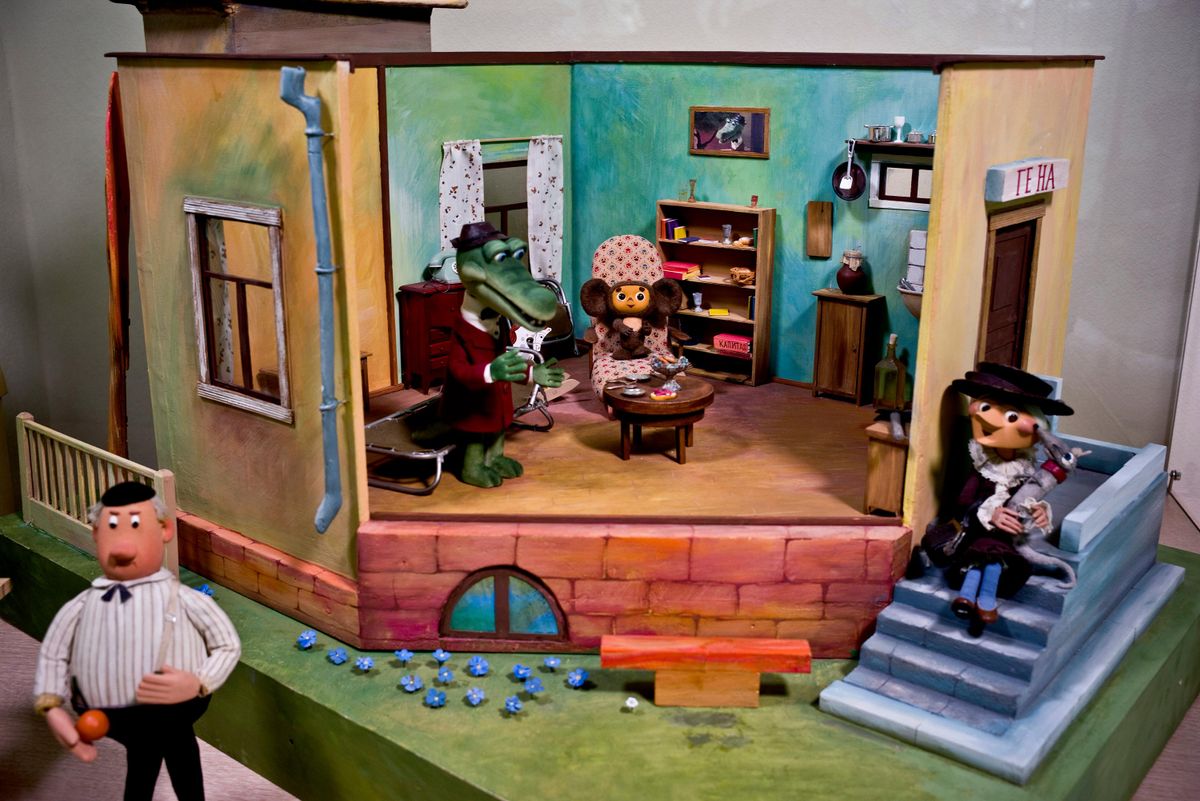
The iconic House of Friendship started with Gena the Crocodile’s room. An exhibit from the Soyuzmultfilm Film Studio Museum.
Having succeeded in dealing with the scarcity of construction materials and overcoming red tape, as well as the dirty tricks played by the universal evil in the face of Old Lady Shapoklyak and Lariska, her pet rat, the team completed the project on time.
The crocodile cut the ribbon with his teeth when it dawned on everyone that they already knew where their sympathies lay. Maria Frantsevna may be a monkey but even she became friends with Anyuta, the giraffe, and climbed on her neck. Dima may have been a slacker, but things turned out for the better for him too, since he could benefit from his friendship with Marusya who let him copy her homework. A good start for a love affair.
Therefore, this was a Friends’ Club rather than a Friendship House. Feel the difference? It does exist though.
Formed spontaneously, this group of like-minded characters wanted Cheburashka to take up residence in the building. He did not have a home, after all. But Cheburashka firmly refused. A no is a no.
“Never,” said Cheburashka – or should we call him Che for his unwavering position? “It will be a club and nothing more, while you can send me to the kindergarten as a toy.” Not a bad choice indeed: a kindergarten means a job with teaching experience, as well as bed and board.
This is to say that Cheburashka made a reasonable choice as a true leader. He may not be the best on strategic matters, but as far as tactics were concerned he did a descent job. Taking over the new building would have led to suspicion that he had a vested interest in the whole affair bordering on financial improprieties. But he made a good choice and deserves to be honored and respected for his posture.
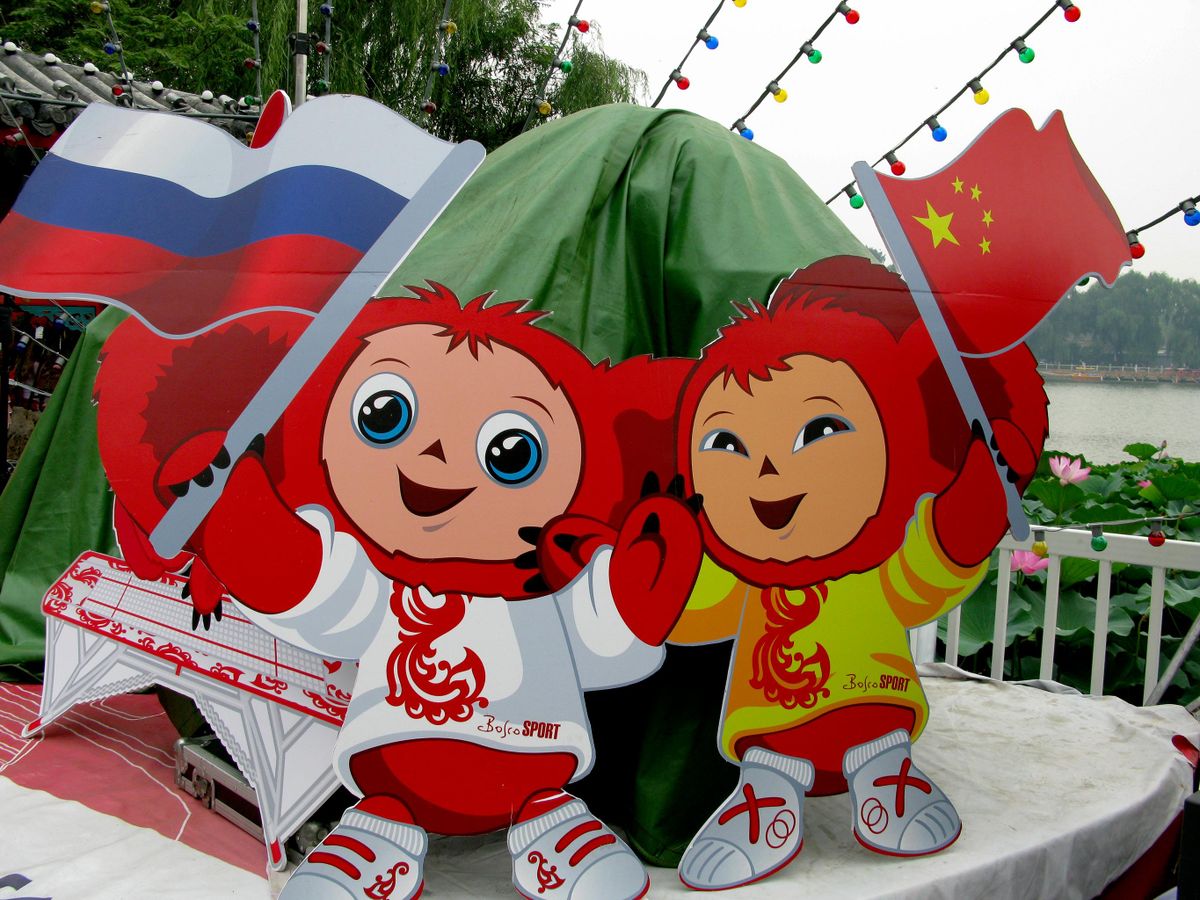
It is this calculated move that made Cheburashka a legend with his never-ending presence on cinema screens and on souvenirs. He went as far as become a mascot for the national Olympic team, which was no small feat considering that this meant competing against the 1980 Mishka the bear mascot. No small feat indeed.
By the way, this year marks the 60thanniversary of the first Cheburashka book. It told the story of an undefined creature with a good heart. Several generations grew up in our country following his adventures and marveling at his credulous and somewhat distraught smile.
The legendary Cheburashka – one of Russia’s most recognizable symbols. A booth at the St. Petersburg International Economic Forum.
This is to say that you now have all the elements there is to know about the most famous Friendship House in the post-Soviet space. In fact, you even remember the way Klara Rumyanova said, “We built and built, and finally we built it!” in her inimitable voice from the 1969 cartoon. Everything was fine and dandy, so time to move on.
But wait, Cheburashka’s adventures must stay in our memory as a positive and instructive story. But it can hardly serve as a blueprint for action in today’s challenging, rapidly changing and high-tech environment. Who would launch a major construction project to build, say, a Friendship House, without understanding what kind of purpose it will serve, the risks and possible benefits. This would be too naïve even for Cheburashka.
Today, we face an imperative to have a clear understanding who should be our friends, for what purpose and why. Knowing with whom to work to counter someone is even better. But this spills into the territory of sophisticated diplomacy and military doctrines. Of course, even Tobi would know that if you want to build a Friendship House it must be designed to last for centuries so that every detail is taken into account and included in the project and the whole world is blinded by its beauty.
Guards on the high banks of the Amur
Russia has recently, barely a year ago, opened a unique Friendship House. I am referring to the House of Russian-Chinese Friendship. It is located in the most logical place for it – Blagoveshchensk. There is no city in our country, let alone a regional center, located closer and more conveniently to China than the capital of the Amur Region.
The distance to the closest Chinese city, Heihe, is barely 700 meters, as you can read on various signs located around Blagoveshchensk, including gift magnets. On the other hand, even without reminders, you’d have to go out of your way not to notice China’s proximity. The ultramodern city of Heihe, shining with lights at night on the other bank of the Amur, which has grown out of a shanty town over the past 40–45 years, is a phenomenon in itself.
Russia and China have been through various situations, and far from all of them were positive. It sometimes came to open confrontation, and even hostilities. In such periods, the border location of Blagoveshchensk brought nothing to its residents except increased anxiety and the need to remain perpetually on high alert. The border pillar on the waterfront is more than just a symbol. It is a reminder that this the place where the invisible dashed line runs separating Russia from China. A state border is no child’s play.
Standing on that waterfront is also an active border watchtower, in sharp contrast to the colorful crowd casually strolling by and the retirees busting a move to classic Soviet tunes and Russian folk melodies.
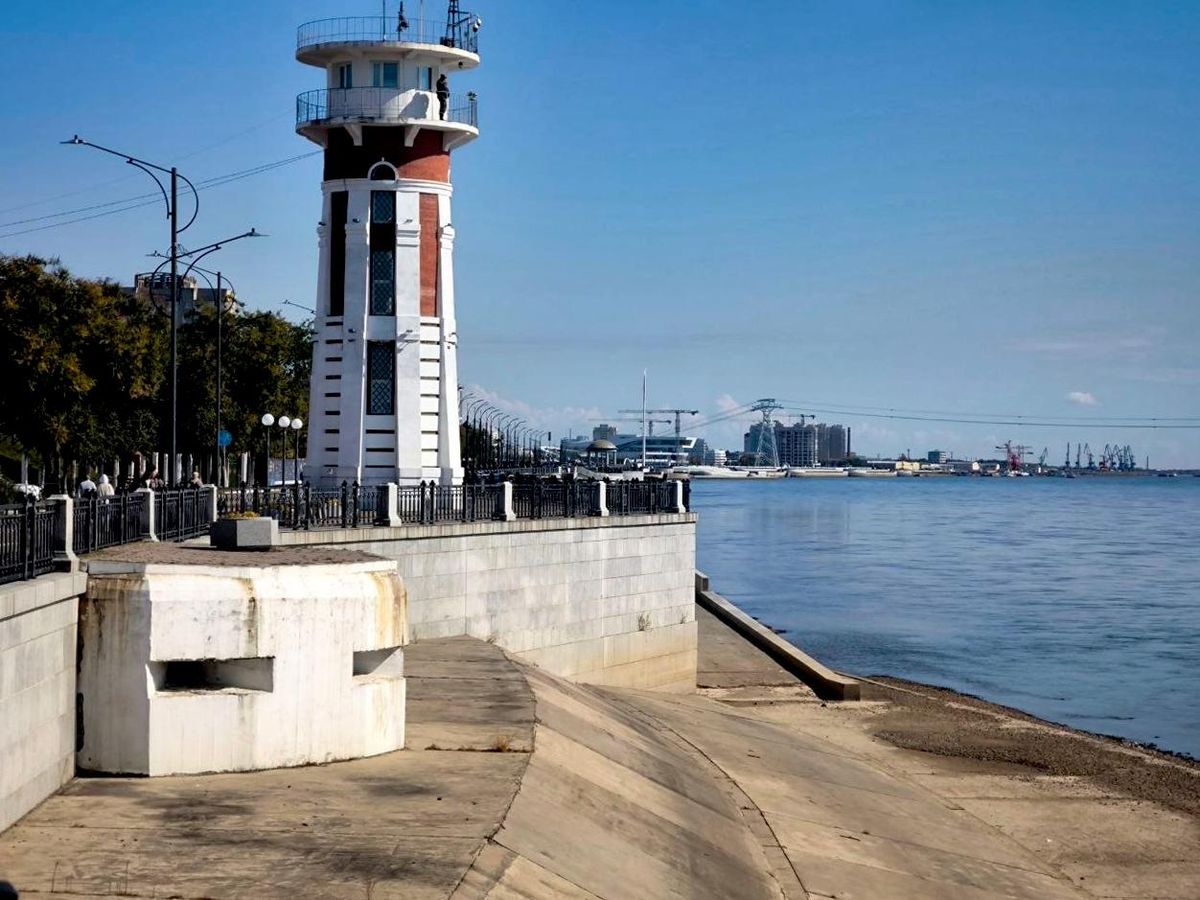
An active border watchtower on the Blagoveshchensk waterfront.
“While ordinary life goes on below, the staff of the FSB Border Directorate for the Amur Region are on duty around the clock up above, protecting the state border. It is 86 steps up a spiral staircase to the observation post. Serving in this post is an honor and a great responsibility, for the whole of Russia is behind you,” reads a statement on the website of the Blagoveshchensk,” reads a statement on the website of the Blagoveshchensk Culture Center written in the blunt language of a poster.
There are really border guards on that beautiful latticework, yet functional tower. It’s difficult to say what they are watching, because there must be much more advanced means of monitoring the border zone. On the other hand, even in this age of AI you can completely rely only on a real person, especially if they received border guard training.
Moreover, a real border guard standing in a watchtower that is far from a museum piece is another reminder of a complicated past – as well as a warning against future incursions. It is much more interesting and pleasant to be friends, understanding and respecting each other, and building up mutual benefits.
Knock on wood, Russia-China relationship, while not exactly all sunshine and rainbows, can at least be described as healthy and constructive cooperation and geostrategic partnership across various spheres. Therefore, if a reminder that our border is under lock and key stands on the waterfront of Blagoveshchensk, which serves as the showcase for all of Russia, at least in China’s eyes, there should also be a clear indication that borders are no barrier to true friends.
In other words, the House of Russian-Chinese Friendship serves as such an indication, or even more so. The luminous sign of the Komsomolsk fur supermarket on the Chinese side is reciprocated by the RCF House, an abbreviation familiar to everyone in these latitudes. Isn’t it an open invitation to the Chinese comrades to be friends, with a great little spot saved up just for that?
1/2
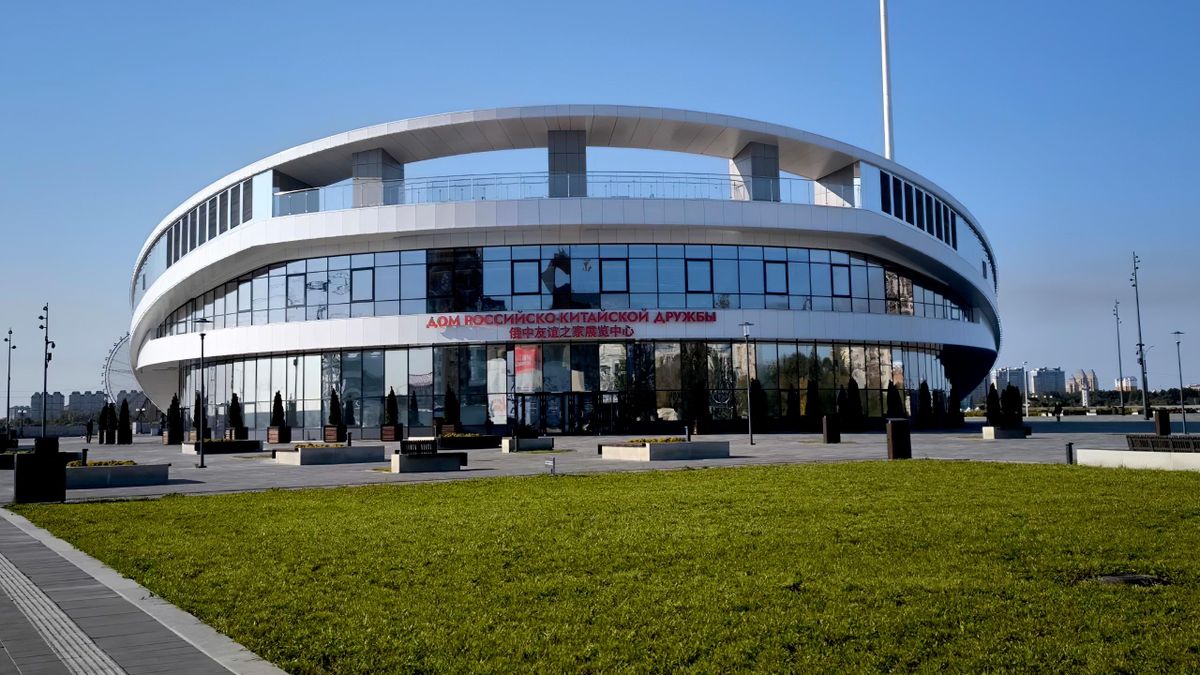
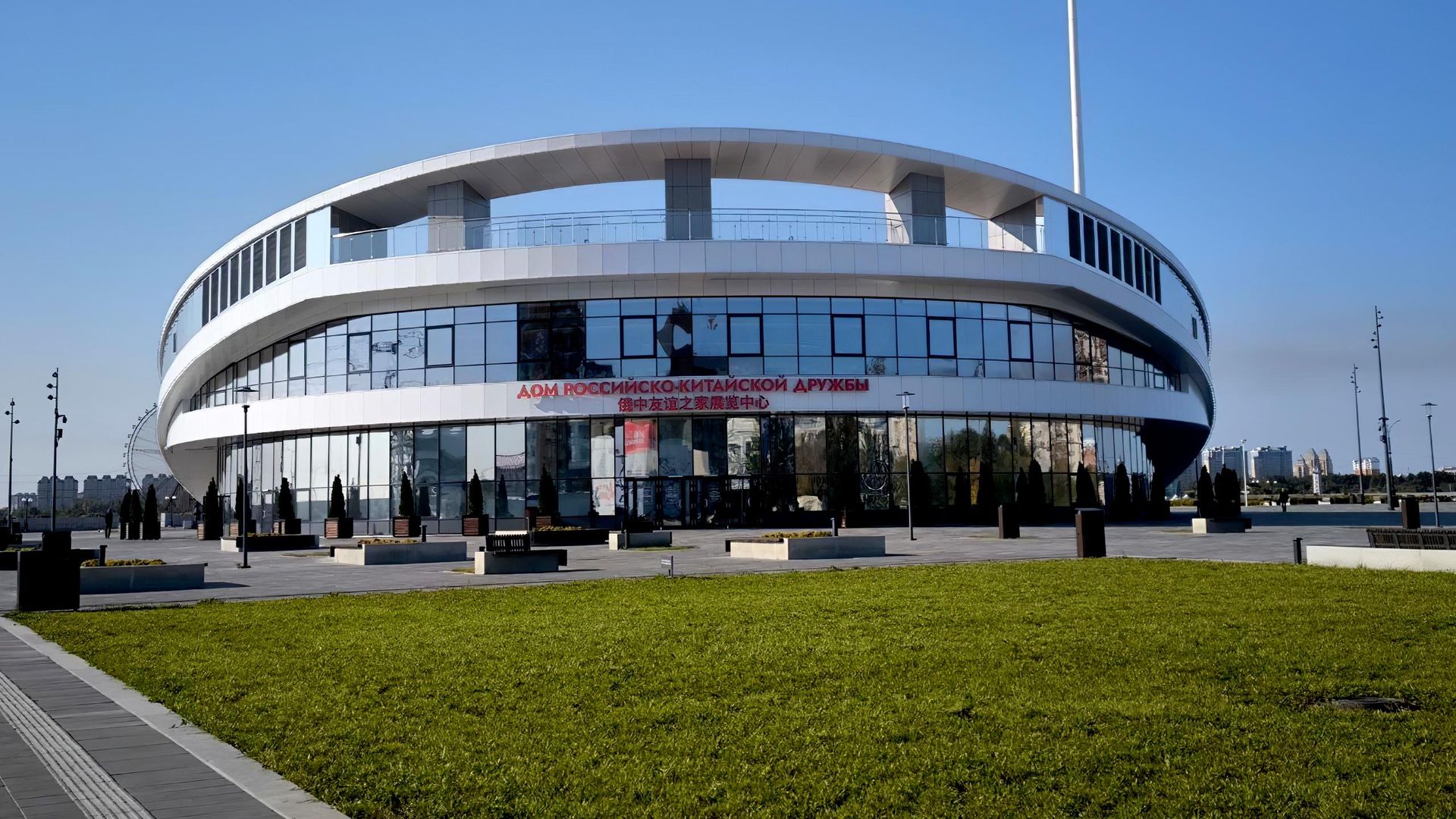
RCF House (the House of Russian-Chinese Friendship) is a widely recognizable acronym in Blagoveshchensk
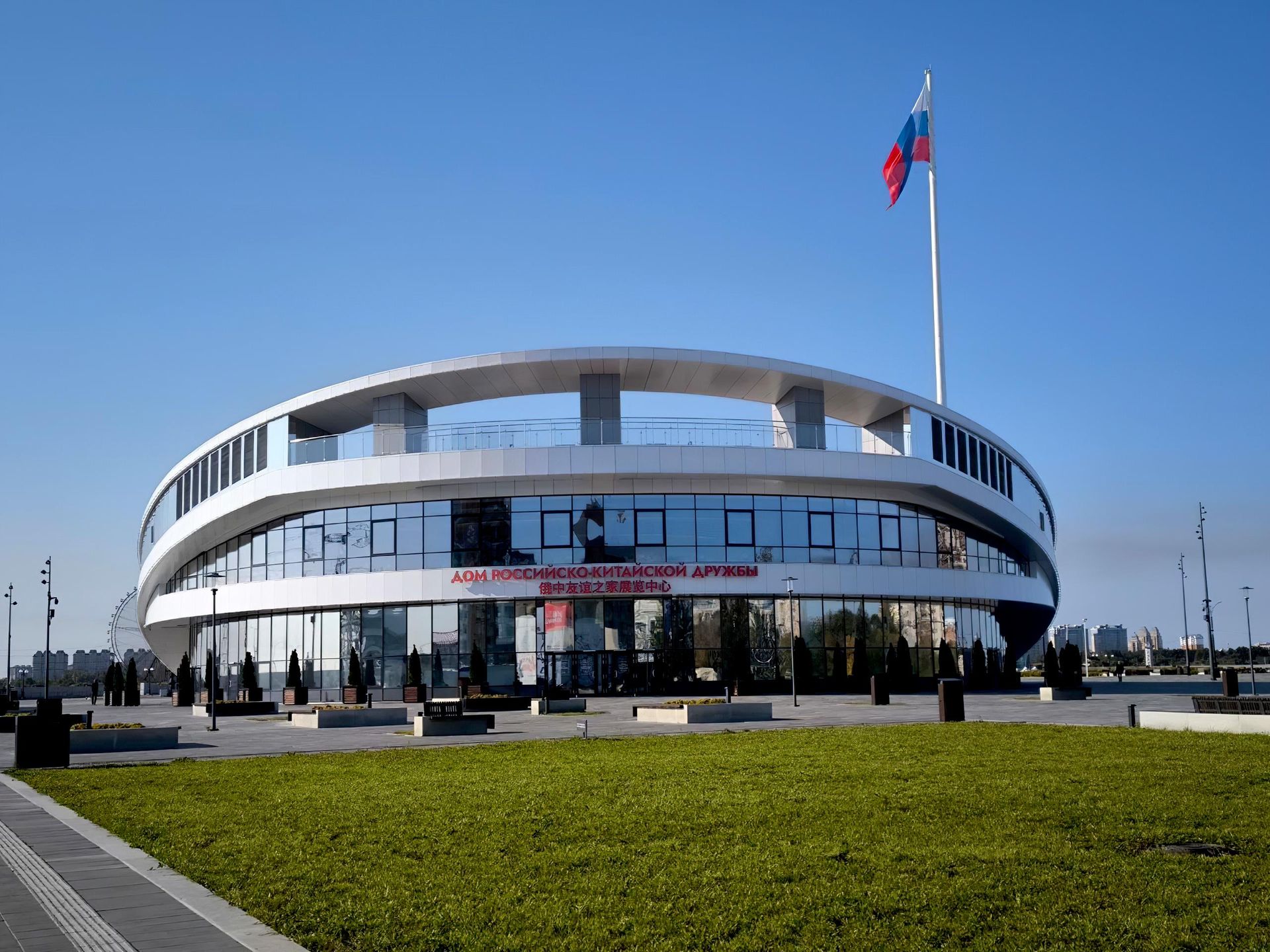
The House of Russian-Chinese Friendship is much more than a place where you can talk friendship and cooperation. You may ask: what other purposes does this enormous 900-square-meter spacecraft-looking structure serve?
Certainly, more than how Gena the Crocodile, Galya and Cheburashka entertained themselves according to children’s author Eduard Uspensky: “After work, they would get together at the crocodile’s to chat, drink coffee and play Tic-Tac-Toe.”
So what exactly is the House of Russian-Chinese Friendship in Blagoveshchensk?
Is it a museum, an exhibition hall, a multimedia platform, an art venue, or a leisure club? All of the above and more – and neither. When there is no equivalent and nothing to compare it with, try to show the core idea visually.
The best way is to ask an expert. So, I spoke to Nadezhda Parkhunova, Director of the House of Russian-Chinese Friendship. She certainly knows her facility better than anyone.
“Yes, it is a leisure center in a sense. It is also a place where we can discuss our regional points of growth, get together and talk,” Ms. Parkhunova explains patiently. “At the same time, there are aspects of the Russia-China relations that never get addressed by either government bodies or educational institutions or cultural organizations. But we can address them, in any format we see fit. We’ve been given a free hand, which is a great privilege. The only disadvantage is that we are too young.”
“Is it really a disadvantage? It seems like a wonderful benefit,” I say, surprised.
“Certainly. It is a disadvantage because we opened just recently, merely a year ago.”
“The house opened in October 2025, didn’t it?”
“Right. The first six months were spent on making finishing touches and adjustments. We started getting visitors, prompted to learn more about their interests. We could see what sections received a response and where people were less engaged even if we believed that a certain section was necessary. I don’t enjoy the first year of any project but I love the second.”
“Congratulations, then. The second year – your prime era – is beginning. What makes the second year better?”
“At this point, we already know how everything works, including visitor traffic fluctuations. Broadly speaking, we know more or less how to get through winter.”
“I’ve never heard before that winter is such a specific stage in project development. But I have worked in milder climates for most of my life.”
“In winter, we get temperatures as low as -40°C degrees. Have you noticed the square outside the House of Friendship?”
“I loved it, it’s beautiful. There is a monument commemorating explorers, and gorgeous musical fountains.”
“In winter, our visitors have to cross these 30 meters in the wind at -40°C degrees. It means they must be greeted with hot tea or coffee. So, we came up with a lounge area with cushions on windowsills.”
1/2
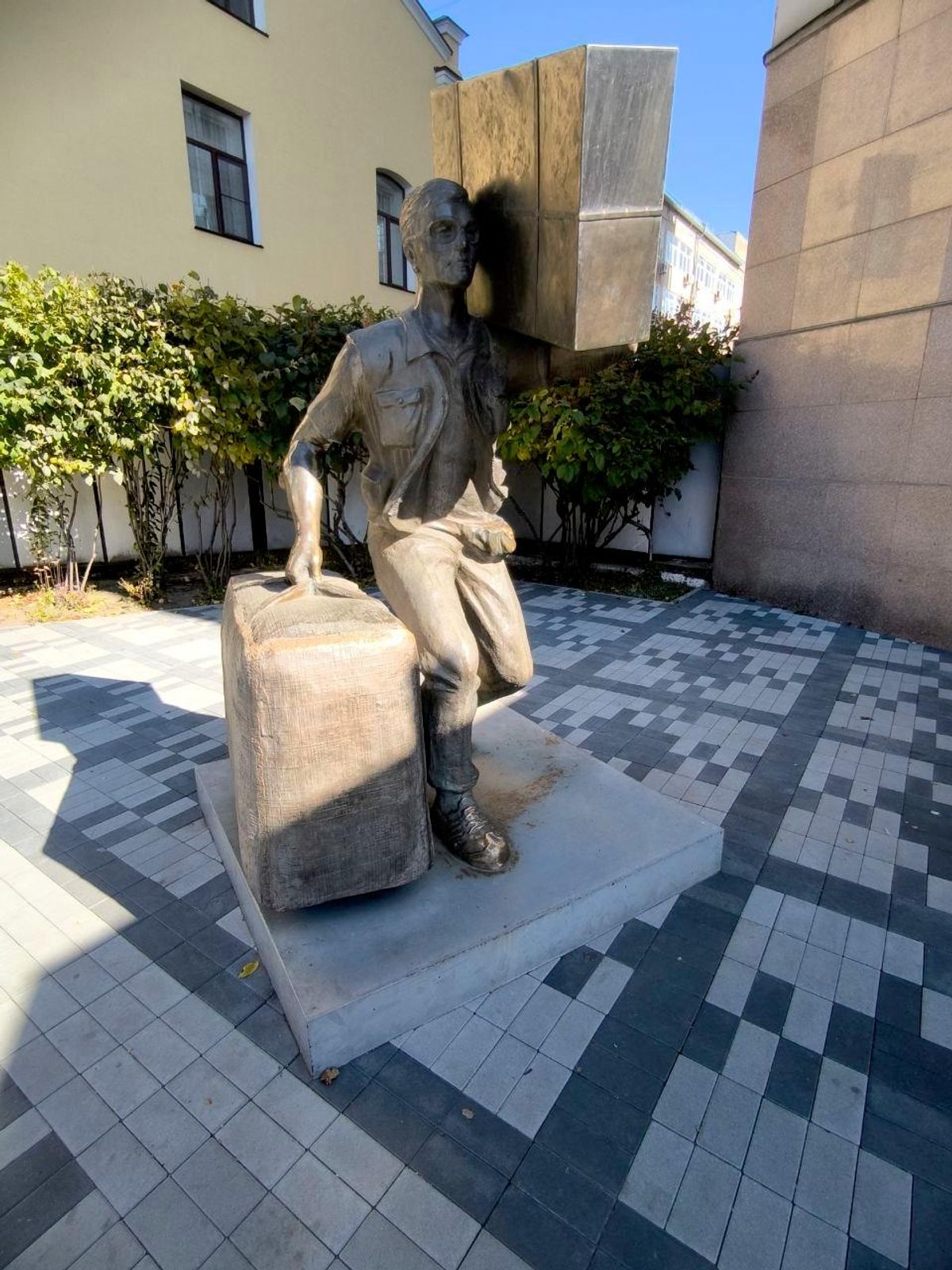
The memorial stone honoring the pioneers of Blagoveshchensk
In winter, it is not always easy to cross the square in front of the House of Russian-Chinese Friendship, which features the memorial stone honoring the pioneers of Blagoveshchensk
“It looks cozy, by the way. Although I didn’t register this lounge area as a buffer between harsh cold and the warmth – in all respects – of the House of Friendship.”
“But of course. It is a place for children to get warm. Now that we have clarified all – or many – aspects, we are starting the second round of work on this remarkable project. For instance, recently we met with a company that wants to organize a Chinese-Russian ethnic fashion show here and present a book by fashion legend Tatyana Smirnova. She is 95 years old and she remains a wonderful advocate for Russian traditions. Isn’t it worth seeing?”
“Absolutely.”
“Businesses approach us with their event ideas, of course. Knowing what hits the spot, we will be updating and improving our main halls soon. It is a space that is alive with action.”
A tale of the pipa and the balalaika
At the heart of this vibrant space – and that’s no exaggeration – are eight themed rooms housing a permanent exhibition. With remarkable ingenuity and an interactive approach, the exhibition does not set the various facets of Russian and Chinese life against one another; instead, it invites a thoughtful comparison between them.
The cultural phenomena on display are so diverse that it’s almost too much to take in. Yet, without them, grasping the profound essence of our two civilizations would be daunting – if not impossible.
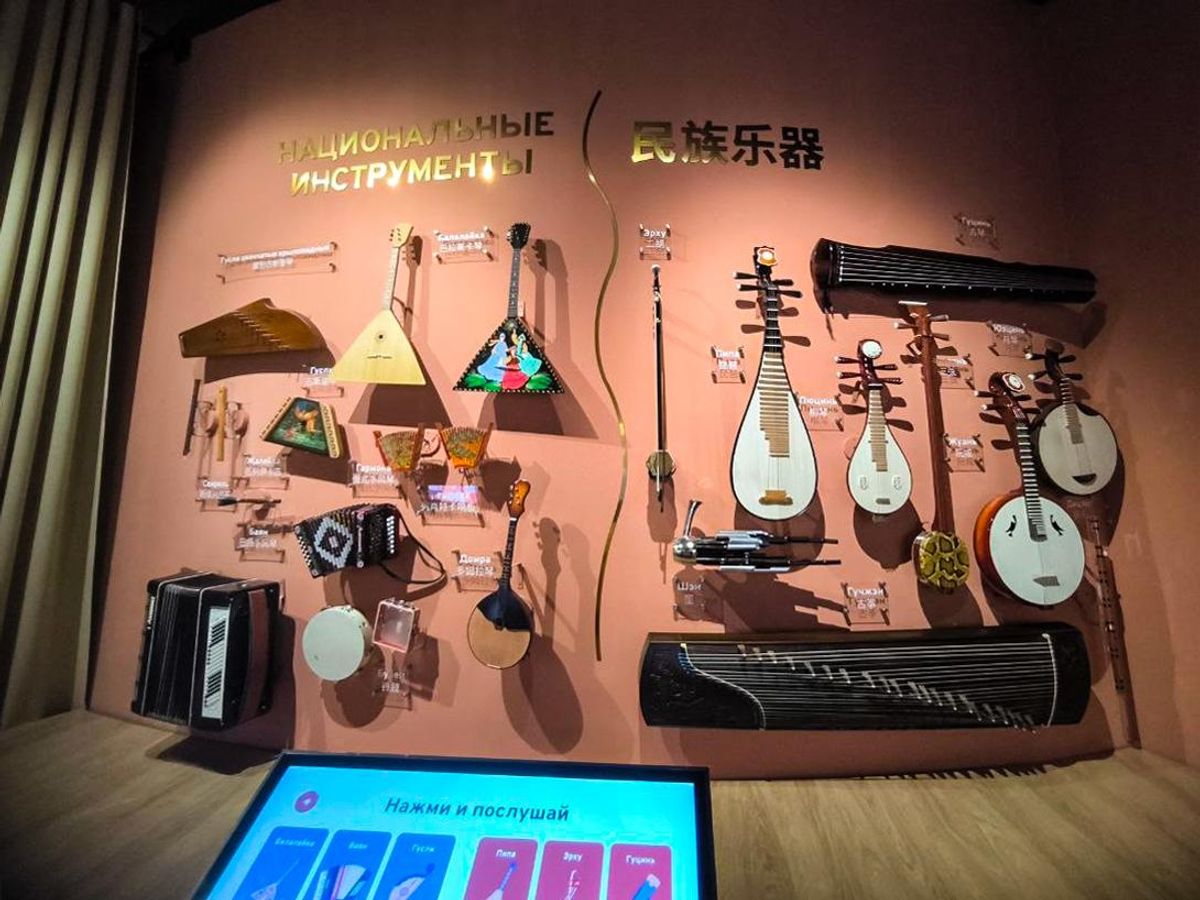
After all, one wouldn’t exactly compare the contributions to world culture, or even just the sounds, of the Russian balalaika and the Chinese pipa at a formal governmental level, would one? (For those unfamiliar, the pipa is a lute-like instrument.) Both have wooden bodies, tuning pegs, and strings – three on the balalaika, four on the pipa. But what vastly different paths they’ve taken – and how distinct their sounds are!
In a sense, the balalaika speaks in Russian, while the pipa speaks in Chinese. Visitors can hear these sounds, enjoy them, and let their imaginations roam—all without leaving the exhibit hall at the House of Russian-Chinese Friendship.
Musical instruments of Russian commoners and the Chinese elite
In fact, you can hear these instruments in a very lifelike way, thanks to modern computer technology. You can even generate a rendition of a well-known Russian folk melody – on a Chinese guzheng, for instance. People have come up with all sorts of creative arrangements for Kalinka-Malinka.
Pavel Karaush, the virtuoso guide who accompanied me through the exhibition, pointed out a particular detail that had never occurred to me before. Our instruments came out of the common people – from the folk itself, stretching back centuries. Chinese instruments, by contrast, trace their lineage back to the imperial chambers. An intriguing distinction, isn’t it?
It’s true, when you think about it: it’s hard to imagine Tsar Ivan the Terrible blowing into a zhaleika(a traditional Russian folk reed pipe). Yet it’s quite easy to picture the musically gifted Emperor Huizong of the Song Dynasty plucking the delicate strings of a guqin – a seven-stringed instrument that bears a faint resemblance to our own gusli. The rulers lived in different eras, but that’s not the point; what matters is the unique, distinct path each culture has taken.
Many Russian monarchs – though not all – were also musicians. Peter the Great, it is said, was a decent drummer and also had an affinity for the oboe and the bagpipes. Peter III, perhaps less successful as a ruler, compensated for his lackluster governing skills with a talent for the violin. Alexander I played the violin and the clarinet too – a fitting choice for his character. Nicholas I favored the flute and the French horn; Nicholas II played the piano; Alexander III, the trumpet…
Yet these are instruments with a more universal, predominantly European character. Russian rulers may have taken to these instruments, but that didn’t stop ordinary people from playing their bayans(button accordions) with abandon at celebrations or pounding their tambourines with wild energy. China followed its own path – neither better nor worse, simply different.
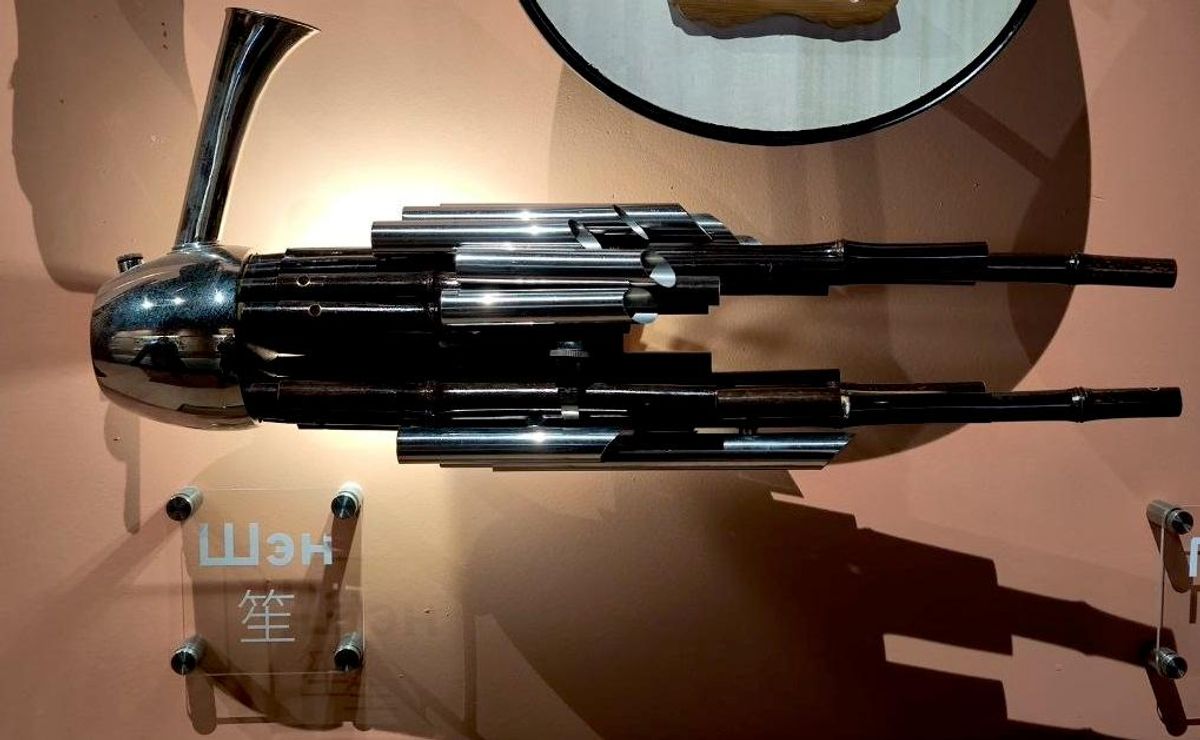
Incidentally, among the instruments from our neighbors on display at the House of Russian-Chinese Friendship, the one that left the deepest impression on me was the sheng. It is an ancient mouth organ – some three or even four thousand years old. The European harmonium and accordion both descended from it – though this happened quite recently, in the 18th century.
On its stand, a sheng gleamed with nickel-plated pipes, looking like a model of an alien spacecraft – a far cry from its ancient ancestor, made from gourd and bamboo.
The modern sheng looks like a model of an alien starship, while its predecessor was made of gourds and bamboo.
The House of Russian-Chinese Friendship differs from most museums across the globe in one fundamental respect: strictly speaking, it isn’t a museum at all. And most importantly, nobody here follows visitors around or slaps their curious hands away when they reach out to touch an exhibit. Quite the contrary: the staff not only allow visitors to touch, operate, move, listen to, and even smell the exhibits, but actively encourage them to do so.
That’s the whole idea: to immerse visitors completely in the experience. As it turns out, this is also a much more effective way of taking in information.
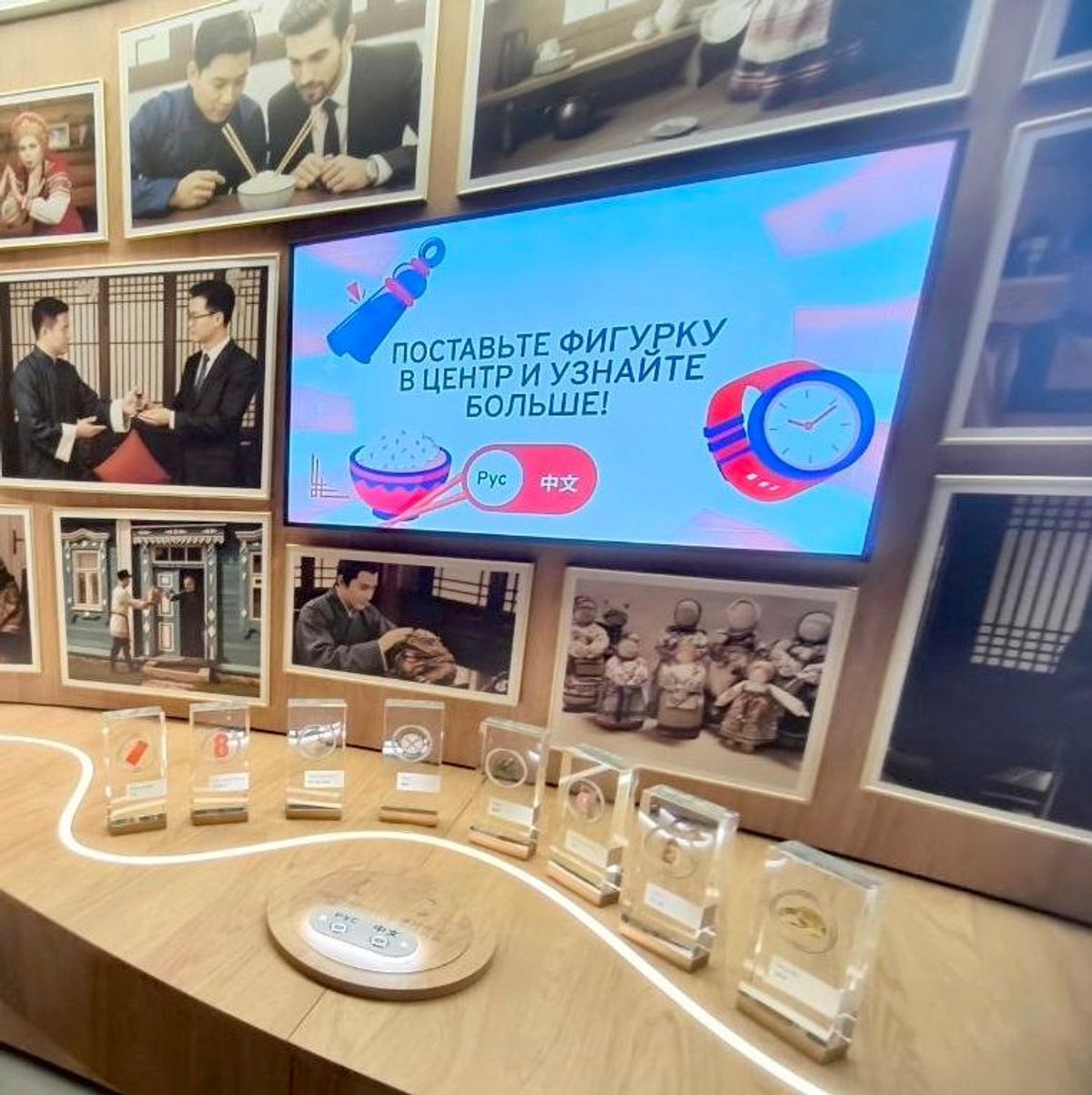
Many of the exhibits are interactive, allowing visitors to pick up an item that appeals to them or, say, a block bearing a schematic image of some symbol and to place it in a designated spot, triggering a presentation on the subject in question. These presentations are both comprehensive and concise, complete with illustrations and animations, and are available in either of the House’s two working languages, Russian and Chinese.
The tables laid out for a Chinese tea ceremony and a traditional, informal Russian tea gathering are among the most popular exhibits. And little wonder: tea has always played an important, sometimes even strategic, role in the relations between our two cultures. At these tables, visitors can easily learn what the various cups, bowls, teapots, and jade frogs are used for in the Chinese tradition, or find out what best goes with a cup of tea served the Russian way.
Pavel Karaush, who seems to know the subject inside out, points out that the main difference between the two traditions is this: our Chinese neighbors enjoy a wide variety of teas and ways of serving them, but have no accompanying snacks. We, on the other hand, think nothing of adding sugar to a freshly brewed pot of tea, slipping in a slice of lemon or, depending on our mood, adding milk, honey or jam. And a traditional Russian tea gathering simply wouldn’t be complete without bubliki (ring-shaped rolls), pretzels, or cookies.
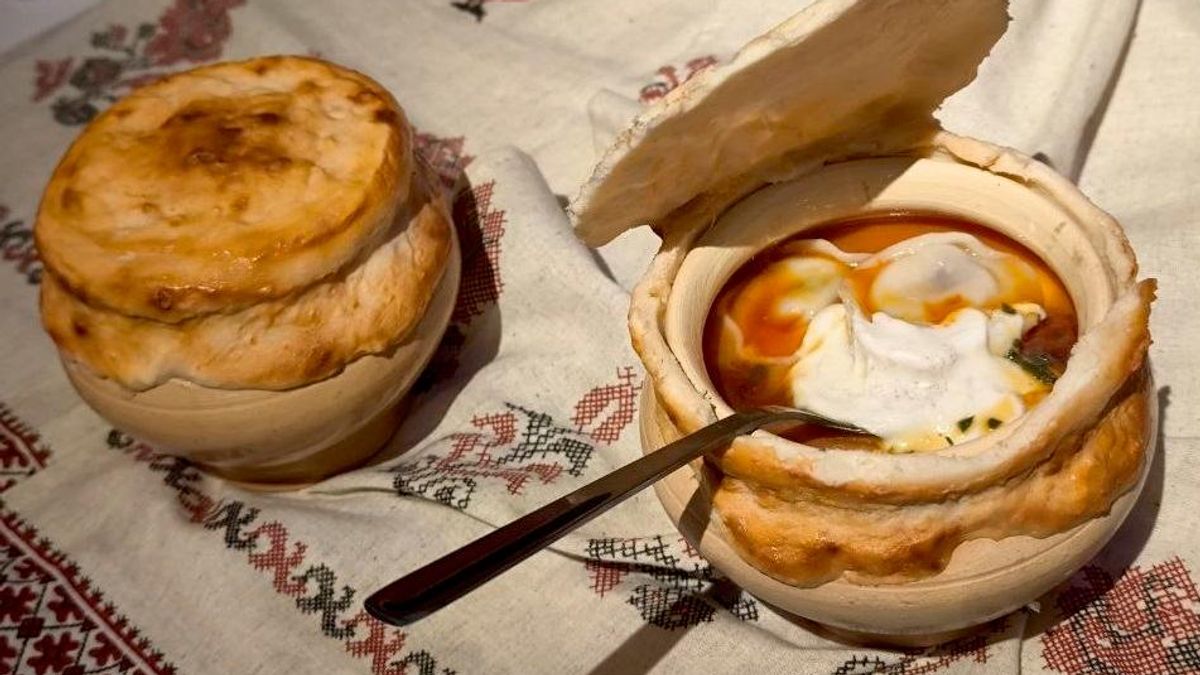
Unable to resist, I chipped in with a joke. Imagine a cast-iron pot of steaming-hot borscht on the table, alongside a loaf of rye bread cut into thick slices and pickled cucumbers dressed up with Yalta onions and drizzled with fragrant Kuban sunflower oil. There’s salo (cured pork fat), its delicate pink streaks all the more tempting, and garlic to add a sharp, biting kick. A skillet of fried potatoes is on its way, along with pirozhki (small pies), kulebyaka(a large, elaborate pie) and whatever else the good Lord has seen fit to put on the table. From the ice cellar comes a large jug of khlebnoye vino (traditional grain spirit), beaded with condensation... And when someone quite reasonably asks, “So, what exactly are you doing here?”, the blissful answer is: “Why, we’re having tea!”
Nobody is in the least bit bothered by the absence of a samovar or even a tea brewing pot.
1/4
Pinecone jam – the Far East’s piquant contribution to the modest Russian tea tradition. An exhibit at the House of Russian-Chinese Friendship (Blagoveshchensk)
A sugarloaf – a wonderful accompaniment to the traditional Russian style of drinking tea while holding a sugar cube in the mouth. An exhibit at the House of Russian-Chinese Friendship (Blagoveshchensk)
A tea bowl for the Chinese tea ceremony; for a Russian, it is clearly a bit too small. An exhibit at the House of Russian-Chinese Friendship (Blagoveshchensk)
In Russian tradition, “having tea” can mean any convivial feast or a good, heartfelt chat among friends, regardless of food or drinks on the table. Besides, everyone knows perfectly well that the tea itself will become the centerpiece sooner or later; it’s bound to find its way to the center of the gathering, just after the customary invitation: “Well, shall we have a cup of tea before we go?”
Obviously, the whole thing might seem a little baffling to our Chinese friends. But that’s perfectly okay – we’ll explain it all, tell them the story, and show them how it’s done.
A matter of taste and superstition
Where else but at the House of Russian-Chinese Friendship could you get such an expert introduction to the world of superstitions? It’s truly remarkable how stubbornly these old wives’ tales persist, having survived from time immemorial into the age of nuclear power, online marketplaces and ubiquitous digital technology. There’s simply no getting rid of them!
What’s more, these superstitions can unsettle or even distress the more impressionable among us. So it’s probably best to know a thing or two about them, if only to avoid causing someone emotional trauma.
Do you know what is considered a sign of impending wealth in Chinese culture? Well, obviously, going to work is still the surest way to make money. But according to our Chinese neighbors, the number eight is also a reliable omen of financial prosperity. Who would have thought?
In Russia, they say you should never whistle indoors, or you’ll end up penniless. Yet common sense suggests that if every Russian family that refrained from whistling were suddenly showered with untold riches, the Forbes rich list would be packed with Russian names. Instead, it’s dominated by Americans – a nation of enthusiastic whistlers. And yet this does absolutely nothing to undermine the remarkable staying power of the superstition.
If you happen to be in China – or even at home, but in the company of Chinese friends – and you’re eating rice with chopsticks (no mean feat, it must be said), never, ever stick them upright into your food. This is associated with death, funerals and mourning. It’s a ritual gesture, and making it at the wrong time is said to bring you more enemies rather than good friends.
Is there a Russian equivalent to this superstition? Perhaps there is. Imagine that a lively, boisterous Russian tea party – of the kind described in the previous section – is in full swing, when someone solemnly and inexplicably covers their shot glass of vodka with a piece of bread. They would certainly be in for a thrashing. At the very least, nobody would think much of such behavior, and they certainly wouldn’t be invited back for tea, let alone to share a meal of rice.
One of the most popular exhibits at the House of Russian-Chinese Friendship is dedicated to superstitions.
But let’s finish off our discussion of food by taking a look at one particular pavilion at the House of Russian-Chinese Friendship. Contrary to the general spirit of the place, it’s best to keep your hands to yourself there – and certainly not to put the exhibits in your mouth!
After all, you wouldn’t want to showcase the different approaches to cooking favored by Russian and Chinese chefs – and, even more so, home cooks – using real ingredients and actual dishes, would you? Replacing stale or dried-out exhibits with fresh ones every day, or even several times a day, would be terribly wasteful. So replicas were made instead, and such lifelike ones that some visitors have actually tried to take a bite. It’s hard to resist the temptation and believe that the shashlik skewers, blini, apples and even the traditional rooster-shaped sugar lollipops aren’t real when your mouth is already watering.
This same section also features one of the most striking displays among the more than 500 exhibits at the House of Russian-Chinese Friendship: a pair of refrigerators, one Russian and one Chinese. Each is stocked with foods typical of its respective culture.
You can linger there watching, marveling at what you see, rejoicing (on your own behalf), or perhaps feeling a little concerned (for the Chinese).
1/3
On the left is a Chinese refrigerator, and on the right, a Russian one.
Nearby, symbolic multimedia cooking pots hiss and bubble, preparing traditional Russian borscht – a firm favourite with the Chinese – alongside Chinese noodles, an equally ancient and time-honored staple that Russians are also very fond of.
Pushkin and Li Bai – both great but so different
Comparing food in its tangible form is quite easy, and we are all great at doing it, that much is sure. But intellectual nourishment is equally important, and could be even more important than savory sauces and shanga rolls. This is where we start a section on outstanding people from Russia and China, including rulers, thinkers and educators.
Organizers managed to single out just a few of so many prominent and outstanding persons representing the rich histories of our two countries. Go figure how they did it, but the selection process was tough, no doubt about that. Every person on one national team was matched with someone from the other camp, which created quite an interesting mix.
Of course, there is always room for questioning specific choices, but you can complain as much as you want as long as you stay involved.
For example, what does Confucius, a Chinese philosopher, have in common with Sergius of Radonezh, Russia’s spiritual leader of the 14th century. Nothing, in fact, apart from both acting as towering figures in their respective countries, and as uncontested moral and spiritual leaders to be viewed as role models but with an understanding that no one will ever succeed in achieving this ideal.
The stands presenting these outstanding figures were installed in a way that made it possible for visitors to read something about them and to hear their extraordinary stories.
The same happened to poets. Alexander Pushkin represents Russia in the House of Friendship, just like anywhere else on this planet. And he deserves it, considering that he is everything for us. As for China, it is represented by Li Bai, who was also a prominent poet, even if we can read his poems only as translations in the hope that they offer a glimpse of the poet’s talent and intellectual depth.
Comparing poets could be an even more ungrateful task than weighing philosophical concepts. Every poet has his or her own unique style, after all, even if poets may have similar thoughts on the tip of their quills no matter when and where they are. Of course, love is the single most important topic for them.
Here’s a textbook example from Pushkin’s verses so that even a person who knows little about poetry recognizes it:
I still recall the wondrous moment:
When you appeared before my sight,
As though a brief and fleeting vision,
As pure and radiant beauty's sprite.
And here’s a verse by Li Bai:
In clouds, I think of her raiment, in flowers, see her face,
Blooming, beaming by the railing, in Zephyr’s dewy embrace.
‘Tis only on Hills of Emerald, might such a beauty be seen, else
By moonlight at Jasper Terrace, be blest to encounter her grace.
Which of these two verses is more beautiful and penetrating? A tough question to answer. This is a matter of taste, of personal emotion and what you feel deep down in your soul. Otherwise, there are always various nuances, especially when trying to compare poets representing two very distinct civilizations.
Take Pushkin. He devoted his poem to Anna Kern, née Poltoratskaya and known as Markova-Vinogradskaya after her second marriage. She managed to catch the poet’s attention.
As for Li Bai’s lines from the To the Tune of Qing and Ping (for Lady Yang), they celebrated Yang Guifei, the Imperial consort who was famous for her beauty. The ruler liked the poem, and his consort blushed, while the poet got in trouble for bringing this relationship into the spotlight. But let’s leave all these details to specialists. What matters for us is that we see true passion in these hieroglyphs or at least a sense of falling in love and other fundamental instincts reaching us through centuries.
We all come from childhood – Nadezhda Parkhunova, director of the House of Russian-Chinese Friendship, and I easily found common ground on this popular, broadly accepted premise, one might say, the moment we were introduced.
Approaching the impressive building where the modern principles of our relations with our neighbors across the Amur are now being shaped, I somehow assumed that the office of the person running such a major project would have to be grandiose. Nothing of the sort!
Nadezhda Parkhunova works in a very minimalist space, sharing it with a couple of other employees at nearby desks. To avoid interrupting their creative work, we stepped out to talk in a hall… Or is it not a hall? What should we call it?
The thing is that the House of Friendship in Blagoveshchensk, in addition to its main pavilions, is full of distinctive, I would even say unconventional spaces that are only now taking on meaning and being adapted to specific purposes. For example, for hosting temporary exhibitions, workshops, or conferences – or who knows what else the creatives will dream up.
Moreover, all the spaces are low-key, free of excessive structure and the kind of officialdom that weighs on the psyche. In such places, you can talk about the most important things completely at ease.
So, the space where we settled in for our conversation was furnished with a sturdy table, chairs, and the necessary equipment. For press conferences, it would probably be ideal. Or for seminars and training sessions. But what stirred that childhood feeling was none of that, rather one of the large reproductions on the wall – Viktor Vasnetsov’s painting Ivan Tsarevich on the Gray Wolf.
The same reproduction once hung in my grandmother’s modest home above her black-and-white Ogonyok-2 TV set. I shared this surge of memories with Nadezhda Parkhunova, and it turned out that she, too, had a similarly important canvas:
“The paintings that hung in our grandparents’ homes stay with us forever. My grandmother also had a reproduction, though it was of a work by Ivan Kramskoi depicting a garden. When I saw the original at the Tretyakov Gallery, I could not tear myself away from it for a long time; it felt like such a connection with my grandmother.”
Later, wandering through the halls of the House of Friendship, filled with all manner of Russian-Chinese information, images, symbols, displays, and screens, I concluded that the maxim “We all come from childhood” applies here in full measure. Perhaps it is even one of the project’s central principles. Awakening childhood spontaneity and curiosity in audiences of any age is not easy, but it is possible. And the best start button for your inner child, lurking deep inside an adult or even inside a somewhat older, life-battered person, is play.
When you mirror the exercises of an animated character who presides over the wellness hall, while watching your surreal digital silhouette move clumsily across a huge monitor, you somehow see with fresh eyes the similarities and differences between our morning exercise routine and the Chinese practice of qigong. The essence of our sambo and their kung fu and wushu also comes into focus more quickly.
You should have seen the zeal with which respectable visitors arrange virtual furniture in an imaginary room, guided by the eternal rules of feng shui. They argue, get excited, and move rugs and sofas around with childish eagerness and uncompromising determination. From time to time, they forget that they are not merely hauling furniture, but harmonizing the flows of qi energy, if you know what I mean…
Incidentally, when it comes to arranging a Russian izba properly, not everything is as simple as it might seem. Our compatriots sometimes know the Daoist practice of feng shui better than the simple formula for determining the “red corner.” And that matters, because that is where the icons are placed. Then again, “simple” is not a clear-cut word either, especially today. I hope everyone knows that originally the “red corner” was directly tied to the location of the Russian stove. That is where you have to start from. Another question is how this looks today.
As an aside, let me say: I was once wandering in Blagoveshchensk through a recently built full-scale (that is, 1:1) replica of the famous Albazinsky Cossack ostrog (stockaded town), talking with local historian Yaroslav Bylin. He recounted that a young married couple suddenly, as these things happen, turned to him for advice. They asked him for guidance on how to determine the “red corner” in a modern apartment. Their uncertainty centered on the microwave – should it be considered a stove? And what about the multicooker? Yaroslav said that this was outside his area of expertise and referred the young couple to an Orthodox priest.
And he did the right thing! For a blessing, you should always go to a priest. As for training sessions, they can be held at the House of Russian-Chinese Friendship; they have special tablets for that.
Having played enough with the digital features, having had their fill of augmented reality, where schematic models are overlaid with virtual layers and come to life (the model of the cross-border cable car now under construction across the Amur looks especially spectacular in this mode), and having enjoyed other amazing technologies, children become more serious and graduate to books. Our inner children, too, are steered toward the bookcase near the end of the tour, where they again become serious and thoughtful. The adults, that is. And if they are actual children, in the original sense of the word, they continue to make mischief, though not without casting curious glances at the spines of real and prop books.
The bookcase is no ordinary shelf; it has a secret. By pressing on a volume, you can call up vivid, concise information about a particular literary work on a screen that unfolds, again, like a book. Popular and even celebrated works by Russian and Chinese authors are featured. I could not resist calling up And Quiet Flows the Don on the bank of the Amur. Not that I expected to learn anything new about Mikhail Sholokhov’s immortal work; I simply love and deeply value this saga about one of the most fateful, dramatic, and tragic chapters of our history.
While I was examining how the creators of the installation imagined and presented Grigory Melekhov and Aksinya, my guide Pavel Karaush informed me that, for all the uniqueness of Russia’s Civil War, something comparable in intensity and broad patterns also occurred in China. He was referring to the Xinhai Revolution of 1911. Here, too, you know, we see the fall of the monarchy, a historical rupture, a brutal reshuffling of social strata, and broken lives. We are familiar with these events from the works of Sun Yat-sen.
How many parallels there are in our histories – that is worth thinking about.
1/2
And Quiet Flows the Don – the heroism and horrors of the Civil War displayed on a screen shaped like an open book.
Now that we have a basic, yet enthusiastic, grasp of the specifics of the House of Russian-Chinese Friendship in Blagoveshchensk, it wouldn’t hurt to review the statements of its director, Nadezhda Parkhunova, about the project’s outlook, development potential, and basic worldview tenets.
“Of course, Moscow and St. Petersburg are ahead of the curve, together with Yekaterinburg. I mean the companies that are building interesting exposition spaces. They are something to look up to,” Nadezhda said. “We are trying to create both an engaging and learning environment, and even a bit of scientific space. Personally, I think that it should be interesting for our visitors, who must learn something new during their visits here. Leaving nothing more than an impression is not what we want.”
“I would say that you are doing well. I walked around, found it interesting, and learned something new. For example, I didn’t know that the Chinese filmmaker Yuan Muzhi took part in the work on Sergei Eisenstein’s film Ivan the Terrible, or that ‘Me no understand you’ isn’t just a joke but a literal transfer of Chinese grammar into a Russian phrase. And I barely scratched the surface.”
1/3
Chinese cinema legend Yuan Muzhi studied under the great Sergei Eisenstein
“I wish that upon leaving our house people would like to revisit it again and again. Our space is deeply saturated and dense. As you have rightly noted, we have barely cast a fleeting glance at some reference points. But our visitors can return here to walk around the rooms and cast a fresh glance at many. The Feng Shui zone alone is worth it! It’s not a big zone, but it features absolutely all elements.”
“Yes, it’s a separate universe.”
“We can talk about it for hours. In short, we face a challenging task of talking about global phenomena concisely, clearly, and engagingly. We set high standards for our tour guides. They need to have vast knowledge, be engaging storytellers, and think on their feet. And they must answer all kinds of questions, both childish and adult ones.”
“And you never know which questions are harder to answer.”
“We applied these standards when employing our guides. We also have two multimedia halls no one else has, at least in the Amur Region. We are trying to align them not only with the history of our Russian-Chinese center but find a broader use for them.”
“Like what?”
“Take the French Impressionism project, which brings paintings to life. It is mostly an emotional story. It has very little educational value. We are considering a Hironimus Bosch project, and I’m not at all sure of the viewers’ reaction.”
“Yes, he is a highly specific artist.”
“Yes, he is that, but this is exactly what we want to show. A certain remoteness of our region, which you are most likely aware of, and a relatively small population – there are only 225,000 residents in Blagoveshchensk, call for creative solutions.”
“If I get you right, there’s no reason to expect a major influx of new clients for your services, and you need to look for hidden reserves amid a low purchasing power.”
“Yes, we think that this is how we should act in the near future. Besides, the tourism project has come up against certain problems this year.”
“Why? Didn’t our visa free relations with China help increase the tourist flow?”
“A visa free regime is very good, but when Chinese tourists had to apply for visas and came in groups, travel agencies had their own sightseeing itinerary that featured the local history museum, our Friendship House, and a few other stops. When tourists travel independently, they are left to their own devices, choosing what is interesting to them personally. Therefore, we need to lure them in somehow.”
“Well, this is a wonderful creative challenge.”
“Absolutely, but it is also a problem. It’s not enough to say that our Friendship House is an interesting location, at least until a certain number of our visitors share their impressions with friends and relatives back home, telling them that there is really a lot to see in our House.”
“Word of mouth?”
“Yes, something like that. It takes time to get things moving.”
“Since you are greatly interested in Chinese tourists, I gather your staff speaks Chinese.”
“It is mandatory for our tour guides to be able to speak Chinese. But residents of the Amur Region usually can speak some basic Chinese. For example, our governor is a fluent speaker. We are very proud of this. It is good to see that the governor of Russia’s Amur Region can speak our neighbours’ language.”
“It’s not something you see often.”
“It is rare. And I must say, this language is not the easiest to switch to.”
“A really ancient joke comes to mind: optimists learn English, pessimists learn Chinese, and realists learn how to handle a Kalashnikov. Does it mean the Amur Region is populated by pessimists?”
“Absolutely not. Why do we emphasize our special affinity to the Chinese language? We have an enormous Chinese market. Chinese visitors don’t necessarily speak English or Russian.”
“They usually don’t.”
“That means, we need to learn Chinese. It is a neighbourly thing to do. Moreover – and I go back to our exhibition – with all the striking visual difference between our cultures, if you dive deeper you’ll discover that we are very much alike. As for the languages, we are neighbours, so we speak their language and they speak ours – at least well enough for everyday communication. Let’s say, somebody doesn’t study Chinese but they do have knowledge of basic concepts and understand where red lines are drawn – the dos and don’ts. For example, there is a stand on superstitions at our exhibition.”
“That’s right. There is a great example of how sticking chopsticks into a bowl vertically is a big no-no.”
“Exactly. It is part of a funeral custom. One must understand such things in order to avoid faux pas and annoying a Chinese person. As for optimism and pessimism, we are definitely not pessimists. We learn and expand our horizons. Perhaps we are not wild optimists either. I’ll say this: our border is secured extremely well.”
“I skim read your biography and one of your hobbies is shooting. That is as realistic as it gets.”
“I love shooting.”
“Do you shoot with a gun or an assault rifle?”
“A rifle. Although a gun sounds good, too. Many people in the Amur Region have weapons. There are plenty of hunters. The region is not densely populated while the woods are rich with game. So every other person likes hunting. My father is a hunter, my friends, my relatives. But I personally have not killed a single animal.”
“What’s the point of hunting then? To give animals something to eat and drink?
“I’ll be frank. I was once invited to hunt exactly because I’m a good shot. But I simply couldn’t bring myself to fire when I saw a roe deer. My father said I ruined their hunt when I started screaming, ‘Please, don’t kill them!’ I like shooting in a range, that’s true. But not shooting at live creatures.”
A thrill ride of unmatched cool
“Nadezhda, you do not know this yet, but I already suspect that one of the most popular characters from our childhood – Cheburashka – will march through the entire piece about the House of Russian-Chinese Friendship with that shuffling cavalry gait of his.”
“Is that so?”
“The founding father of building houses of friendship, as you can imagine.”
“We built and built, and finally we built it…”
“Exactly! So Cheburashka’s task was to bring everyone together as friends. But you do not have that task; you already know in advance who your friends are…”
“And they know who their friends are.”
“All the more so!”
“Unlike Cheburashka, we are already more or less friends.”
“And why ‘more or less’?”
“After all, our cultures are quite different. In our history as neighbors, there has been both close cooperation and partnership, but there have also been less pleasant chapters. We acknowledge this, which is important. It takes great courage to admit that we also share history we are not proud of and that we regret. But it did happen. We lived side by side, yet we were afraid, and so were they. Now it is completely different.”
Stalin and Mao are listening to us. One of the historical posters from the collection of the House of Russian-Chinese Friendship (Blagoveshchensk)
“In European Russia, there is this phobia: the Chinese will eventually seize our entire Far East. And if someone voices such a concern, they might easily hear in response: ‘Will seize? They have already seized it!’”
“There is no such danger. At least people who have lived here a long time understand that the Chinese think differently. They have long proverbs that distill centuries of wisdom. Those proverbs hold that they are a very patient nation that will never disrupt harmony with war, rash actions of their own, or even harsh statements. The Chinese are people who greatly value energy and harmony.”
“Well said.”
“This is our land, we cultivate it, we have, excuse me, a cosmodrome built here, and hydroelectric power plants. It is all ours! And in any case, we do not feel that our neighbors could encroach on it. Besides, many people here now say that we live here safe and sound, as if cradled in the palm of God’s hand.”
“Please explain.”
“Relations with China are restrained and friendly. And we are very far from everyone else.”
“Right next to your House of Friendship, a cable car to China is being built. Honestly, it feels like something out of a soaring, cosmic fantasy. But this surely expensive project is designed to operate for a long time. A route like that only makes sense if there is visa-free travel. What is the point if the ride takes two minutes, yet beforehand you have to spend a huge amount of time on paperwork and other hassles…”
“In our case, all of this was simplified as far as possible, even when visas were still required. By boat – half an hour. Then they built a bridge. My goodness, what a beauty! Everything became even more convenient! And the cable car is just pure luxury at this point.”
“What do you mean?”
“It is no longer just the highlight of the region, but something truly extraordinary. You ride over the river, seeing both Russia and China at once. And in two minutes, you are on the other bank!”
“A thrill ride of unmatched cool, and with expanded capabilities, too.”
“It is very easy for us to step out and find ourselves in China. Keep in mind, you arrive right in the heart of the city – that is what makes the situation unique. And the Chinese arrive right in our city, and we in theirs. They preserve their authenticity. Heihe may be a border town, but it is the real China, and not some kind of imitation.”
“Earlier you said that you like the project’s first year, the trial year, less than the second, when much is already clear and adjustments can be made. Where are clarifications and corrections needed?”
“When we started living and working here, we understood, of course, that our exhibition and display space is fairly static. Little by little, we are fine-tuning it; it evolves along with us. We change things up and add playful elements. But most importantly, we have pinpointed the aspects that need strengthening. For example, one of our halls is lagging a bit. We are giving serious thought to how to make it more engaging.”
“Which hall is that?”
“It is called Development. When we were just starting our business relations with China, there were so many interesting stories connected with our river and its people. The shuttle traders! We realized that they are also part of our identity. But the people who designed the exhibition space did not know this, so nothing of the kind is represented here. Fortunately, we have a chance to change that.”
The shuttle trader – a part of the Amur Region’s identity. A monument in Blagoveshchensk.
“But, as I understand it, apart from improving the main exhibition, you also have many promising plans and fresh ideas?”
“On the floor above our exhibition, the restaurant Berega(Shores) has opened. Now we will have to see how we collaborate and how this will affect visitor flow. The restaurant is not a division of ours; it operates on a lease. Still, it fits well into our concept.”
“I’ve been there. Fascinating pan-Asian cuisine: khuushuur with venison, black buuzy, and pumpkin soup with Kamchatka crab – so good you could lick the plate clean. Plus, of course, the one-of-a-kind view from the veranda of the Blagoveshchensk waterfront and the neon lights of Heihe. It seems to me that they could charge money just for that view. It would not surprise me if they do, indirectly…”
“The price tag reflects that, though there are plenty of people of means. We understand that the restaurant is a matter of image.”
“You and I are talking not in an office or a hall, but rather in a space unlike anything else…”
“This is precisely an example of how we found a use for such beautiful walls. Why should they stand idle? We intend to use everything to the fullest, even the corridors. Workshops and exhibitions are held here, and there are plans to host fashion shows and immersive performances. All sorts of interesting meetings can happen here. We, of course, try to link all our activities to Russian-Chinese history, to our cultures… But not always. Take the Impressionists, or Bosch, or Aivazovsky – they do not belong to any single time or country. Their heritage belongs to everyone.”
“You said Aivazovsky?”
“We hope to bring in the multimedia play I Am Aivazovsky, in which Sergei Garmash speaks in the first person as Ivan Aivazovsky, and the paintings come to life. It is very beautiful.”
A grandstand for grand words and big deeds
The House of Russian-Chinese Friendship is the centerpiece of a sprawling public and cultural complex in Blagoveshchensk, integrated with a landscaped park along the Amur River waterfront. The complex is called the Tribuna Hall.
It has no shortage of attractions, from a 75-meter flagpole flying the Russian flag to an 11,000-seat amphitheater built into an artificial hill, and from DinoPark to CosmoPark. But the House of Russian-Chinese Friendship is the foundation of this unusual space, both architecturally and, more importantly, symbolically.
So why Tribuna Hall? I wondered, looking at the sign at the nearest bus stop. Two rather abstract words, neither Russian nor Chinese.
But then I took a closer look at the unusual, hockey-puck-shaped building, with its staggered levels. One side is the façade of the House of Russian-Chinese Friendship; the other is a stepped descent that blends a park, an observation deck, and a giant photo spot with a natural backdrop no computer-generated image could hope to match. And then it dawned on me: this really is a grandstand. A tribuna, in Russian.
That’s the literal meaning of tribuna, in the sense of a sports arena: a place for spectators. You can settle in and admire the picturesque Amur River and the Chinese bank on the opposite shore. Or you can contemplate the prospects for mutually beneficial cooperation – something that true friendship is bound to lead to.
But there’s another meaning of tribuna, and it’s just as fitting: a platform or rostrum from which to address an audience and make your views heard. The House of Friendship is precisely such a platform – a place from which Russia speaks of its peaceful intentions (at least until someone goes for its throat), its neighborly goodwill, and its commitment to seeking mutual understanding and, through it, greater prosperity. A grandstand for grand words and big deeds. Not a bad metaphor, is it? Quite an excellent one, actually.
And grand opportunities of a kind even Cheburashka never dreamed of.
Ruslan Marmazov
Cheburashka’s friendliness is appreciated in both Russia and China