It was a terrible tragedy. A mudflow of tremendous force engulfed adults and young alike, smashing everything around it and mangling bodies… The death toll ran into the dozens, perhaps even the hundreds. To this day, no one has been able to establish the exact number of victims. The raging elements scattered body fragments so widely that specialists were unable to piece together even a single complete skeleton, despite their best efforts. And then there were the merciless jaws of predators that converged on the disaster site to finish the job. No humans were around to come to the rescue…The Cretaceous brandThen again, how could there have been any people around? The catastrophe unfolded some 65–66 million years ago, during the Cretaceous period. Homo habilis, or “handy man,” appeared only about 2.3 million years ago. It took another two million years for this early human to evolve into Homo erectus, or “upright man,” and a further leap brought us to Homo sapiens a mere 300,000 years ago.In the history of life on planet Earth, 300,000 years is but a fleeting moment.The mudflow, in times so distant they are almost impossible to imagine, engulfed a large herd of ornithischian dinosaurs. Today, we know them as Amurosaurus.It is remarkable that a catastrophe from time immemorial should have inspired creative solutions in our own day – solutions as interesting as they are positive. The dinosaur from the banks of the Amur has become one of the most eye-catching, unusual and, let’s face it, downright cool brands in Blagoveshchensk and the Russian Far East as a whole. The bones of these duck-billed herbivores of the Cretaceous period, which once grazed at leisure among lush thickets in the twilight of the dinosaurs’ reign on Mother Earth, spurred our contemporaries to bold acts of ingenuity.Let’s be honest: with brains that were rather small for their massive bodies, and hardly the sharpest tool in the shed, Amurosaurus could never have imagined that mammals would one day rule its planet. In fact, they probably couldn’t imagine much of anything beyond what their primary and secondary instincts demanded of them. Those prehistoric monsters could hardly have dreamed of cities springing up along the banks of the Amur, let alone of the river itself in its present-day form.And yet, somehow, this duck-billed creature with a distinctive crest at the back of its head has become the undisputed leader of Russian dinosaurs. Its images in all sorts of guises are now everywhere in Blagoveshchensk. Of course, the Amurosaurus can take little credit for this. The applause belongs to the intelligent residents of today’s Amur Region, blessed with exceptionally fertile and unconventional imaginations.They have managed not only to give their fossil charges endearing personality traits (a dinosaur with a personality – imagine that!) and the qualities of loving family members (dinosaurs, of all things!), which we’ll discuss a little later, but also to see these enormous, 10- to 12-meter-long reptiles as something like household pets.The home of the Russian dinosaurs and tireless inventorsAs for the title of leader among the Russian dinosaurs, oddly enough, it is not just a figure of speech. At any rate, when in 2015 the staff of Moscow’s Darwin Museum decided to create their own Paleopark – a large-scale visual exhibit featuring a collection of prehistoric animal models – it was the Amurosaurus that took pride of place.The life-size sculpture was made in China’s Sichuan Province and then transported by sea and land over a long distance, from an area very close to the Amurosaurus’s natural habitat to the Russian capital, where such creatures had never roamed. But now Moscow’s children, and adults too, happily pose for photos with this Far Eastern beast.I have a feeling that if, say, a Tyrannosaurus rex – which leaves no doubt as to its bloodthirstiness and nasty disposition – had taken the Amurosaurus’s place, you can rest assured that the residents of Blagoveshchensk would have managed to turn it into something cute, too. At least in their descriptions and souvenir merchandise. But since the people of the Amur Region struck it lucky and ended up with a giant, lovable duckbill dinosaur, the predatory Tyrannosaurus makes a splendid contrasting backdrop, further emphasizing all the Amurosaurus’s qualities, both evident and hypothetical.Incidentally, they were contemporaries: the Amurosaurus and the Tyrannosaurus. Of course, that is only as far as the term applies to prehistoric times, when accuracy to within a few million years is considered the norm. But both dinosaurs lived during the Cretaceous Period – fortunately, at a considerable distance from each other. We can all picture perfectly well where the Amurosaurs grazed, while the Tyrannosaurs terrorized other life forms in what is now North America.Well, well – the glorious, cuddly Russian Amurosaurus and the inherently vicious American Tyrannosaurus rex… One might almost think that the foundations of our modern geopolitical reality were being laid in those antediluvian times…It is worth noting that the rather emphatic phrase “Amur Region – the home of the dinosaurs” is part of a set of accepted truths about Blagoveshchensk and the surrounding region that everyone is supposed to know by heart.When you start asking the locals something like, “Folks, are you serious? This isn’t some joke from the Club of the Funny and Inventive People, is it? But then it follows that, well, if this is their homeland, it was right here that the dinosaurs first appeared, and then crawled, ran and flew off across the entire planet.” Right?At first, they look at you with mild bewilderment, as if to say, “How can anyone fail to understand such elementary things?” Then they launch into an impassioned explanation: “But we’re talking only about certain species of dinosaurs…”That is precisely when you should be ready to hear a detailed account of the genus, family, and order characteristics of the Amurosaurs, followed by a brief excursion into the history of excavations at the Blagoveshchensk dinosaur bonebed, the only one in the world located not in a desert or somewhere out in the middle of nowhere, but right within the city limits.Moreover, of all the Russian regions where traces of prehistoric creatures have ever been discovered, the Amur Region has yielded the greatest variety of species. As for the Amurosaurus, found nowhere else, it is an unbeatable trump card in any such discussion. The name alone is worth something: Ryabinin’s Amurosaurus! Amurosaurus riabinini, to use its Latin name.Fair enough. If the locals find nothing outrageous or irritating about claiming their region as the home of the dinosaurs, who am I to tell them what to love and what to denounce?Honestly, if residents of Moscow’s Pechatniki, Kuzminky, or Kuntsevo districts – it doesn’t matter which – found deposits of previously unknown dinosaurs right on their doorstep, a Moscosaurus, for instance, they would be incredibly proud of that fact. As if they had personally buried them there for a while, only to unveil them to the world at just the right moment as an important link in the evolution of life on Earth.Why be coy about it? Long ago, when I was a young but zealous journalist, I worked for the Donetsk edition of Komsomolskaya Pravda. Those were the days when Donbass, by an incredible and bizarre whim of history, was temporarily part of Ukraine, and the newspaper’s regional editions submitted their story pitches to the head office in Kiev. And so, somehow, I met an interesting man, an archaeologist from Mariupol – a serious scholar, no sort of crackpot – who presented me with evidence that he had found a wheel older than the Mesopotamian one, which is traditionally considered the oldest. In any case, it was an interesting subject, perfectly suited to the format of the publication in question.I pitched the idea to the executive editor in Kiev, who responded sarcastically: “How about a column called ‘Donbass – the home of the mammoths’?” People in Kiev were not particularly fond of Donbass residents and their irrepressible Donbass-centrism. The feeling was entirely mutual… I replied, more or less, as follows: “Nothing of the sort. ‘Mariupol is the home of the mammoths,’ while Donbass, as everyone knows, is the home of the dinosaurs.”Years passed. Donbass, thank God, is now in Russia. And now fate has brought me to visit the true home of the Russian dinosaurs. Such things happen.A Cossack wouldn’t harm a dinosaur?The residents of the Amur Region didn’t simply stumble upon their dinosaur. In a sense, it was hard-earned and long-awaited – as if the right moment had to arrive for the bonebeds near Blagoveshchensk to be found, properly excavated and described, and for the findings to take their place in the scientific record. For a long time, that moment simply wouldn’t come.At the Darwin Museum – that bastion of evolutionary science – the story of paleontology in the Amur Region begins with Fyodor Schmidt’s expeditions in the 1850s and 1860s. A geologist, botanist and paleontologist, Schmidt contributed a great deal to science and uncovered much in that part of the world, yet he never managed to unearth a dinosaur. Worse, he misidentified the suspicious bones he did find, mistaking them for mammals rather than dinosaurs – an unfortunate blunder. Had he got it right, we might be talking about a Fyodorschmidtosaurustoday.The Amur Cossacks very nearly galloped their way into the annals of global paleontology. Their contribution to the Russian Far East is immense – that much is beyond dispute. They took an interest in everything, including prehistoric beasts. More than that, they put these creatures to work – in the most literal, practical, utilitarian sense.In 1902, near the village of Kasatkino – which, by local standards, is quite close to Blagoveshchensk, a mere 400 kilometers downstream – the Cossacks came upon a massive skeleton nearly ten meters long. The local press reported the find, though the sensation remained incomplete: the Cossacks had already taken the skeleton apart. Some bones went to collectors of curiosities; others were repurposed as boat anchors. It was, perhaps, the first instance in the Amur Region of a dinosaur being “put to use” by humans. In the 21st century, this practice has become far more widespread – and highly technological besides. We shall come to that part of the story in due course.Some of the fossils were recovered from the Cossacks by Colonel Mikhail Manakin – later military governor of the Primorye Region and appointed ataman of the Ussuri Cossack Host – and described by him. He, too, made his contribution to science. While a Cossacksaurus never came to be – a pity, to be sure – the discovery served as a firm rebuttal to the American paleontologist Othniel Charles Marsh, who had claimed that dinosaurs never existed in Russia and that searching for them there was futile. How naive these American paleontologists can sometimes be!In 1914, researcher Afrikan Krishtofovich arrived in the Amur Region. From a local historian and amateur archaeologist named Alexei Gurov, he obtained a fragment of a massive fossilized bone found on the bank of the Amur. After the specimen was examined in Petrograd by paleontologist Anatoly Ryabinin, it was realized – to great excitement – that the bone, a tibia, belonged not to a mammoth or a woolly rhinoceros but to a giant duck-billed dinosaur.Admittedly, Ryabinin believed he was studying and reconstructing the skeleton of a Late Cretaceous dinosaur – Mandschurosaurus amurensis. A great deal of time and effort went into the endeavor, but the result was, in effect, a chimera. Later generations, perhaps more meticulous, concluded that Ryabinin and his colleagues had likely assembled their prehistoric giant from bones not merely of different individuals but of entirely different species. Yet that is not the most significant point. What matters is that Ryabinin provided definitive scientific proof: dinosaurs once inhabited the Amur Region, and it was worth searching for their remains.All that remained was to find and excavate these prehistoric monsters by the Amur – and to immortalize Ryabinin’s own name in the designation of the most significant find. After all, a Ryabinin’s Amurosaurus sounds far better and more patriotic than Mandschurosaurus.The keen nose of an antediluvian sommelierIn Blagoveshchensk, chatting with people about all sorts of things, including paleontology, I heard this several times: “Oh! So it was my neighbor who discovered the dinosaurs!” Or a distant relative. Or a relative’s neighbor. Or a neighbor’s relative.Different names and surnames came up, but the stories all followed roughly the same plot: an inquisitive schoolboy discovered some unusual bones and took them to scientists (I wonder which ones, and where?), who saw nothing remarkable in them. But the enthusiastic young researcher refused to give up... And so it went, until competent specialists finally came along and confirmed that the boy had been right: the search had to continue, and the remains of ancient reptiles would surely turn up. And indeed they did, in considerable numbers.The details and dates vary from one story to another. So what? It’s no big deal. For one thing, urban legends, if that’s what these are, can easily be transformed versions of real-life events, adapted to the collective unconscious. For another, who says there was only one Amur schoolboy who found dinosaur bones?In any case, the dawn of the era of the Amurosaurus, brought back from oblivion in Blagoveshchensk, began with the righteous labors and dogged persistence of Yuri Bolotsky, the guru of Far Eastern paleontology.In the summer of 1981, Bolotsky headed to an abandoned quarry. From the last stop on the bus route, he climbed the hillside and spotted the first bone before he had even reached the site. “Right in the middle of the trail, lying straight across it, was a large white bone, crisscrossed with cracks, with fragments scattered around it,” Vokrug Sveta magazine quoted Bolotsky as saying in 2022.History has a funny way of shuffling the cards. Just recently, Galina, a tour guide at the Amur DinoPark in Blagoveshchensk, who can explain all sorts of intimate details of the Amurosaurus’s life – including their eating habits – “Just look at the jaw. It has several rows of tiny teeth fused into a single dental battery. An Amurosaurus had several of these batteries. They were needed to grind tough vegetation, pine needles, branches, and little cones” – tried to send me to that very bus stop.“Take Route 5, and it’ll take you to the last stop,” that’s how she put it.“Will the driver announce, ‘Last stop, dinosaur graveyard?’ And remind us not to leave our trowels, brushes, and containers for paleontological finds on the bus?”“Not exactly, but close,” Galina smiled.“And what will I see there?”“A fence.”I didn’t go, you know. I’ve seen plenty of fences in my time, some quite impressive ones at that. And whatever lay inside this particular enclosure had already been dug up before I arrived.It was in this spot that Yuri Bolotsky struck a true paleontological goldmine. In the clay, according to him, lay a veritable “bone logjam,” which had to be meticulously sorted out. Every square meter of the excavation yielded two or three dozen bones. Vertebrae, ribs, limb fragments, skull cases – it was a dinosaur hunter’s sweetest dream.The bones kept coming in such quantities that schoolchildren had to be recruited to help with the excavations. There simply weren’t enough hands. The young paleontologists were even taught to work with their tongues. That is, if a rock looked like a bone, they were supposed to lick it. Dinosaur remains, believe it or not, stick to your tongue. So keep that technique in mind, just in case.At first, Bolotsky thought he would wrap up work at the site in a couple of months. As it turned out, it would take a lifetime. And who knows how much prehistoric treasure is still buried in the ground today?“Dinosaurs may still be found throughout the areas bordering the Zeya-Bureya Plain. But here, unlike in Montana, Mongolia, and perhaps China, where blades of grass grow a meter apart, everything is covered by swamps and forests. That’s why all our fossil sites are in artificial excavations. There was a quarry here, for example,” Yuri Bolotsky told Komsomolskaya Pravda in 2014. “We studied their braincases. It turns out these dinosaurs had an incredibly developed sense of smell,” the paleontologist explained. “They were like French sommeliers! Why a herbivore would need such a keen sense of smell is anyone’s guess.”Many details of the work of the permanent Blagoveshchensk paleontological expedition have been preserved, enough to fill several volumes. But what matters to you and me is the bottom line. And here it is: in 1991, paleontologists Yuri Bolotsky and Sergei Kurzanov described a duck-billed herbivorous dinosaur with an extraordinarily keen sense of smell, for reasons no one could explain. They named it Ryabinin’s Amurosaurus, laying the foundations for the Amurosaurus craze we see today.Know it like its own three toesWhere can you see an Amurosaurus in Blagoveshchensk? In all sorts of places. One is the famous local riverfront, something of a landmark in the regional capital, where a dinosaur sculpture was unveiled in 2021. It’s not particularly huge, at just seven meters long, considering that specimens of this species once roamed the areamillions of years ago measuring a full 12 meters.A short distance from this local favorite, a Kerberosaurus has left its tracks. Well, not quite the dinosaur itself, of course. These three-toed footprints, belonging to a herbivore (not a predator either, did you notice?), were crafted for the amusement of passersby by Blagoveshchensk’s irrepressible creative crowd. And so the phrase “to know the prehistoric Amur Region like the back of your hand” has acquired a whole new meaning: the Kerberosaurus knew it like its own three toes.One of the simulated footprints has a QR code that lets you look up information about the creature that had feet like these millions of years ago. Surprised? What did you expect? Even prehistoric beasts deserve a modern approach.One important detail: the Kerberosaurus was discovered and described by Yury Bolotsky, a master of paleontology. He had a lot of fun coming up with its name, too. Its full scientific name is Kerberosaurus manakini. Kerberos, or Cerberus, was the three-headed hound of ancient Greek mythology who guarded the gates to the underworld. The species name, manakini, refers to Mikhail Manakin. Remember the Cossack leader on the Ussuri River who took dinosaur bones away from his men in the name of science? That’s the man, forever etched in the pages of paleontology textbooks. Thank you, Bolotsky, for your attention to your colleagues.Of course, children’s playgrounds are full of all sorts of dinosaur-themed attractions. Kids are especially thrilled by these giants of the past.The Amur Region is perhaps the only place in Russia where you can find an offer to rent a dinosaur. Not a real one, of course, but at least it won’t cost much.In Lenin Park, named in connection with Blagoveshchensk’s award of the Order of Lenin in 1967, you can easily find a life-size Amurosaurus woven from willow branches.An Amurosaurus art installation made from woodworking waste was sent to the Amur Regioncity of Svobodny a couple of years ago as part of an environmental campaign. There, it acquired a new name: Svobodosaurus.You’ve probably spotted the pattern by now. Add the ending -saurus (from the Greek sauros, meaning “lizard”) to almost any word, and you can come up with the name of a new dinosaur species. Well, you could if you were a lucky paleontologist. The rest of us can still have fun playing with names. Want to give it a try? Add -saurus to your first or last name, your hometown, or even your favorite river, and see what you get.Naturally, images of the Amurosaurus and its fossil relatives, near and distant, can be found in just about every souvenir shop in the Amur Region. Magnets and T-shirts, pins and keychains, cups and plates, thimbles and pencils, and all sorts of other tourist trinkets are brightly decorated with dinosaur faces, paws, tails, and silhouettes. There are even lollipops shaped like dinosaur footprints.But my personal prize for the most extraordinary local souvenir goes to an object that could be a shot glass, a candlestick, an Amurosaurus or a Cossack. Take your pick.What can I say? That’s practically what the packaging says, in black and white. In essence, it’s a ceramic Amurosaurus head wearing a traditional Cossack hat. Or at least that’s what it looks like. The hat itself doubles as a vessel for a shot of liquor or a socket for a candle, depending on what function its owner decides to assign to this Cossack-dinosaur hybrid.I came across these marvelous heads in the gift shop of the Babintsev City Museum, housed in the restored mansion of a merchant family held in high regard throughout the Far East, from Blagoveshchensk to Harbin. I asked Alexandra, the museum’s manager, where these wonderful ceramic dinosaurs came from. Surely not China? As it turned out, no: this was a unique local creation by Alexander Kantemirov. Bravo, master! A boundless imagination and a total departure from clichés.The ceramic Olorotitan displayed beside the Cossack Amurosaurus on the souvenir shelf was a fine creation in its own right. It looked like a humpbacked horse from a fairy tale – or perhaps Pegasus. The name Olorotitan actually means “giant swan,” which may explain the artist’s winged-horse-like flights of fancy.And, of course, this 12-meter-long monster with a distinctive crest on the back of its head was discovered in the Amur Region. Where else? It, too, is unique. According to local lore, it is the only dinosaur found in Russia whose skeleton has survived almost – or perhaps entirely – intact. The story goes that the first bones of the Olorotitan were discovered by a teenage boy, Ivan Bolotsky, the son of paleontologist Yury Bolotsky, who helped his father on the expedition.They gave the dinosaur an affectionate nickname: Vanyusha. Only later was it officially entered into the scientific record as Olorotitan.Zinaida the pterodactylBut all this dinosaur extravaganza in the Amur Region – lizards cast in solid forms or woven, made of ceramic, plastic, tin, wood or glass – is only the opening act. The main event lies ahead: a genuine fairy tale brought to life in the 21st century.Opened in the summer of 2026 on the Golden Mile (a prestigious cultural and business district in Blagoveshchensk), DinoPark is a true epicenter ofdinosaur wonder– a place with a real charge to it, and one you can feelfor yourself.Paleontological knowledge, compactly packed inside an artificial hill and presented with a combination of great artistic flair and cutting-edge technology – how does that strike you? Can every city boast something like this? Not by a long shot.And there’snone of that dreary, droning, textbook lecturing on evolution. Everything is vibrant, concise, interactive, alive. It’s an engaging two-storyquest that leaves you with at least a basic understanding of the age of the dinosaurs. And, at best, a boost of energy, a great mood and emotions that won’tfade anytimesoon.To activate an interactive feature at each display, visitors simply step on dinosaur footprints. Children, naturally, are the most enthusiastic participants – though adults, whomay initially put on a stern or indifferent face, often dive in with even more zealthan the little ones.Needless to say, the exhibition has a strong local Amur Region focus. Fortunately, there’s plenty of authentic local material to draw on. At the very centerof the display, as you might guess, stands the flagship of Russian dinosaurs: the Amurosaurus.It’s a huge, life-sizeanimatronic – essentially, a mobile robot with a metal endoskeleton and a soft outer covering that mimics living tissue. It looks quite realistic: it moves and even blinks. Every five minutes or so, it lets out a roar, though it’s quite musical and quiet enough not to scare the visitors away.I wouldn’tsay the mechanical Amurosaurus goes wild with its movements. It certainly doesn’t wander from its spot. But it gives a friendly wag of its tail and moves its neck – quite enough to make anyone with a vivid imagination feel that they’re looking at a genuine prehistoric animal rather than a puppet.I was admiring this Far Eastern dinosaur star alongside Ksenia Gip, the director of DinoPark. She revealed that the creature standing before me wasn’t just any dinosaur but a female – a “dino-girl.” I didn’t venture to check; I took her word for it. Besides, I wouldn’t have the slightest idea how one might establish such a thing in this rather unusual case. As for her name, they kept it simple: Amura.Personally, I might have gone with Amurka. But it turned out that name was already taken– it’s the brand name of a popular local vodka, with a tiger or a bear on the label. What a shame! It would have been even better if it had been an Amurosaurus. That would have brought the whole thing neatly full circle.Ksenia Gip insists that giving names to DinoPark’smain characters is sweet and delightful. I wasn’t in the least inclined to argue – they truly are sweet, and genuinely delightful.Besides Amura, Dinopark is home to two other named artificial creatures. One is a velociraptor – a small but cunning, predatory, feathered beast –called Jay (a name derived from the Zeya, a Far Eastern river almost as famous as the Amur). The other is Zinaida the pterodactyl. Thatlast choice is beyond praise: a wonderful name– cozy and even musical.At once, the voice of Vladimir Vysotsky rang out in my head: “Listen, Zina, leave my brother-in-law alone: whatever he may be, he’s family …” As it happens, the exhibition is all about family ties – often complicated, sometimes even questionable – between dinosaurs and other forms of life on Earth. And hovering wisely above this whole tangled, bewildering world is Zinaida the pterodactyl… It’s beautiful, really. And symbolic, too.Speaking of songs, I also remember one from my childhood. It was featured in an episode of the famous TV show Budilnik (Alarm Clock):There once lived an Iguanodon,A giant of eighty tons,Andhe was – whowould expect this? –Friends witha bird,a pterodactyl-ess.That bird never sang a song,Only gnashedher teeth –loud and long.She rattled, she screeched and she groaned,And no other songs she owned.A charming little piece, set to a poem by Valentin Berestov, The Very First Song. Back in those days, they knew how to make even complex scientific subjects accessible to children.A devoted family man vs. an evil womanizer“Xenia, how long did it take to create your wonderful DinoPark?”“The deadlines were extremely tight, so we worked at a tremendous pace. The project was already underway when I joined, but bringing it to life took four months.”“So all this beauty was created in just four months?”“Yes! It was an enormous undertaking. When I first came here, there was nothing but a construction site, dust, and dirt. We spent four months building everything, decorating it, and putting the finishing touches on the content. Every detail had to be agreed on, and we produced video clips…”“Which, by the way, are really well done and look incredibly realistic. It’s like watching a documentary about events that took place millions of years ago.”“We also came up with a mascot. His name is Yury.”“Who’s that?”“A character who accompanies visitors around the park. A paleontologist… And, of course, we put a great deal of effort and imagination into Amura and our other dinosaurs.”“We have a fairly good idea of what an Amurosaurus looked like. Quite a lot of bones have been found, so we have a good understanding of what its skeleton must have been like. We can even work out, more or less, how its soft tissues were arranged. But how do you know it had smooth skin like this, rather than scales or some kind of plates? And why this particular color rather than another?“Paleontology has made tremendous strides. Just imagine: scientists can now determine color from traces of pigmentation preserved in fossils. As for the smooth skin… Our Amurosaurus lived in an environment where it didn’t need spines or other protrusions for protection.”“I’ve read that the crests on dinosaurs’ heads helped them produce sounds and attract mates. Is that right?”“That’s one theory.”“At this point, Xenia Gyp gave me a wonderful lecture on the private life of Amurosaurus. In her view, they weren’t just cute to look at; they were kind and caring, too. Creatures with family values!”“They raised their young and even had caregivers to look after them… They had day-care centers around Blagoveshchensk.”“I have to admit, Xenia, I’m astonished. Kind, family-loving dinosaurs? That’s wonderful. And completely unexpected.”“Well, that’s what we believe. The fact that they cared for their offspring is certainly telling.”“So the Amurosaurus was a devoted family man, while the Tyrannosaurus rex was a philanderer and womanizer?“They had different ways of life. But Amurosaurs lived in family groups.”“There’s something about your Amurosaurus moral code that suggests not only a deep immersion in the subject, but also a great affection for these ancient creatures.”“I’ll be perfectly honest: four months before the project launched, I knew very little about dinosaurs. But then I really immersed myself in the subject and became fascinated by it. I threw myself completely into the project. I read a great deal of literature on the subject. For example, I absolutely loved the books by Steve Brusatte, the American paleontologist. Everyone involved in the project studied dinosaurs, immersed themselves in the subject, and worked alongside scientists. Our aim is to offer content that’s not just entertaining, but educational as well.”“Which paleontologists advised you?”“Ivan Bolotsky, a well-known paleontologist.”“Of course! I know him! He comes from the famous Bolotsky paleontological dynasty. He’s the son of Yury Bolotsky, the godfather of Amurosaurus and other Far Eastern reptiles. Wasn’t Ivan the one who discovered the famous Olorotitan Vanyusha?”“We have a special display dedicated to that discovery.”Healed like a TyrannosaurusAfter waiting for Amura to show signs of mechanical life, shift its endoskeleton, flex its soft tissues, and, most importantly, announce its presence on the science and entertainment hill with its low, heartfelt, and even, in a sense, an inviting bellow, Xenia Gipp apologized for having to leave me and rush off to attend to her complex and demanding dinosaur domain.But I was not left to my own devices. All the while the unblinking – and therefore especially frightening – eye of a Tyrannosaurus kept glancing at me from the bushes. Seeing such a thing in the wild is the last thing anyone would want.Furthermore, I was joined by Galina, the guide I mentioned earlier when describing the road to the dinosaur graveyard.“That young lady has an interesting job,” I thought to myself, “although, of course, it takes strong nerves to work day in, day out, from morning till night, among dinosaurs, even if they are not exactly real.”As if to confirm my words, the Tyrannosaurus winked from the bushes. Or perhaps I just imagined it…Galina carried not buckets of water, but rather all that was wise, good, and eternal in the history of the life and death of dinosaurs. Her yoke, if it bent at all, bent under the weight of her encyclopedic knowledge of all manner of prehistoric reptiles.Admit it, it takes no small measure of expertise to give an engaging account of how the teeth of the Amurosaurus or the Olorotitan differ from the fangs of tyrannosaurids, share insights about the claws of feathered velociraptors found in the Amur Region, and marvel at such a rare exhibit as “a dinosaur’s ulna showing signs of pathology.” When I asked what ailment had befallen the fossil beast, Galina explained that scientists would give anything for a chance to determine from the bones what ailments dinosaurs had suffered during their lifetimes. In this particular case, the dinosaur had sustained a fracture that had healed, but incorrectly. This, of course, caused the reptile problems and left it with shortened bones, while giving paleontologists plenty to think about.“Healed like a Tyrannosaurus,” I thought to myself. Once again, the artificial jungle winked at me with the giant eye of an ill-tempered reptile from the Cretaceous Period.Steven Spielberg and the mystery of our love of monstersSpeaking of geological periods, American filmmakers have certainly played a huge role in popularizing dinosaurs among the general public. But they have also created a fair amount of confusion. Not in the scientific community, where people are rather harder to fool, but among ordinary people with no particular knowledge of paleontology.Steven Spielberg populated his Jurassic Park with dinosaurs that are, in fact, anything but typical of the Jurassic Period. The Tyrannosaurus rex, which could be called the very emblem of the film franchise, actually lived during the Cretaceous Period, the same period as our now familiar Amurosaurus. But good luck trying to get this truth across to people around the world when everyone has such a strong association with Jurassic Park.Having reinforced our knowledge, with Galina’s help, of the Kundur fossil site, where the first complete Olorotitan skeleton in Russia was discovered – and in a state of natural articulation, which is highly unusual and relatively rare! – and having once again marvelled at the Amurosaurus, which had been clever enough to bury itself precisely where Blagoveshchensk would emerge many centuries later, we watched a five-minute video about the origin of life on Earth, brilliantly made in terms of its presentation, though thoroughly godless in its underlying concept. After taking in the many ancient bones, some genuine and others replicas, we headed off to play.Ultimately, however significant the scientific and educational dimension of DinoPark may be, it remains an amusement park first and foremost. Besides, combining instruction with fun always produces better results than instruction alone. It’s been that way for ages – ever since the time of the dinosaurs, in fact.Among the many high-tech attractions at DinoPark, there are several absolute hits, guaranteed to win over the crowds. For instance, I was invited to check my weight. A purely dietary exercise, you might say – only not for my sake, but for that of a Tyrannosaurus rex.I had tried a similar attraction before at Moscow’s Lunarium. There, you could find out how much you would weigh on different planets, depending on their gravitational pull. At DinoPark, however, the display tells you how many people of your weight a T. rex would need for its daily ration. Rather specialized knowledge, wouldn't you say?As it turned out, even a fairly large primate like me wouldn’t be enough to satisfy a T. rex. What a nasty, gluttonous beast! And as for the children who cheerfully and laughungly stepped onto the scales before and after me – well, you’d need a whole sackful of them to keep this Cretaceous predator fed.Is it pleasant to think of yourself as food? A starter, a main course or even dessert? Not exactly, I can tell you. It’s a rather unsettling feeling, to say the least. Although, in my case, it did lead to an important realization.I’ve long wondered where this mass fascination with dinosaurs comes from. What’s so great about them? You look at these awkward ancient creatures and think: “Good grief, you lot really are a bunch of ugly freaks.” And yet some people actually like them. Some are even crazy about them and, if they’re cool enough, fall in love with these monsters.Children, as I’ve already mentioned, are particularly susceptible to dinosaur mania. I’ve come across young, inquisitive kids for whom not knowing the difference between a Halszkaraptorand a Kulindadromeusis tantamount to admitting that you’re hopelessly stupid.Clearly, films like Jurassic Park, all kinds of dinosaur cartoons and the other wonders of global marketing have played their part. But there must be something deeper at work, some underlying reason.And then, as I stood on the scales, imagining myself as a T. rex’s lunch and gleefully wondering whether the scales on its snout might crack under the sheer caloric burden, it suddenly dawned on me: We find dinosaurs fascinating, even endearing, because they are enormous, terrifying and untamable, yet belong to the distant, distant past, millions of years ago. We can encounter them only virtually or in a place like DinoPark. In real life? Never! Unless, of course, some highbrowmad scientists decide to turn the ideas from Jurassic Park into reality. But that’s highly unlikely. And that thought comes as a relief. It means there is one less danger to worry about – and a very serious one at that.Amusing images from the depths of timeAs they leave the Blagoveshchensk DinoPark, virtually all visitors, I imagine – without the slightest exception – have their souvenir photo taken with a dinosaur. Some even have several.Here, artificial intelligence has been put to work in the entertainment business. You take your place at a designated spot, look toward a marked point, strike an appropriate – or perhaps not so appropriate – pose, and let the equipment scan you. A moment later, it generates an image of you, say, riding a pterodactyl or standing alongside some other prehistoric beast. The results are amusing and, basically, quite life-affirming.The DinoPark staff say that Chinese tourists, who are plentiful in Blagoveshchensk, are absolutely delighted with their dinosaurportraits. Apparently, they come out looking so much like themselves that even their own mothers wouldn’t be able to tell them from the real thing. (The Chinese tourists, that is, not the dinosaurs.) For some reason, the AI seems to reproduce this particular facial type with greater accuracy and conviction.“Could the software be Chinese?” I wondered, although I had no way of confirming or disproving my theory.As for my own image, I was quite satisfied with the result, even though I’m not Chinese. And what’s even better, with this cutting-edge technology, you can download the image via a QR code and print as many copies as you like, whether to hand out autographed portraits or display one in a gilded frame in the grand hall of your ancestral estate.The artificial hill that houses the DinoPark’s small but lively “lost world” is obviously an irresistible attraction. It’s far from the only sight worth seeing in Blagoveshchensk, but it’s certainly an original one and well worth a visit.What’s more, you don’t necessarily have to go inside every time. There’s simply something about the place that draws you in and makes you want to hang around nearby. Kids, for instance, love climbing to the top and then tumbling head over heels down the lawn, although this is not particularly encouraged out of consideration for the grass. Older visitors, meanwhile, are charmed by a sculptural group on one side of the hill, which could easily be titled “What are you staring at?”It amusingly depicts the various stages of a baby dinosaur hatching from its egg. And what cheerful, upbeat-looking eggs they are!On the other side of the hill, facing the Amur River and, beyond it, China, stands a giant plasma screen. After dark, dinosaurs light up its surface. They roam endlessly, take flight or swim, and get on with their busy, if entirely virtual, lives.Interestingly, this “dinosaur hill” stands almost directly opposite the Ferris wheel that rises prominently on the Chinese bank of the river, in the city of Heihe. The wheel no longer serves its original purpose; instead, our neighbors have turned it into a giant advertising billboard, beaming “useful” information across the river to us Russians: advertisements for soybean oil, household appliances, job openings, and the like.In return, we show them something ancient, truly timeless and unchanging: dinosaurs, led by the most Russian of them all, the Amurosaurus, a symbol of Blagoveshchensk and indeed the entire Russian Far East.And here’s another curious observation. I’m not sure you’ll agree with me, but I can’t shake the feeling that the outline of the Amur Region on the map looks remarkably like the head of an Amurosaurus. No, really, take a closer look!By Ruslan Marmazov
Арктика
info@#.ru
1
5
4.7
96
353
60
2026
Арктика
info@#.ru
1
5
4.7
96
353
60
Новости
ru-RU
https://en.arctic.ru/docs/about/copyright.html
https://xn--c1acbl2abdlkab1og.xn--p1ai/
Арктика
info@#.ru
1
5
4.7
96
353
60
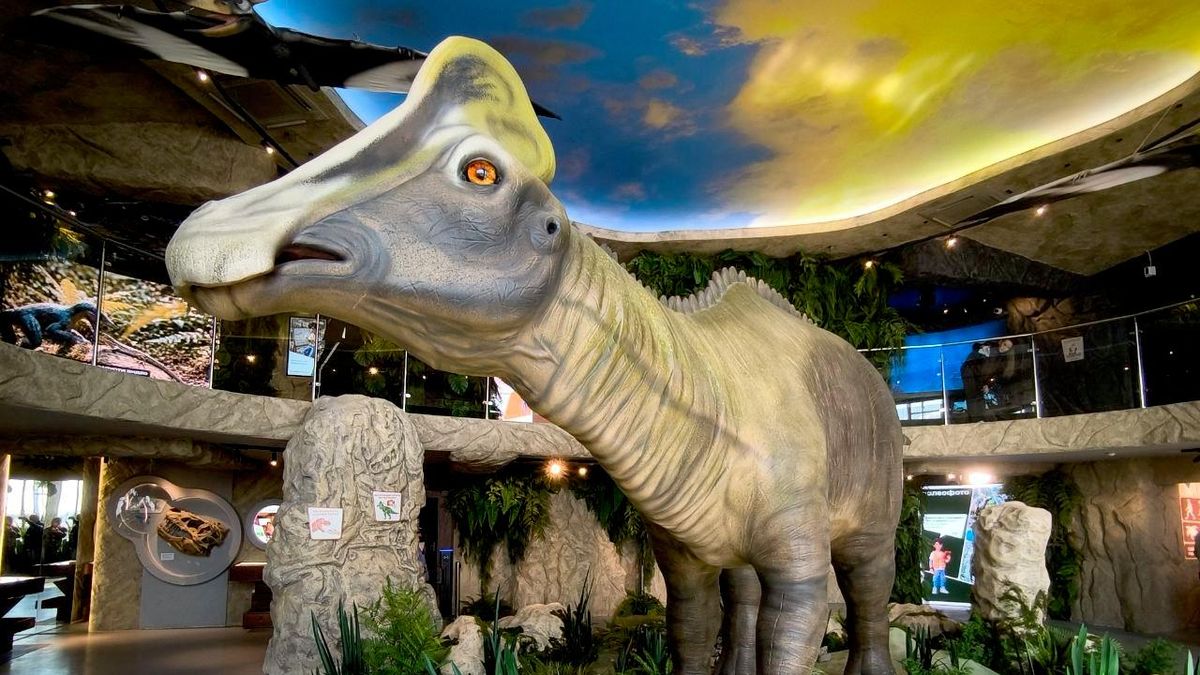
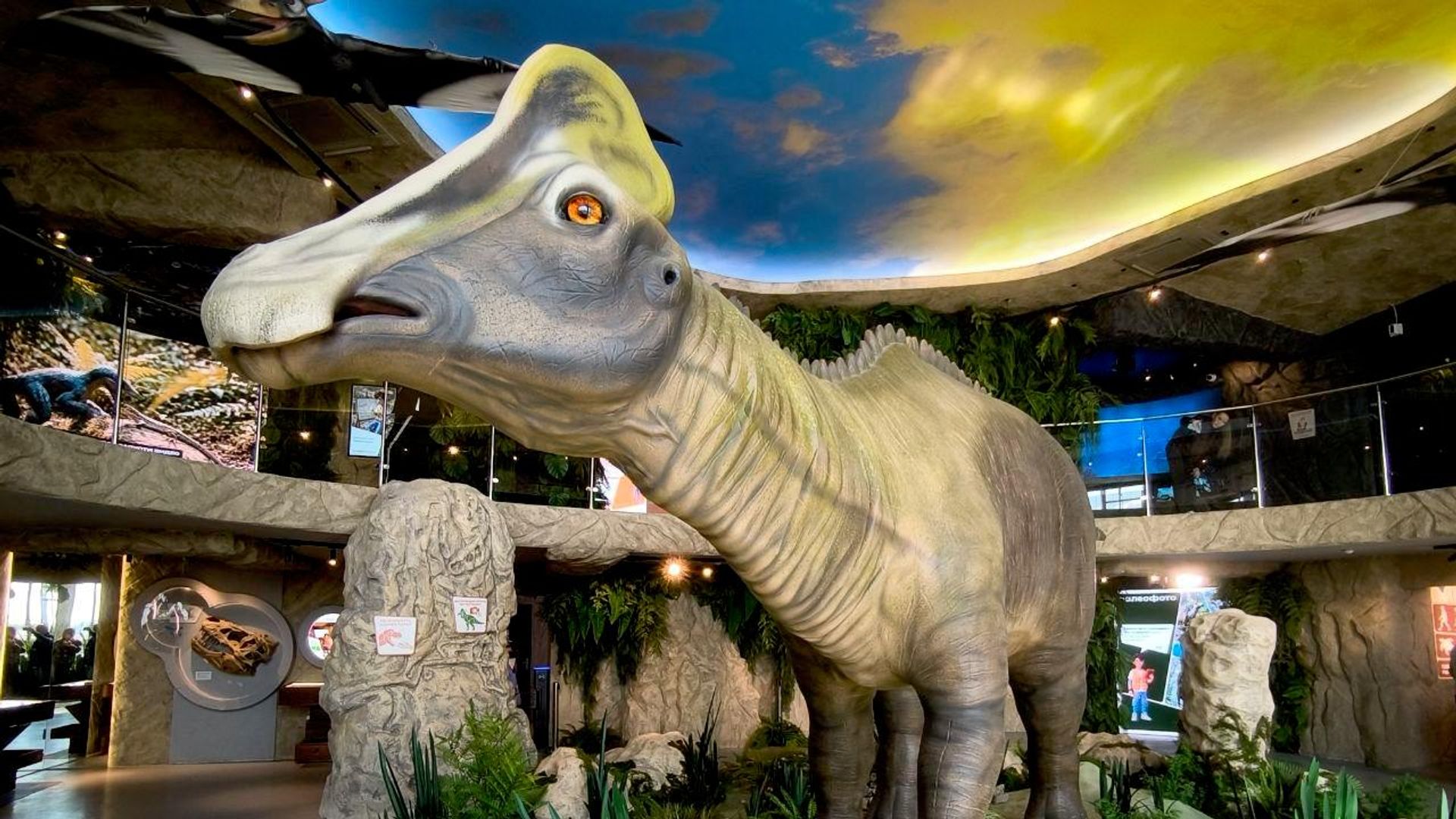
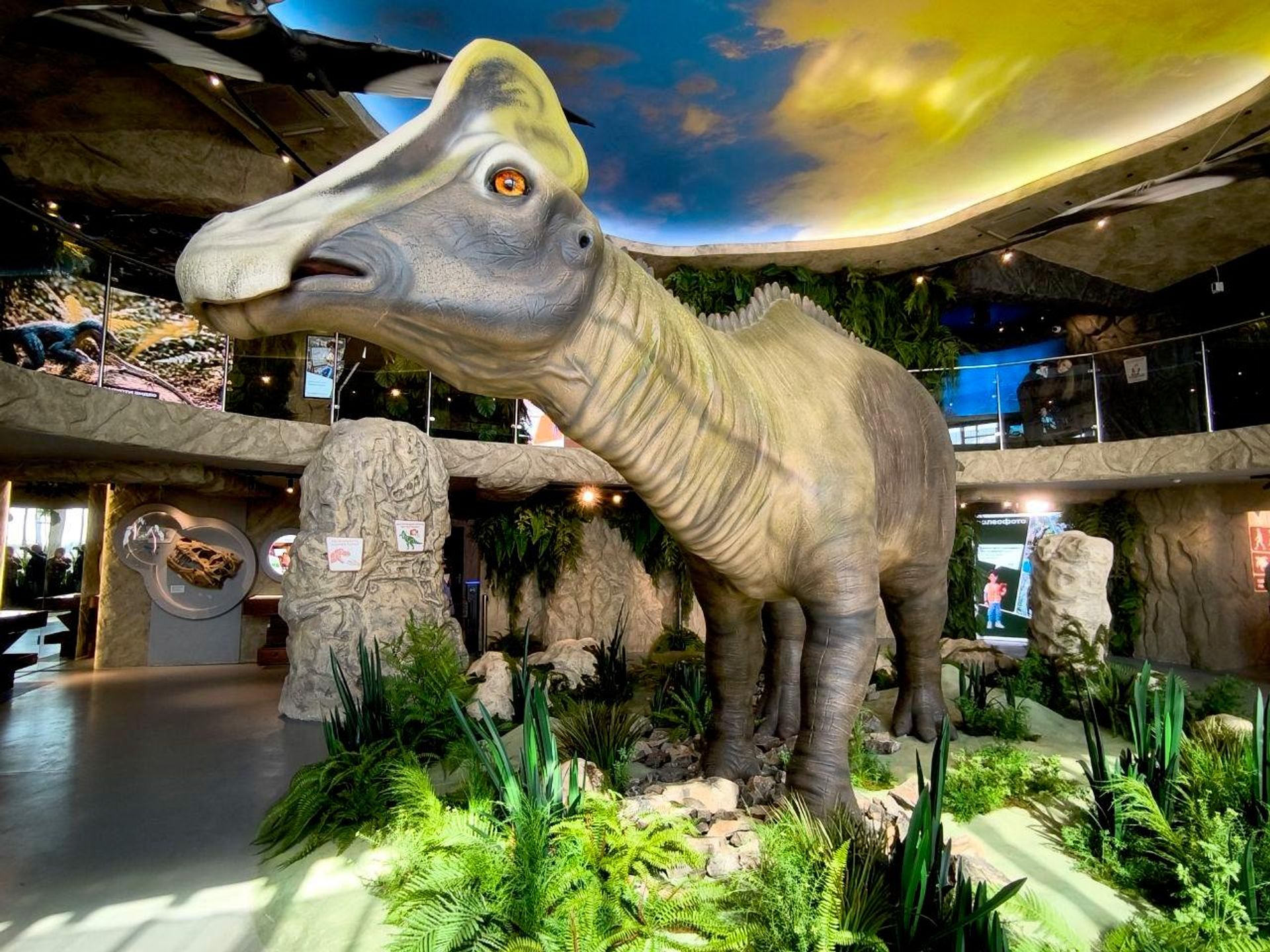
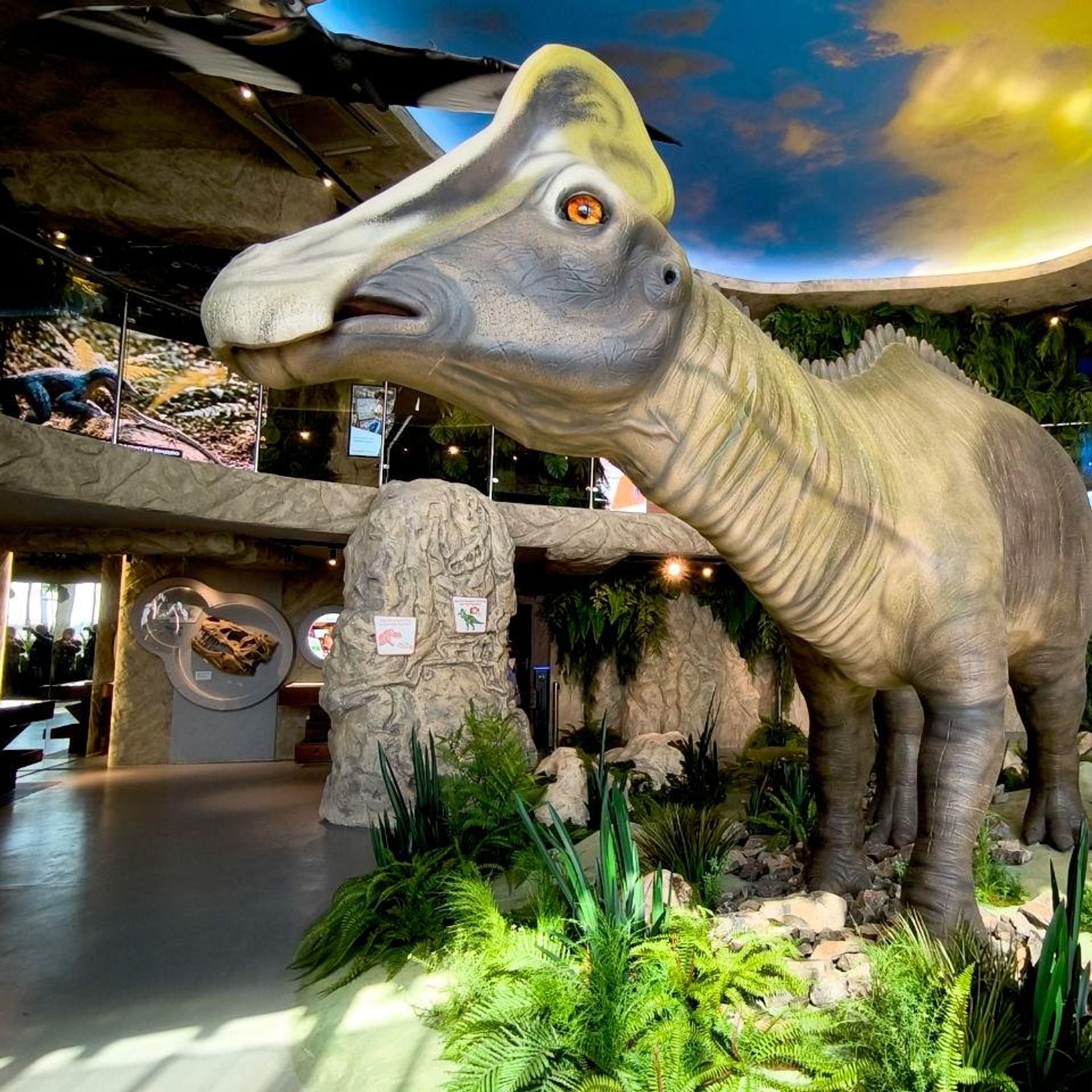
The Amurosaurus, a symbol of Blagoveshchensk and the centerpiece of the local DinoPark
Самка амурозавра по кличке Амура раз в 5 минут бодрит посетителей "Динопарка" мелодичным рыком
It was a terrible tragedy. A mudflow of tremendous force engulfed adults and young alike, smashing everything around it and mangling bodies… The death toll ran into the dozens, perhaps even the hundreds. To this day, no one has been able to establish the exact number of victims. The raging elements scattered body fragments so widely that specialists were unable to piece together even a single complete skeleton, despite their best efforts. And then there were the merciless jaws of predators that converged on the disaster site to finish the job. No humans were around to come to the rescue…
The Cretaceous brand
Then again, how could there have been any people around? The catastrophe unfolded some 65–66 million years ago, during the Cretaceous period. Homo habilis, or “handy man,” appeared only about 2.3 million years ago. It took another two million years for this early human to evolve into Homo erectus, or “upright man,” and a further leap brought us to Homo sapiens a mere 300,000 years ago.
In the history of life on planet Earth, 300,000 years is but a fleeting moment.
The mudflow, in times so distant they are almost impossible to imagine, engulfed a large herd of ornithischian dinosaurs. Today, we know them as Amurosaurus.
It is remarkable that a catastrophe from time immemorial should have inspired creative solutions in our own day – solutions as interesting as they are positive. The dinosaur from the banks of the Amur has become one of the most eye-catching, unusual and, let’s face it, downright cool brands in Blagoveshchensk and the Russian Far East as a whole. The bones of these duck-billed herbivores of the Cretaceous period, which once grazed at leisure among lush thickets in the twilight of the dinosaurs’ reign on Mother Earth, spurred our contemporaries to bold acts of ingenuity.
Let’s be honest: with brains that were rather small for their massive bodies, and hardly the sharpest tool in the shed, Amurosaurus could never have imagined that mammals would one day rule its planet. In fact, they probably couldn’t imagine much of anything beyond what their primary and secondary instincts demanded of them. Those prehistoric monsters could hardly have dreamed of cities springing up along the banks of the Amur, let alone of the river itself in its present-day form.
And yet, somehow, this duck-billed creature with a distinctive crest at the back of its head has become the undisputed leader of Russian dinosaurs. Its images in all sorts of guises are now everywhere in Blagoveshchensk. Of course, the Amurosaurus can take little credit for this. The applause belongs to the intelligent residents of today’s Amur Region, blessed with exceptionally fertile and unconventional imaginations.
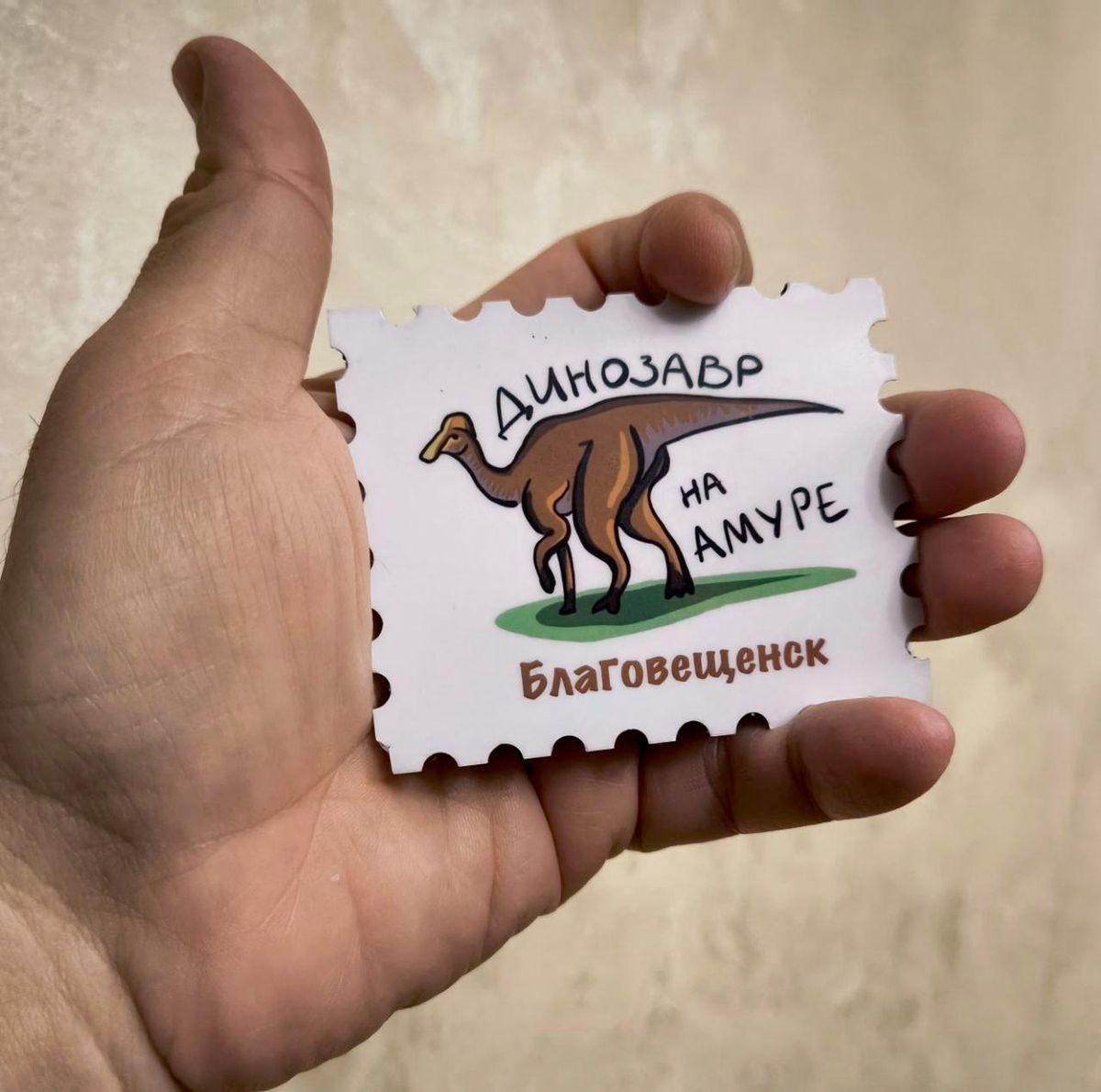
A dinosaur on the Amur River.
A unique and charming symbol of Blagoveshchensk, and a popular motif in the Far East’s souvenir trade
They have managed not only to give their fossil charges endearing personality traits (a dinosaur with a personality – imagine that!) and the qualities of loving family members (dinosaurs, of all things!), which we’ll discuss a little later, but also to see these enormous, 10- to 12-meter-long reptiles as something like household pets.
The home of the Russian dinosaurs and tireless inventors
As for the title of leader among the Russian dinosaurs, oddly enough, it is not just a figure of speech. At any rate, when in 2015 the staff of Moscow’s Darwin Museum decided to create their own Paleopark – a large-scale visual exhibit featuring a collection of prehistoric animal models – it was the Amurosaurus that took pride of place.
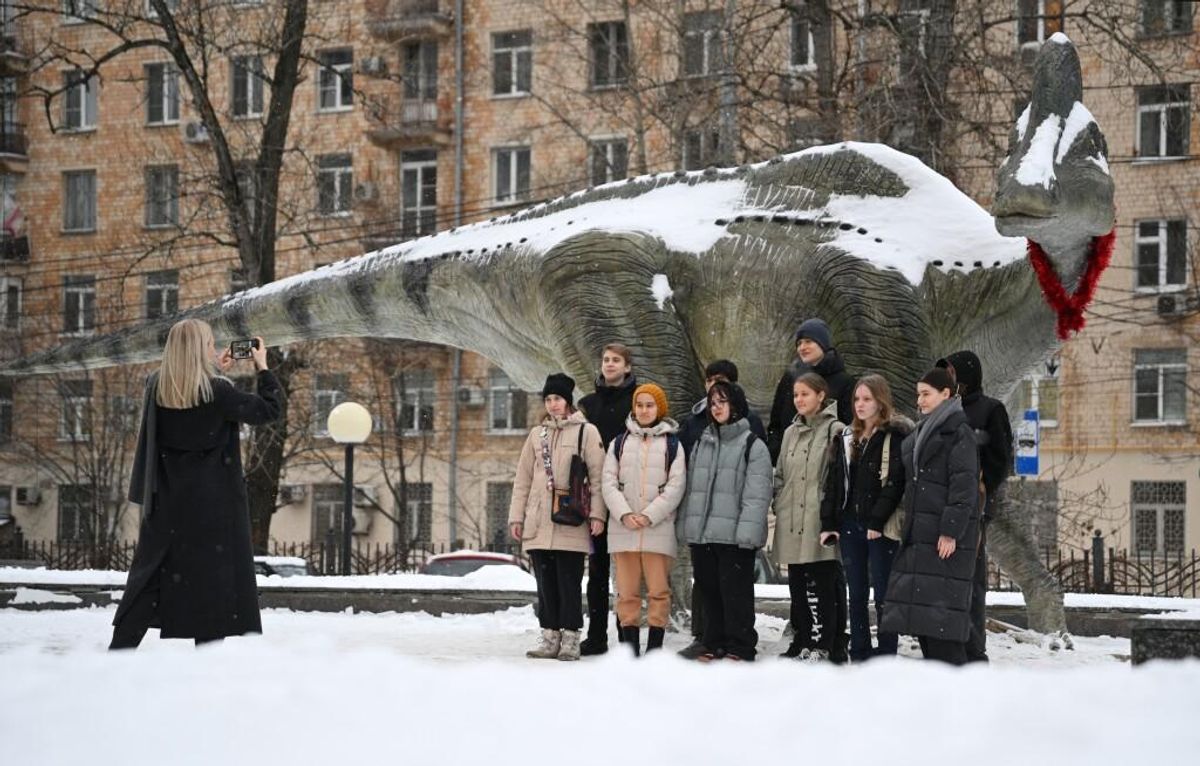
The life-size sculpture was made in China’s Sichuan Province and then transported by sea and land over a long distance, from an area very close to the Amurosaurus’s natural habitat to the Russian capital, where such creatures had never roamed. But now Moscow’s children, and adults too, happily pose for photos with this Far Eastern beast.
Schoolchildren pose for photos in front of a snow-dusted Amurosaurus sculpture.
State Darwin Museum, Moscow
I have a feeling that if, say, a Tyrannosaurus rex – which leaves no doubt as to its bloodthirstiness and nasty disposition – had taken the Amurosaurus’s place, you can rest assured that the residents of Blagoveshchensk would have managed to turn it into something cute, too. At least in their descriptions and souvenir merchandise. But since the people of the Amur Region struck it lucky and ended up with a giant, lovable duckbill dinosaur, the predatory Tyrannosaurus makes a splendid contrasting backdrop, further emphasizing all the Amurosaurus’s qualities, both evident and hypothetical.
Incidentally, they were contemporaries: the Amurosaurus and the Tyrannosaurus. Of course, that is only as far as the term applies to prehistoric times, when accuracy to within a few million years is considered the norm. But both dinosaurs lived during the Cretaceous Period – fortunately, at a considerable distance from each other. We can all picture perfectly well where the Amurosaurs grazed, while the Tyrannosaurs terrorized other life forms in what is now North America.
Well, well – the glorious, cuddly Russian Amurosaurus and the inherently vicious American Tyrannosaurus rex… One might almost think that the foundations of our modern geopolitical reality were being laid in those antediluvian times…
It is worth noting that the rather emphatic phrase “Amur Region – the home of the dinosaurs” is part of a set of accepted truths about Blagoveshchensk and the surrounding region that everyone is supposed to know by heart.
When you start asking the locals something like, “Folks, are you serious? This isn’t some joke from the Club of the Funny and Inventive People, is it? But then it follows that, well, if this is their homeland, it was right here that the dinosaurs first appeared, and then crawled, ran and flew off across the entire planet.” Right?
At first, they look at you with mild bewilderment, as if to say, “How can anyone fail to understand such elementary things?” Then they launch into an impassioned explanation: “But we’re talking only about certain species of dinosaurs…”
That is precisely when you should be ready to hear a detailed account of the genus, family, and order characteristics of the Amurosaurs, followed by a brief excursion into the history of excavations at the Blagoveshchensk dinosaur bonebed, the only one in the world located not in a desert or somewhere out in the middle of nowhere, but right within the city limits.
Moreover, of all the Russian regions where traces of prehistoric creatures have ever been discovered, the Amur Region has yielded the greatest variety of species. As for the Amurosaurus, found nowhere else, it is an unbeatable trump card in any such discussion. The name alone is worth something: Ryabinin’s Amurosaurus! Amurosaurus riabinini, to use its Latin name.
Fair enough. If the locals find nothing outrageous or irritating about claiming their region as the home of the dinosaurs, who am I to tell them what to love and what to denounce?
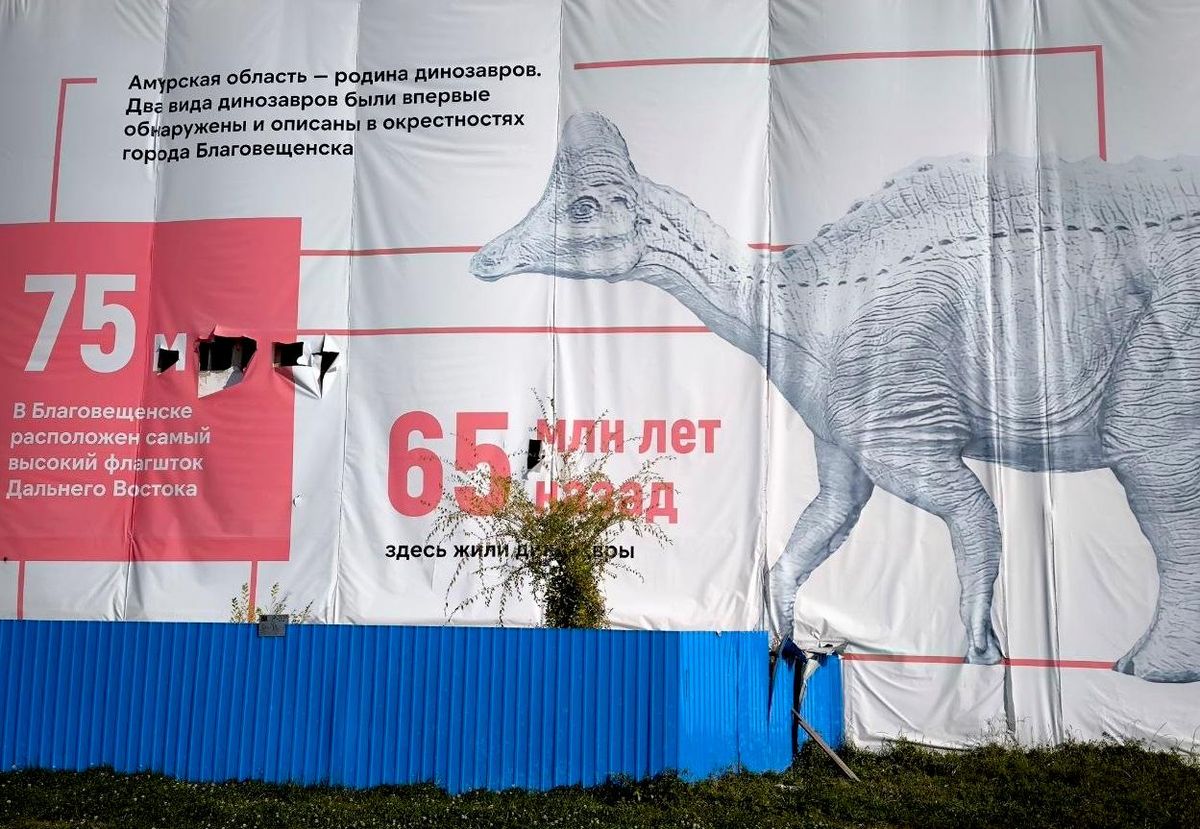
The Amur Region, the birthplace of dinosaurs.
An example of public outreach and local history promotion on a street in Blagoveshchensk
Honestly, if residents of Moscow’s Pechatniki, Kuzminky, or Kuntsevo districts – it doesn’t matter which – found deposits of previously unknown dinosaurs right on their doorstep, a Moscosaurus, for instance, they would be incredibly proud of that fact. As if they had personally buried them there for a while, only to unveil them to the world at just the right moment as an important link in the evolution of life on Earth.
Why be coy about it? Long ago, when I was a young but zealous journalist, I worked for the Donetsk edition of Komsomolskaya Pravda. Those were the days when Donbass, by an incredible and bizarre whim of history, was temporarily part of Ukraine, and the newspaper’s regional editions submitted their story pitches to the head office in Kiev. And so, somehow, I met an interesting man, an archaeologist from Mariupol – a serious scholar, no sort of crackpot – who presented me with evidence that he had found a wheel older than the Mesopotamian one, which is traditionally considered the oldest. In any case, it was an interesting subject, perfectly suited to the format of the publication in question.
I pitched the idea to the executive editor in Kiev, who responded sarcastically: “How about a column called ‘Donbass – the home of the mammoths’?” People in Kiev were not particularly fond of Donbass residents and their irrepressible Donbass-centrism. The feeling was entirely mutual… I replied, more or less, as follows: “Nothing of the sort. ‘Mariupol is the home of the mammoths,’ while Donbass, as everyone knows, is the home of the dinosaurs.”
Years passed. Donbass, thank God, is now in Russia. And now fate has brought me to visit the true home of the Russian dinosaurs. Such things happen.
A Cossack wouldn’t harm a dinosaur?
The residents of the Amur Region didn’t simply stumble upon their dinosaur. In a sense, it was hard-earned and long-awaited – as if the right moment had to arrive for the bonebeds near Blagoveshchensk to be found, properly excavated and described, and for the findings to take their place in the scientific record. For a long time, that moment simply wouldn’t come.
At the Darwin Museum – that bastion of evolutionary science – the story of paleontology in the Amur Region begins with Fyodor Schmidt’s expeditions in the 1850s and 1860s. A geologist, botanist and paleontologist, Schmidt contributed a great deal to science and uncovered much in that part of the world, yet he never managed to unearth a dinosaur. Worse, he misidentified the suspicious bones he did find, mistaking them for mammals rather than dinosaurs – an unfortunate blunder. Had he got it right, we might be talking about a Fyodorschmidtosaurustoday.
The Amur Cossacks very nearly galloped their way into the annals of global paleontology. Their contribution to the Russian Far East is immense – that much is beyond dispute. They took an interest in everything, including prehistoric beasts. More than that, they put these creatures to work – in the most literal, practical, utilitarian sense.
In 1902, near the village of Kasatkino – which, by local standards, is quite close to Blagoveshchensk, a mere 400 kilometers downstream – the Cossacks came upon a massive skeleton nearly ten meters long. The local press reported the find, though the sensation remained incomplete: the Cossacks had already taken the skeleton apart. Some bones went to collectors of curiosities; others were repurposed as boat anchors. It was, perhaps, the first instance in the Amur Region of a dinosaur being “put to use” by humans. In the 21st century, this practice has become far more widespread – and highly technological besides. We shall come to that part of the story in due course.
Some of the fossils were recovered from the Cossacks by Colonel Mikhail Manakin – later military governor of the Primorye Region and appointed ataman of the Ussuri Cossack Host – and described by him. He, too, made his contribution to science. While a Cossacksaurus never came to be – a pity, to be sure – the discovery served as a firm rebuttal to the American paleontologist Othniel Charles Marsh, who had claimed that dinosaurs never existed in Russia and that searching for them there was futile. How naive these American paleontologists can sometimes be!
In 1914, researcher Afrikan Krishtofovich arrived in the Amur Region. From a local historian and amateur archaeologist named Alexei Gurov, he obtained a fragment of a massive fossilized bone found on the bank of the Amur. After the specimen was examined in Petrograd by paleontologist Anatoly Ryabinin, it was realized – to great excitement – that the bone, a tibia, belonged not to a mammoth or a woolly rhinoceros but to a giant duck-billed dinosaur.
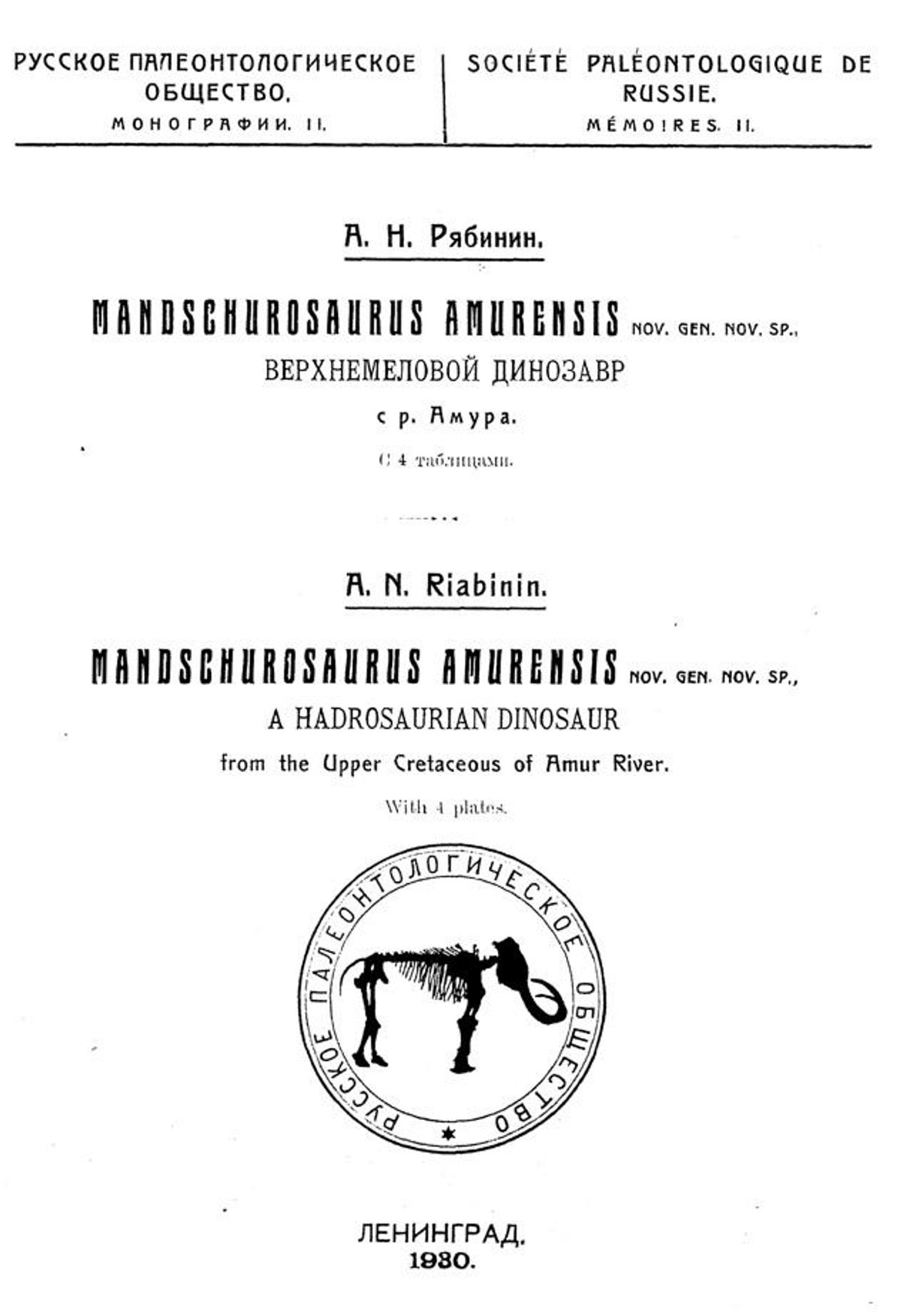
Admittedly, Ryabinin believed he was studying and reconstructing the skeleton of a Late Cretaceous dinosaur – Mandschurosaurus amurensis. A great deal of time and effort went into the endeavor, but the result was, in effect, a chimera. Later generations, perhaps more meticulous, concluded that Ryabinin and his colleagues had likely assembled their prehistoric giant from bones not merely of different individuals but of entirely different species. Yet that is not the most significant point. What matters is that Ryabinin provided definitive scientific proof: dinosaurs once inhabited the Amur Region, and it was worth searching for their remains.
The title page of Anatoly Ryabinin’s monograph on Mandschurosaurus amurensis. Leningrad, 1930
The magnificent logo of the Russian Paleontological Society
All that remained was to find and excavate these prehistoric monsters by the Amur – and to immortalize Ryabinin’s own name in the designation of the most significant find. After all, a Ryabinin’s Amurosaurus sounds far better and more patriotic than Mandschurosaurus.
The keen nose of an antediluvian sommelier
In Blagoveshchensk, chatting with people about all sorts of things, including paleontology, I heard this several times: “Oh! So it was my neighbor who discovered the dinosaurs!” Or a distant relative. Or a relative’s neighbor. Or a neighbor’s relative.
Different names and surnames came up, but the stories all followed roughly the same plot: an inquisitive schoolboy discovered some unusual bones and took them to scientists (I wonder which ones, and where?), who saw nothing remarkable in them. But the enthusiastic young researcher refused to give up... And so it went, until competent specialists finally came along and confirmed that the boy had been right: the search had to continue, and the remains of ancient reptiles would surely turn up. And indeed they did, in considerable numbers.
The details and dates vary from one story to another. So what? It’s no big deal. For one thing, urban legends, if that’s what these are, can easily be transformed versions of real-life events, adapted to the collective unconscious. For another, who says there was only one Amur schoolboy who found dinosaur bones?
In any case, the dawn of the era of the Amurosaurus, brought back from oblivion in Blagoveshchensk, began with the righteous labors and dogged persistence of Yuri Bolotsky, the guru of Far Eastern paleontology.
In the summer of 1981, Bolotsky headed to an abandoned quarry. From the last stop on the bus route, he climbed the hillside and spotted the first bone before he had even reached the site. “Right in the middle of the trail, lying straight across it, was a large white bone, crisscrossed with cracks, with fragments scattered around it,” Vokrug Sveta magazine quoted Bolotsky as saying in 2022.
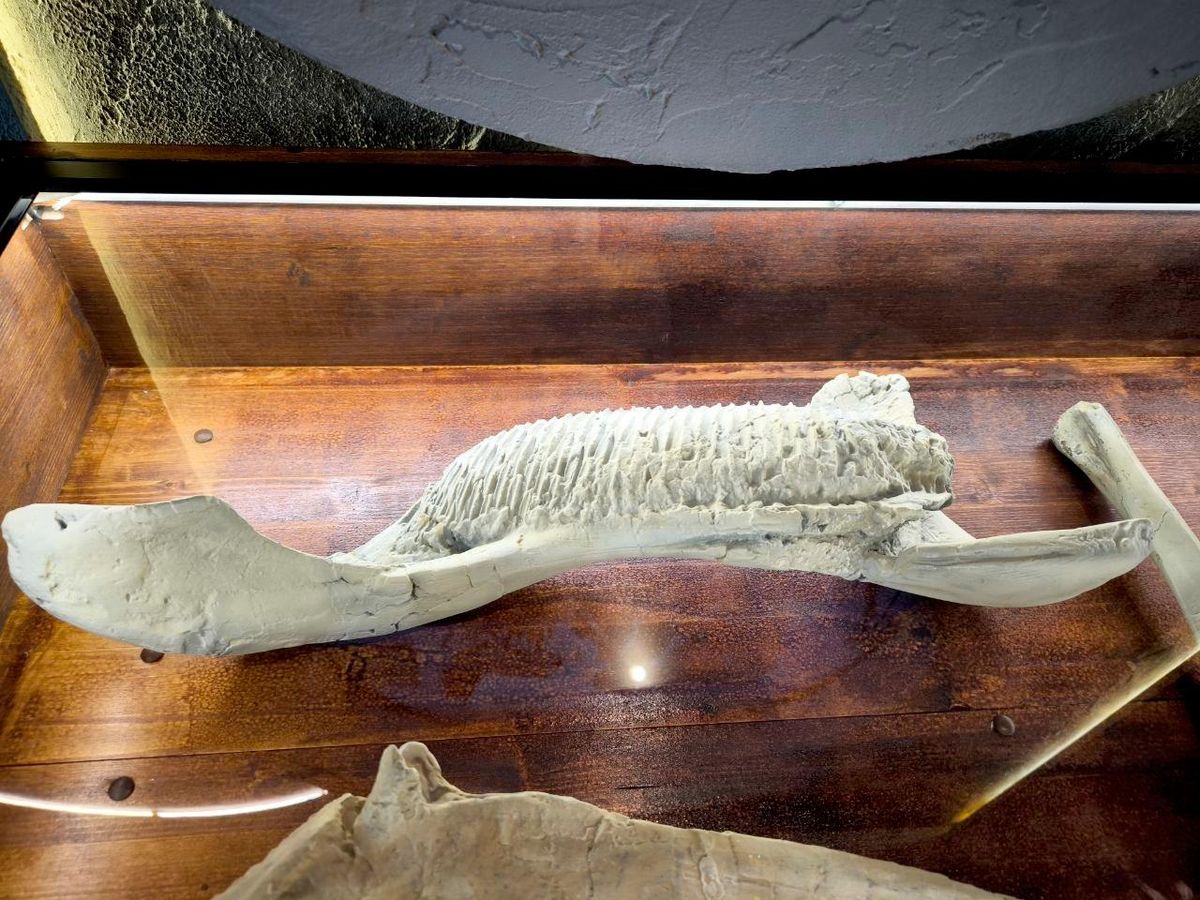
History has a funny way of shuffling the cards. Just recently, Galina, a tour guide at the Amur DinoPark in Blagoveshchensk, who can explain all sorts of intimate details of the Amurosaurus’s life – including their eating habits – “Just look at the jaw. It has several rows of tiny teeth fused into a single dental battery. An Amurosaurus had several of these batteries. They were needed to grind tough vegetation, pine needles, branches, and little cones” – tried to send me to that very bus stop.
The dental battery of a herbivorous dinosaur.
With teeth like these, you could grind up any pinecone.
An exhibit at the Amur DinoPark
“Take Route 5, and it’ll take you to the last stop,” that’s how she put it.
“Will the driver announce, ‘Last stop, dinosaur graveyard?’ And remind us not to leave our trowels, brushes, and containers for paleontological finds on the bus?”
“Not exactly, but close,” Galina smiled.
“And what will I see there?”
“A fence.”
I didn’t go, you know. I’ve seen plenty of fences in my time, some quite impressive ones at that. And whatever lay inside this particular enclosure had already been dug up before I arrived.
It was in this spot that Yuri Bolotsky struck a true paleontological goldmine. In the clay, according to him, lay a veritable “bone logjam,” which had to be meticulously sorted out. Every square meter of the excavation yielded two or three dozen bones. Vertebrae, ribs, limb fragments, skull cases – it was a dinosaur hunter’s sweetest dream.
The bones kept coming in such quantities that schoolchildren had to be recruited to help with the excavations. There simply weren’t enough hands. The young paleontologists were even taught to work with their tongues. That is, if a rock looked like a bone, they were supposed to lick it. Dinosaur remains, believe it or not, stick to your tongue. So keep that technique in mind, just in case.
At first, Bolotsky thought he would wrap up work at the site in a couple of months. As it turned out, it would take a lifetime. And who knows how much prehistoric treasure is still buried in the ground today?
“Dinosaurs may still be found throughout the areas bordering the Zeya-Bureya Plain. But here, unlike in Montana, Mongolia, and perhaps China, where blades of grass grow a meter apart, everything is covered by swamps and forests. That’s why all our fossil sites are in artificial excavations. There was a quarry here, for example,” Yuri Bolotsky told Komsomolskaya Pravda in 2014. “We studied their braincases. It turns out these dinosaurs had an incredibly developed sense of smell,” the paleontologist explained. “They were like French sommeliers! Why a herbivore would need such a keen sense of smell is anyone’s guess.”
Many details of the work of the permanent Blagoveshchensk paleontological expedition have been preserved, enough to fill several volumes. But what matters to you and me is the bottom line. And here it is: in 1991, paleontologists Yuri Bolotsky and Sergei Kurzanov described a duck-billed herbivorous dinosaur with an extraordinarily keen sense of smell, for reasons no one could explain. They named it Ryabinin’s Amurosaurus, laying the foundations for the Amurosaurus craze we see today.
Know it like its own three toes
Where can you see an Amurosaurus in Blagoveshchensk? In all sorts of places. One is the famous local riverfront, something of a landmark in the regional capital, where a dinosaur sculpture was unveiled in 2021. It’s not particularly huge, at just seven meters long, considering that specimens of this species once roamed the areamillions of years ago measuring a full 12 meters.
A short distance from this local favorite, a Kerberosaurus has left its tracks. Well, not quite the dinosaur itself, of course. These three-toed footprints, belonging to a herbivore (not a predator either, did you notice?), were crafted for the amusement of passersby by Blagoveshchensk’s irrepressible creative crowd. And so the phrase “to know the prehistoric Amur Region like the back of your hand” has acquired a whole new meaning: the Kerberosaurus knew it like its own three toes.
One of the simulated footprints has a QR code that lets you look up information about the creature that had feet like these millions of years ago. Surprised? What did you expect? Even prehistoric beasts deserve a modern approach.
1/2
Kerberosaurus has left its tracks along on the Blagoveshchensk riverfront
One important detail: the Kerberosaurus was discovered and described by Yury Bolotsky, a master of paleontology. He had a lot of fun coming up with its name, too. Its full scientific name is Kerberosaurus manakini. Kerberos, or Cerberus, was the three-headed hound of ancient Greek mythology who guarded the gates to the underworld. The species name, manakini, refers to Mikhail Manakin. Remember the Cossack leader on the Ussuri River who took dinosaur bones away from his men in the name of science? That’s the man, forever etched in the pages of paleontology textbooks. Thank you, Bolotsky, for your attention to your colleagues.
Of course, children’s playgrounds are full of all sorts of dinosaur-themed attractions. Kids are especially thrilled by these giants of the past.
The Amur Region is perhaps the only place in Russia where you can find an offer to rent a dinosaur. Not a real one, of course, but at least it won’t cost much.
In Lenin Park, named in connection with Blagoveshchensk’s award of the Order of Lenin in 1967, you can easily find a life-size Amurosaurus woven from willow branches.
An Amurosaurus art installation made from woodworking waste was sent to the Amur Regioncity of Svobodny a couple of years ago as part of an environmental campaign. There, it acquired a new name: Svobodosaurus.
1/3
In Blagoveshchensk, you can find Amurosaurus figures of all kinds, including some woven from willow branches
You’ve probably spotted the pattern by now. Add the ending -saurus (from the Greek sauros, meaning “lizard”) to almost any word, and you can come up with the name of a new dinosaur species. Well, you could if you were a lucky paleontologist. The rest of us can still have fun playing with names. Want to give it a try? Add -saurus to your first or last name, your hometown, or even your favorite river, and see what you get.
Naturally, images of the Amurosaurus and its fossil relatives, near and distant, can be found in just about every souvenir shop in the Amur Region. Magnets and T-shirts, pins and keychains, cups and plates, thimbles and pencils, and all sorts of other tourist trinkets are brightly decorated with dinosaur faces, paws, tails, and silhouettes. There are even lollipops shaped like dinosaur footprints.
But my personal prize for the most extraordinary local souvenir goes to an object that could be a shot glass, a candlestick, an Amurosaurus or a Cossack. Take your pick.
What can I say? That’s practically what the packaging says, in black and white. In essence, it’s a ceramic Amurosaurus head wearing a traditional Cossack hat. Or at least that’s what it looks like. The hat itself doubles as a vessel for a shot of liquor or a socket for a candle, depending on what function its owner decides to assign to this Cossack-dinosaur hybrid.
I came across these marvelous heads in the gift shop of the Babintsev City Museum, housed in the restored mansion of a merchant family held in high regard throughout the Far East, from Blagoveshchensk to Harbin. I asked Alexandra, the museum’s manager, where these wonderful ceramic dinosaurs came from. Surely not China? As it turned out, no: this was a unique local creation by Alexander Kantemirov. Bravo, master! A boundless imagination and a total departure from clichés.
1/2
A Cossack Amurosaurus – an imaginative creation by local Amur craftsman Alexander Kantemirov
The ceramic Olorotitan displayed beside the Cossack Amurosaurus on the souvenir shelf was a fine creation in its own right. It looked like a humpbacked horse from a fairy tale – or perhaps Pegasus. The name Olorotitan actually means “giant swan,” which may explain the artist’s winged-horse-like flights of fancy.
And, of course, this 12-meter-long monster with a distinctive crest on the back of its head was discovered in the Amur Region. Where else? It, too, is unique. According to local lore, it is the only dinosaur found in Russia whose skeleton has survived almost – or perhaps entirely – intact. The story goes that the first bones of the Olorotitan were discovered by a teenage boy, Ivan Bolotsky, the son of paleontologist Yury Bolotsky, who helped his father on the expedition.
They gave the dinosaur an affectionate nickname: Vanyusha. Only later was it officially entered into the scientific record as Olorotitan.
Zinaida the pterodactyl
But all this dinosaur extravaganza in the Amur Region – lizards cast in solid forms or woven, made of ceramic, plastic, tin, wood or glass – is only the opening act. The main event lies ahead: a genuine fairy tale brought to life in the 21st century.
Opened in the summer of 2026 on the Golden Mile (a prestigious cultural and business district in Blagoveshchensk), DinoPark is a true epicenter ofdinosaur wonder– a place with a real charge to it, and one you can feelfor yourself.
Paleontological knowledge, compactly packed inside an artificial hill and presented with a combination of great artistic flair and cutting-edge technology – how does that strike you? Can every city boast something like this? Not by a long shot.
And there’snone of that dreary, droning, textbook lecturing on evolution. Everything is vibrant, concise, interactive, alive. It’s an engaging two-storyquest that leaves you with at least a basic understanding of the age of the dinosaurs. And, at best, a boost of energy, a great mood and emotions that won’tfade anytimesoon.
To activate an interactive feature at each display, visitors simply step on dinosaur footprints. Children, naturally, are the most enthusiastic participants – though adults, whomay initially put on a stern or indifferent face, often dive in with even more zealthan the little ones.
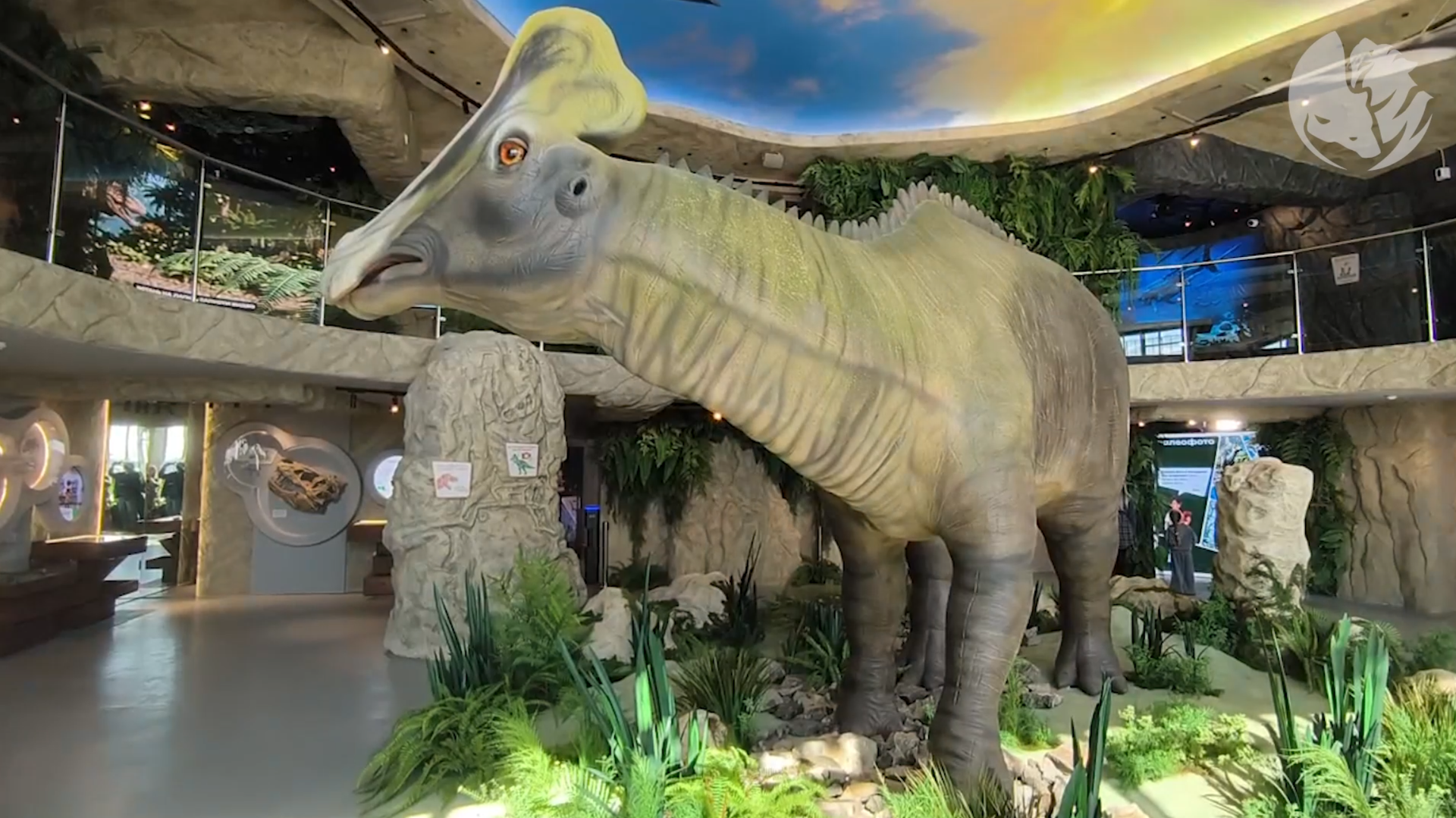
Needless to say, the exhibition has a strong local Amur Region focus. Fortunately, there’s plenty of authentic local material to draw on. At the very centerof the display, as you might guess, stands the flagship of Russian dinosaurs: the Amurosaurus.
It’s a huge, life-sizeanimatronic – essentially, a mobile robot with a metal endoskeleton and a soft outer covering that mimics living tissue. It looks quite realistic: it moves and even blinks. Every five minutes or so, it lets out a roar, though it’s quite musical and quiet enough not to scare the visitors away.
I wouldn’tsay the mechanical Amurosaurus goes wild with its movements. It certainly doesn’t wander from its spot. But it gives a friendly wag of its tail and moves its neck – quite enough to make anyone with a vivid imagination feel that they’re looking at a genuine prehistoric animal rather than a puppet.
I was admiring this Far Eastern dinosaur star alongside Ksenia Gip, the director of DinoPark. She revealed that the creature standing before me wasn’t just any dinosaur but a female – a “dino-girl.” I didn’t venture to check; I took her word for it. Besides, I wouldn’t have the slightest idea how one might establish such a thing in this rather unusual case. As for her name, they kept it simple: Amura.
Personally, I might have gone with Amurka. But it turned out that name was already taken– it’s the brand name of a popular local vodka, with a tiger or a bear on the label. What a shame! It would have been even better if it had been an Amurosaurus. That would have brought the whole thing neatly full circle.
Ksenia Gip insists that giving names to DinoPark’smain characters is sweet and delightful. I wasn’t in the least inclined to argue – they truly are sweet, and genuinely delightful.
Besides Amura, Dinopark is home to two other named artificial creatures. One is a velociraptor – a small but cunning, predatory, feathered beast –called Jay (a name derived from the Zeya, a Far Eastern river almost as famous as the Amur). The other is Zinaida the pterodactyl. Thatlast choice is beyond praise: a wonderful name– cozy and even musical.
At once, the voice of Vladimir Vysotsky rang out in my head: “Listen, Zina, leave my brother-in-law alone: whatever he may be, he’s family …” As it happens, the exhibition is all about family ties – often complicated, sometimes even questionable – between dinosaurs and other forms of life on Earth. And hovering wisely above this whole tangled, bewildering world is Zinaida the pterodactyl… It’s beautiful, really. And symbolic, too.
Speaking of songs, I also remember one from my childhood. It was featured in an episode of the famous TV show Budilnik (Alarm Clock):
There once lived an Iguanodon,
A giant of eighty tons,
Andhe was – whowould expect this? –
Friends witha bird,a pterodactyl-ess.
That bird never sang a song,
Only gnashedher teeth –loud and long.
She rattled, she screeched and she groaned,
And no other songs she owned.
A charming little piece, set to a poem by Valentin Berestov, The Very First Song. Back in those days, they knew how to make even complex scientific subjects accessible to children.
A devoted family man vs. an evil womanizer
“Xenia, how long did it take to create your wonderful DinoPark?”
“The deadlines were extremely tight, so we worked at a tremendous pace. The project was already underway when I joined, but bringing it to life took four months.”
“So all this beauty was created in just four months?”
“Yes! It was an enormous undertaking. When I first came here, there was nothing but a construction site, dust, and dirt. We spent four months building everything, decorating it, and putting the finishing touches on the content. Every detail had to be agreed on, and we produced video clips…”
“Which, by the way, are really well done and look incredibly realistic. It’s like watching a documentary about events that took place millions of years ago.”
“We also came up with a mascot. His name is Yury.”
“Who’s that?”
“A character who accompanies visitors around the park. A paleontologist… And, of course, we put a great deal of effort and imagination into Amura and our other dinosaurs.”
“We have a fairly good idea of what an Amurosaurus looked like. Quite a lot of bones have been found, so we have a good understanding of what its skeleton must have been like. We can even work out, more or less, how its soft tissues were arranged. But how do you know it had smooth skin like this, rather than scales or some kind of plates? And why this particular color rather than another?
“Paleontology has made tremendous strides. Just imagine: scientists can now determine color from traces of pigmentation preserved in fossils. As for the smooth skin… Our Amurosaurus lived in an environment where it didn’t need spines or other protrusions for protection.”
“I’ve read that the crests on dinosaurs’ heads helped them produce sounds and attract mates. Is that right?”
“That’s one theory.”
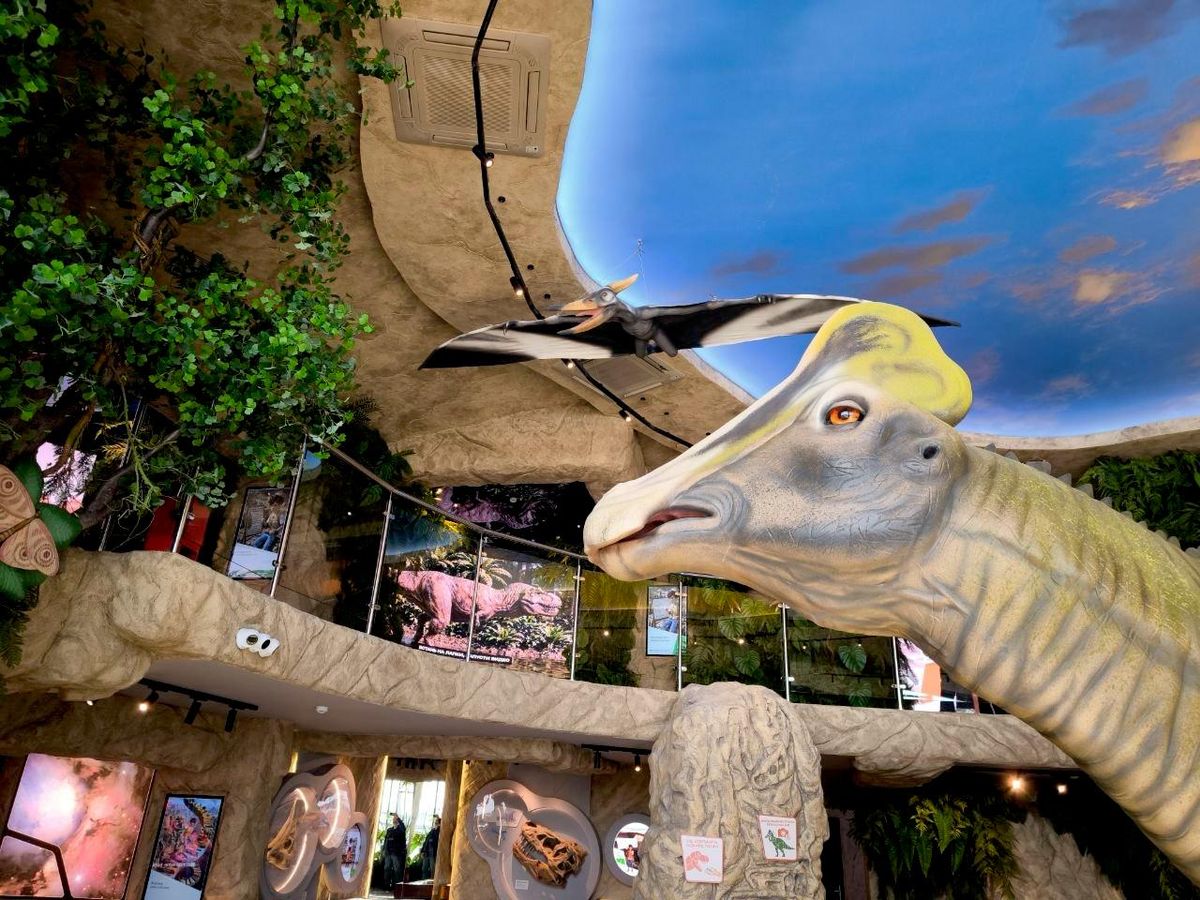
Amura, a female Amurosaurus, lures potential mates with her crest; Zinaida, a female pterodactyl, giggles mischievously overhead; while an unnamed Tyrannosaurus lurks in the undergrowth, hoping for a successful hunt.
A hall at the DinoPark in Blagoveshchensk
“At this point, Xenia Gyp gave me a wonderful lecture on the private life of Amurosaurus. In her view, they weren’t just cute to look at; they were kind and caring, too. Creatures with family values!”
“They raised their young and even had caregivers to look after them… They had day-care centers around Blagoveshchensk.”
“I have to admit, Xenia, I’m astonished. Kind, family-loving dinosaurs? That’s wonderful. And completely unexpected.”
“Well, that’s what we believe. The fact that they cared for their offspring is certainly telling.”
“So the Amurosaurus was a devoted family man, while the Tyrannosaurus rex was a philanderer and womanizer?
“They had different ways of life. But Amurosaurs lived in family groups.”
“There’s something about your Amurosaurus moral code that suggests not only a deep immersion in the subject, but also a great affection for these ancient creatures.”
“I’ll be perfectly honest: four months before the project launched, I knew very little about dinosaurs. But then I really immersed myself in the subject and became fascinated by it. I threw myself completely into the project. I read a great deal of literature on the subject. For example, I absolutely loved the books by Steve Brusatte, the American paleontologist. Everyone involved in the project studied dinosaurs, immersed themselves in the subject, and worked alongside scientists. Our aim is to offer content that’s not just entertaining, but educational as well.”
“Which paleontologists advised you?”
“Ivan Bolotsky, a well-known paleontologist.”
“Of course! I know him! He comes from the famous Bolotsky paleontological dynasty. He’s the son of Yury Bolotsky, the godfather of Amurosaurus and other Far Eastern reptiles. Wasn’t Ivan the one who discovered the famous Olorotitan Vanyusha?”
“We have a special display dedicated to that discovery.”
Healed like a Tyrannosaurus
After waiting for Amura to show signs of mechanical life, shift its endoskeleton, flex its soft tissues, and, most importantly, announce its presence on the science and entertainment hill with its low, heartfelt, and even, in a sense, an inviting bellow, Xenia Gipp apologized for having to leave me and rush off to attend to her complex and demanding dinosaur domain.
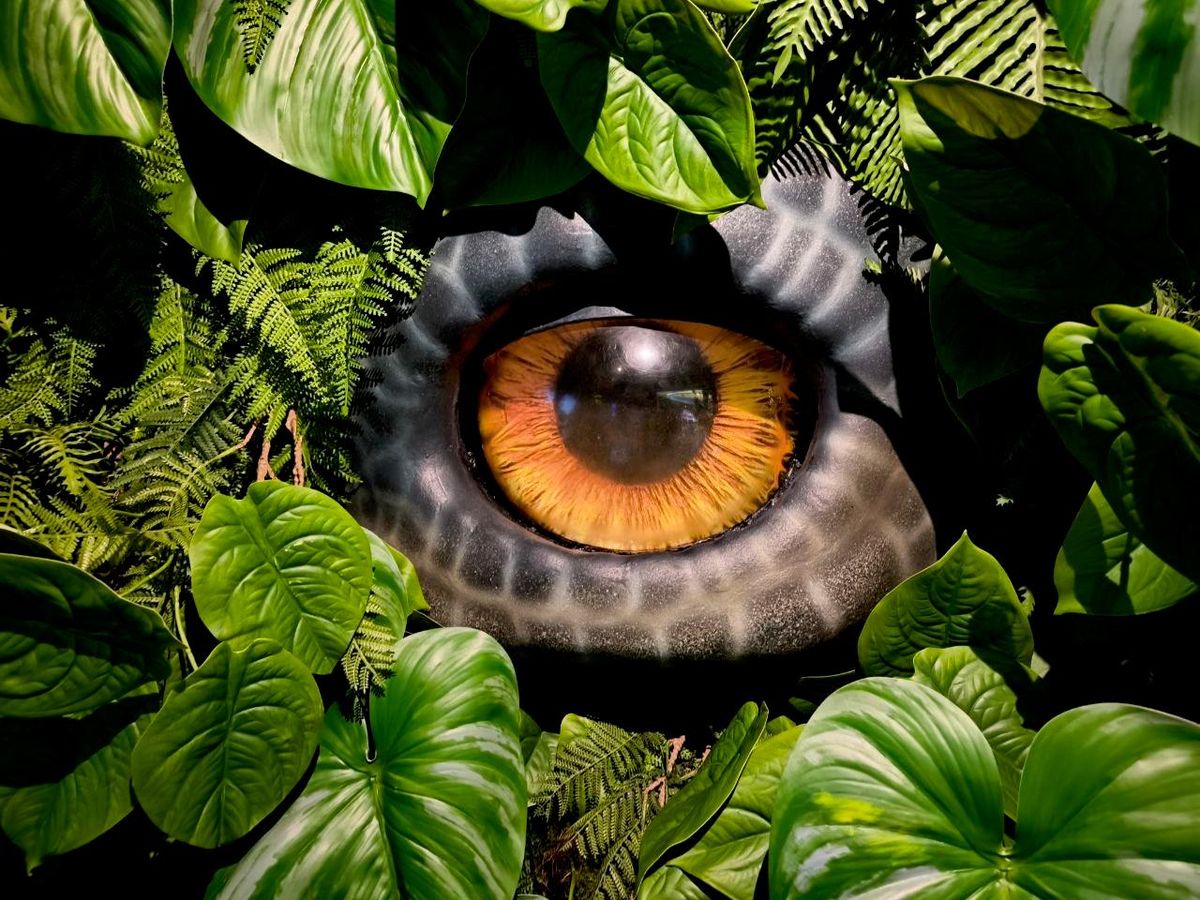
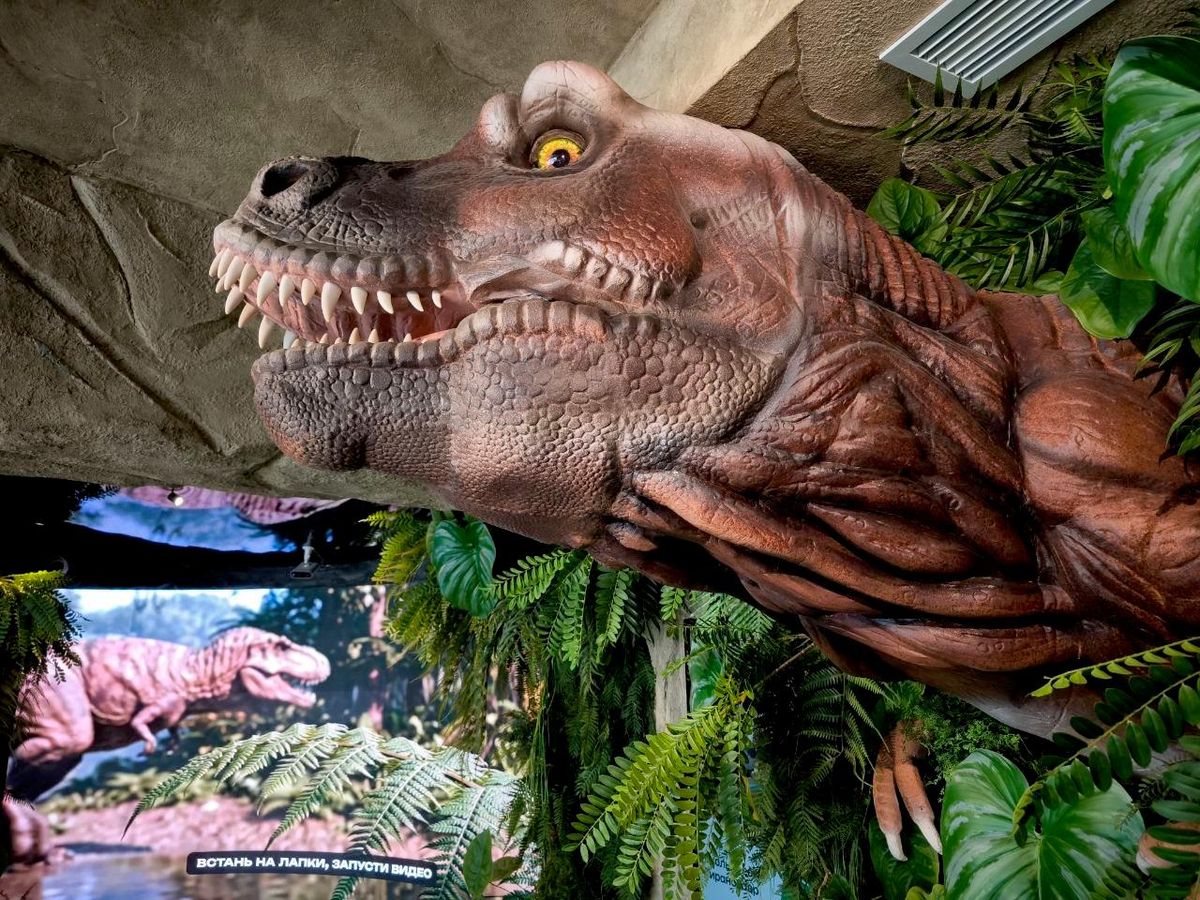
But I was not left to my own devices. All the while the unblinking – and therefore especially frightening – eye of a Tyrannosaurus kept glancing at me from the bushes. Seeing such a thing in the wild is the last thing anyone would want.
Furthermore, I was joined by Galina, the guide I mentioned earlier when describing the road to the dinosaur graveyard.
“That young lady has an interesting job,” I thought to myself, “although, of course, it takes strong nerves to work day in, day out, from morning till night, among dinosaurs, even if they are not exactly real.”
As if to confirm my words, the Tyrannosaurus winked from the bushes. Or perhaps I just imagined it…
Look into my stern eyes...
The Tyrannosaurus never takes its eyes off the visitors, not even for a second. An installation at the Amur DinoPark
Galina carried not buckets of water, but rather all that was wise, good, and eternal in the history of the life and death of dinosaurs. Her yoke, if it bent at all, bent under the weight of her encyclopedic knowledge of all manner of prehistoric reptiles.
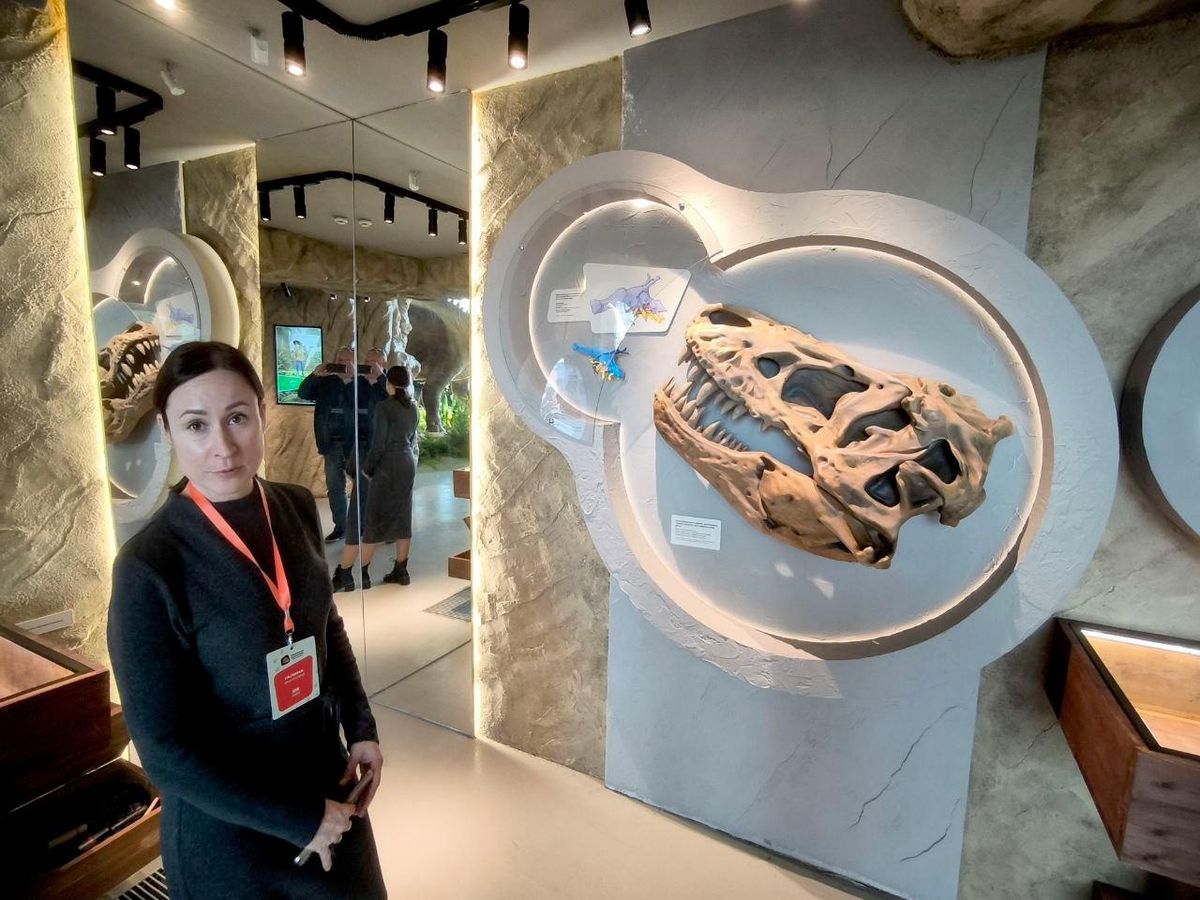
Admit it, it takes no small measure of expertise to give an engaging account of how the teeth of the Amurosaurus or the Olorotitan differ from the fangs of tyrannosaurids, share insights about the claws of feathered velociraptors found in the Amur Region, and marvel at such a rare exhibit as “a dinosaur’s ulna showing signs of pathology.” When I asked what ailment had befallen the fossil beast, Galina explained that scientists would give anything for a chance to determine from the bones what ailments dinosaurs had suffered during their lifetimes. In this particular case, the dinosaur had sustained a fracture that had healed, but incorrectly. This, of course, caused the reptile problems and left it with shortened bones, while giving paleontologists plenty to think about.
“Healed like a Tyrannosaurus,” I thought to myself. Once again, the artificial jungle winked at me with the giant eye of an ill-tempered reptile from the Cretaceous Period.
Steven Spielberg and the mystery of our love of monsters
Speaking of geological periods, American filmmakers have certainly played a huge role in popularizing dinosaurs among the general public. But they have also created a fair amount of confusion. Not in the scientific community, where people are rather harder to fool, but among ordinary people with no particular knowledge of paleontology.
Steven Spielberg populated his Jurassic Park with dinosaurs that are, in fact, anything but typical of the Jurassic Period. The Tyrannosaurus rex, which could be called the very emblem of the film franchise, actually lived during the Cretaceous Period, the same period as our now familiar Amurosaurus. But good luck trying to get this truth across to people around the world when everyone has such a strong association with Jurassic Park.
The Tyrannosaurus, a fearsome predator of the Cretaceous Period, makes a striking contrast with the sweet-natured, gentle Amurosaurus.
An installation at the Amur DinoPark
Having reinforced our knowledge, with Galina’s help, of the Kundur fossil site, where the first complete Olorotitan skeleton in Russia was discovered – and in a state of natural articulation, which is highly unusual and relatively rare! – and having once again marvelled at the Amurosaurus, which had been clever enough to bury itself precisely where Blagoveshchensk would emerge many centuries later, we watched a five-minute video about the origin of life on Earth, brilliantly made in terms of its presentation, though thoroughly godless in its underlying concept. After taking in the many ancient bones, some genuine and others replicas, we headed off to play.
Ultimately, however significant the scientific and educational dimension of DinoPark may be, it remains an amusement park first and foremost. Besides, combining instruction with fun always produces better results than instruction alone. It’s been that way for ages – ever since the time of the dinosaurs, in fact.
Galina confidently guides visitors through the Amur DinoPark’s world of fossilized bones, fangs, and claws
Among the many high-tech attractions at DinoPark, there are several absolute hits, guaranteed to win over the crowds. For instance, I was invited to check my weight. A purely dietary exercise, you might say – only not for my sake, but for that of a Tyrannosaurus rex.
I had tried a similar attraction before at Moscow’s Lunarium. There, you could find out how much you would weigh on different planets, depending on their gravitational pull. At DinoPark, however, the display tells you how many people of your weight a T. rex would need for its daily ration. Rather specialized knowledge, wouldn't you say?
As it turned out, even a fairly large primate like me wouldn’t be enough to satisfy a T. rex. What a nasty, gluttonous beast! And as for the children who cheerfully and laughungly stepped onto the scales before and after me – well, you’d need a whole sackful of them to keep this Cretaceous predator fed.
Is it pleasant to think of yourself as food? A starter, a main course or even dessert? Not exactly, I can tell you. It’s a rather unsettling feeling, to say the least. Although, in my case, it did lead to an important realization.
1/4
Clear and informative displays at the Amur DinoPark
I’ve long wondered where this mass fascination with dinosaurs comes from. What’s so great about them? You look at these awkward ancient creatures and think: “Good grief, you lot really are a bunch of ugly freaks.” And yet some people actually like them. Some are even crazy about them and, if they’re cool enough, fall in love with these monsters.
Children, as I’ve already mentioned, are particularly susceptible to dinosaur mania. I’ve come across young, inquisitive kids for whom not knowing the difference between a Halszkaraptorand a Kulindadromeusis tantamount to admitting that you’re hopelessly stupid.
Clearly, films like Jurassic Park, all kinds of dinosaur cartoons and the other wonders of global marketing have played their part. But there must be something deeper at work, some underlying reason.
And then, as I stood on the scales, imagining myself as a T. rex’s lunch and gleefully wondering whether the scales on its snout might crack under the sheer caloric burden, it suddenly dawned on me: We find dinosaurs fascinating, even endearing, because they are enormous, terrifying and untamable, yet belong to the distant, distant past, millions of years ago. We can encounter them only virtually or in a place like DinoPark. In real life? Never! Unless, of course, some highbrowmad scientists decide to turn the ideas from Jurassic Park into reality. But that’s highly unlikely. And that thought comes as a relief. It means there is one less danger to worry about – and a very serious one at that.
Amusing images from the depths of time
As they leave the Blagoveshchensk DinoPark, virtually all visitors, I imagine – without the slightest exception – have their souvenir photo taken with a dinosaur. Some even have several.
Here, artificial intelligence has been put to work in the entertainment business. You take your place at a designated spot, look toward a marked point, strike an appropriate – or perhaps not so appropriate – pose, and let the equipment scan you. A moment later, it generates an image of you, say, riding a pterodactyl or standing alongside some other prehistoric beast. The results are amusing and, basically, quite life-affirming.
The DinoPark staff say that Chinese tourists, who are plentiful in Blagoveshchensk, are absolutely delighted with their dinosaurportraits. Apparently, they come out looking so much like themselves that even their own mothers wouldn’t be able to tell them from the real thing. (The Chinese tourists, that is, not the dinosaurs.) For some reason, the AI seems to reproduce this particular facial type with greater accuracy and conviction.
“Could the software be Chinese?” I wondered, although I had no way of confirming or disproving my theory.
As for my own image, I was quite satisfied with the result, even though I’m not Chinese. And what’s even better, with this cutting-edge technology, you can download the image via a QR code and print as many copies as you like, whether to hand out autographed portraits or display one in a gilded frame in the grand hall of your ancestral estate.
The author of this article has made friends with the Amur dinosaurs on land, in the sky, and at sea
The artificial hill that houses the DinoPark’s small but lively “lost world” is obviously an irresistible attraction. It’s far from the only sight worth seeing in Blagoveshchensk, but it’s certainly an original one and well worth a visit.
What’s more, you don’t necessarily have to go inside every time. There’s simply something about the place that draws you in and makes you want to hang around nearby. Kids, for instance, love climbing to the top and then tumbling head over heels down the lawn, although this is not particularly encouraged out of consideration for the grass. Older visitors, meanwhile, are charmed by a sculptural group on one side of the hill, which could easily be titled “What are you staring at?”
It amusingly depicts the various stages of a baby dinosaur hatching from its egg. And what cheerful, upbeat-looking eggs they are!
1/2
Which came first: the dinosaur or the egg?
An amusing glimpse into how these charming ancient monsters came into the world
On the other side of the hill, facing the Amur River and, beyond it, China, stands a giant plasma screen. After dark, dinosaurs light up its surface. They roam endlessly, take flight or swim, and get on with their busy, if entirely virtual, lives.
Interestingly, this “dinosaur hill” stands almost directly opposite the Ferris wheel that rises prominently on the Chinese bank of the river, in the city of Heihe. The wheel no longer serves its original purpose; instead, our neighbors have turned it into a giant advertising billboard, beaming “useful” information across the river to us Russians: advertisements for soybean oil, household appliances, job openings, and the like.
In return, we show them something ancient, truly timeless and unchanging: dinosaurs, led by the most Russian of them all, the Amurosaurus, a symbol of Blagoveshchensk and indeed the entire Russian Far East.
And here’s another curious observation. I’m not sure you’ll agree with me, but I can’t shake the feeling that the outline of the Amur Region on the map looks remarkably like the head of an Amurosaurus. No, really, take a closer look!
By Ruslan Marmazov
1/2
The map of the Amur Region resembles the outline of an Amurosaurus’s head.
A map on display at the My Business service center for entrepreneurs in Blagoveshchensk