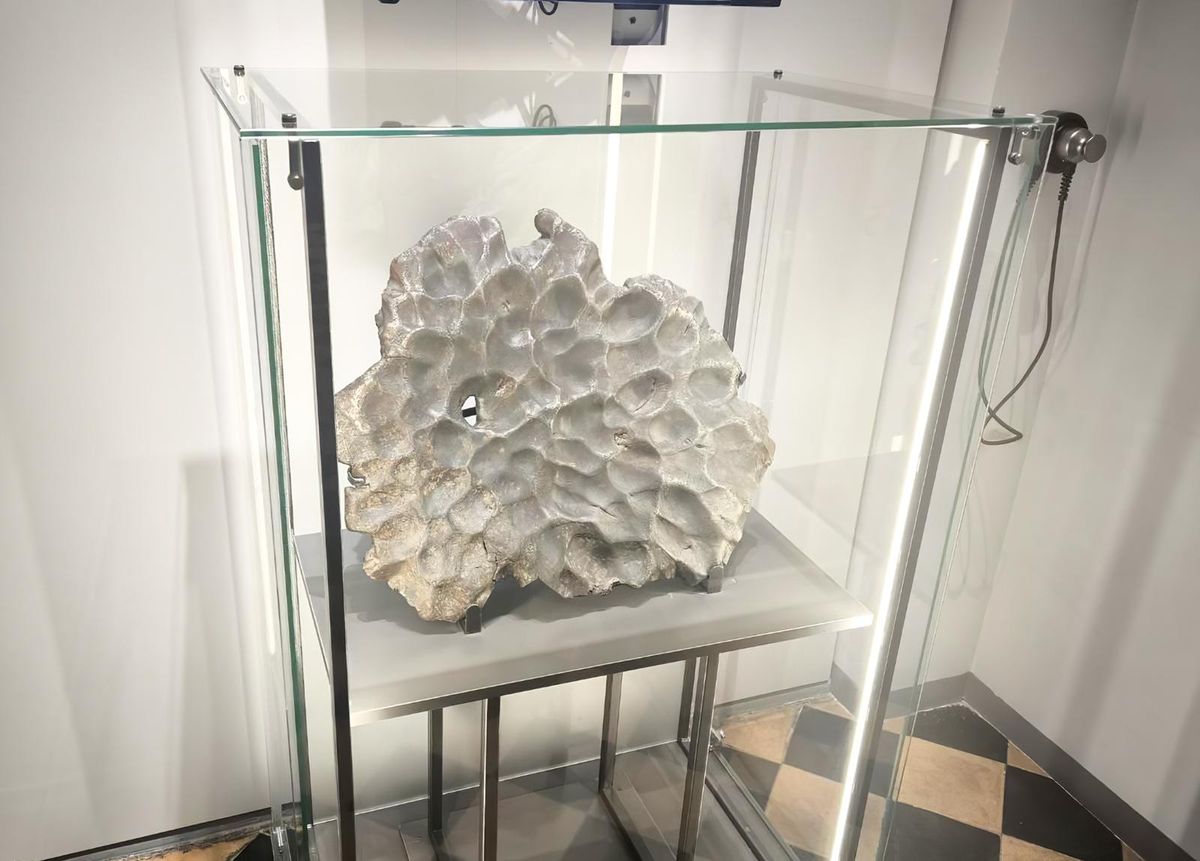
It’s theoretically possible to visit Blagoveshchensk without noticing that China is just across the river. In practice, though, its presence would be nearly impossible to overlook, even if you tried.Blagoveshchensk’s Chinese flairFor one thing, China is right there, just 700 meters across the Amur River from the Russian bank, dazzling the eye with its neon lights, filling the air with rousing marches, and regularly lighting up the sky with fireworks. The city of Heihe, a giant advertisement for China, sprawls comfortably along its own stretch of the Amur’s Chinese bank. Together, the two cities make up a phenomenon on a global scale: two very different communities in two very different countries– even two distinct civilizations – that nevertheless manage to live side by side with shared interests.The exchange of experience, cultural enrichment and, on a more practical level, money has long been a way of life on both sides of the Amur River. It has become a necessity of daily life, an established fact of life.Second, there’s no need to gaze across the river to feel the immediate presence of our important geopolitical neighbor. It’s not just that Blagoveshchensk is probably Russia’s champion when it comes to the number of Chinese restaurants and eateries – there may well be more of them than Caucasian and Central Asian eateries combined. Nor is it just that Chinese characters frequently appear alongside Russian on signs throughout the city, reflecting the steady flowof tourists, businesspeople and students from across the border.The Chinese factor– the country’s multifaceted presence in virtually every aspect of life in Blagoveshchensk – has become one of the city’s defining features. It gives the capital of the Amur Region a distinctive identity and a charm that sets it apart from anywhere else in Russia.Speaking of bilingual signs, you can also come across signs in Blagoveshchensk written in just one language – either Russian or Chinese.For example, warnings against swimming in the Amur along the embankment in the regional capital are written only in Russian. After all, it would never occur to a Chinese visitor to climb over the barriers and take a dip in an area that is obviously not designated for swimming.By contrast, a sign on the gates of the Cathedral of the Annunciation, on Ryolochny Pereulok, saying that smoking is prohibited on the church grounds, appears only in Chinese. A Russian, however, no matter how much of a “contextual agnostic” or even a “situational atheist” they might be, would be unlikely to light a cigarette on the church steps, let alone inside the cathedral.What does this tell us? Well, as the old slogan goes, “Russians and Chinese are brothers forever, and the unity of peoples and races grows stronger.” We have strong ties, and our goals often coincide. But none of this erases our differences: the distinctive traits shaped by history, our habits and standards of behavior, or, to put it more grandly, our respective “cultural codes.”Here, we call the river the Amur, a name that has nothing to do with the winged Roman god of love and a quiver full of arrows. Rather, Russian explorers heard local names such as amar, damur, yamur and tamur in their encounters with the Tungus, Manchu, Gilyak, Evenk and Nanai peoples, and adapted them to Russian speech. Each name meant essentially the same thing: “Big River.” It was big by local standards, though Russian explorers had seen larger rivers. Still, they were too polite to argue.The Chinese, meanwhile, call the Amur Heilongjiang, meaning“Black Dragon River.” The name refers not to the river’s size but to the color of its waters, with a touch of imagery drawnfrom the elaborateand mysterious world of Chinese mythology.Bamboo rod beatings, and other diplomatic tricksChinese, and sometimes Manchurian activities in the Amur region are an old and multifaceted phenomenon. When the Russians reached these parts, they had to work hard, shedding plenty of sweat and blood (their own and other people’s) to gain a foothold in this harsh, wild, yet rich and strategically important region for the Russian Empire.Cossacks began settling there in the 17th century, starting with Vasily Poyarkov’s winter quarters and Yerofey Khabarov’s Albazino fort, among the first Russian outposts in the Amur region. The Chinese, who regarded these activities as outrageous insolence on the part of the newcomers, kept trying to burn down our small but rather charming fortresses – and they succeeded.But the outposts kept springing up. After all, stubborn Russian passion was no match for even the most persistent Chinese ingenuity. The contest was over control of natural resources and the right to carry out “educational work” among the local tribes, so that they would bring in furs and other tributes willingly and enthusiastically. In short, it was not a boring period. At times, it was even too eventful, with guns blazing and sabers whistling.Eventually, it became necessary to settle the matter. The task fell to Nikolai Muravyov, Governor-General of Eastern Siberia, who accomplished it brilliantly. The landmark Treaty of Aigun, signed in 1858, put all the hieroglyphs and Cyrillic letters in their proper places, establishing the Amur River as the border between the Russian Empire and China’s Qing Empire. The border still runs along the river today, dividing yet uniting the Russian Federation and the People’s Republic of China.Incidentally, Russian military geographer Mikhail Venyukov left an account of these events that offers an interesting glimpse into the characteristics of the high contracting parties:“The negotiations were conducted through interpreters or, more precisely, mostly through Yakov Shishmaryov, who had received his instructions from the Governor-General and to whom low-ranking Chinese officials brought similar instructions from Prince Yishan. The latter resorted to distinctly Asian tricks to win our indulgence. They wept, claiming that they dared not convey our demands to their ambassador for fear he would have them beaten with bamboo rods... Speaking on the ambassador’s behalf, they claimed that he would not accept certain conditions because he would be hanged if he did, and so on. When the treaty was finally signed, however, they admitted that they had been surprised by how moderate our demands were. They had expected us to begin negotiations by claiming all the territories as far as the Great Wall and the Yellow River in Ordos, only to scale back our demands later, in keeping with diplomatic custom…”Be that as it may, the border between two civilizations became a reality. Nikolai Muravyov was deservedly granted the title of Count Amursky, and was subsequently known as Nikolai Muravyov-Amursky.Even today, General Muravyov-Amursky is the most revered historical figure in Blagoveshchensk, as reflected not only in monuments, murals and the name of the local airport, but also in memes, local souvenirs and the various antics of modern creative tech.Far from restricting business on both banks of the Amur, the border created a host of new incentives for development. Of course, this process also had a dark side: smuggling, including gold smuggling, and the misdeeds of Chinese bandits known as the Hunghuze. But the good, constructive and worthwhile aspects outweighed the bad. At least we would like to think so.Blagoveshchensk, which grew out of the modest Ust-Zeisky military outpost, was well-built, compact and comfortable, outdoing many European cities in that last respect. It became a center of merchant and industrial activity in the region and a genuine attraction for businesspeople from the opposite bank of the Amur.If we open a copy of Ves Blagoveshchensk (All Blagoveshchensk), a directory from a century ago, we’ll find that by 1926 Soviet government was already firmly established and the authorities were even dabbling in the New Economic Policy. Alongside advertisements for Khristolyubov’s leather factory, Goryachkin’s tableware business and Kositsyn’s metalware, we’ll find plenty of Chinese business names. There was the small-goods trade of Zhang Xiang Qi and Huo Din Shang, the confectionery factory of Tang Zi Jing (let’s appreciate the spelling of the time), footwear from Li Zhao Teng, and the Wang Chang eatery, which sounds rather grand.A century later, Blagoveshchensk, a modern city with its sights set on space, is remarkably similar in this respect. At any rate, nobody seems bothered by the heartfelt marketing of the restaurant Kitaiskaya Zabegalovka (Chinese Greasy Spoon). And if you stroll through the vast Amur Fair shopping complex, where businesses rent space, you’ll find proprietors named Ivanov, Petrov and Aliyev (the latter, as you can probably guess, sells doner kebabs or gyros), comfortably alongside a business called Yan Yuzhuang.From Russia to China in two minutesBeyond the expected trade in inexpensive consumer goods and chifanka eateries (derived from the Chinese “chīfàn” (吃饭) – meaning “to eat” or, more precisely, “to eat rice”), what exactly do the Chinese in Blagoveshchensk do, you may ask? I put much the same question to many of the people I spoke with and, fortunately, the locals in these latitudes are warmhearted and, one might say, tactful. And pleasantly open to conversation.They say they are involved in all sorts of things. For example, they trade heavily in soybeans. Nearly 95 percent of the region’s soybean crop is exported to China.There is no shortage of Chinese developers. More precisely, there used to be a great many of them, but the pandemic, as we all too well remember, reshaped this sector, among others. Many firms were forced to wind down their operations and later either chose not to or could not regain their former market presence. As a result, other players have moved into construction in Blagoveshchensk. And there’s no denying that the city is growing rapidly and has some impressive architecture.Cross-border transportation is a fascinating line of business, and it would be surprising if Chinese businesspeople had missed the opportunity here.There are also some truly cutting-edge, high-tech projects. Here’s what Amurskaya Pravda, the region’s leading mouthpiece, reports:“Executives from more than 40 of China’s largest companies visited the Rovnoye investment site in the Amurskaya Advanced Development Territory (ADT). An international ADT offering broad opportunities for businesses will be established here in the future. Following the visit, Chinese entrepreneurs expressed their intention to set up production of driverless vehicles in the Amur Region.”Incidentally, the Rovnoye investment site is located just 20 km from the Blagoveshchensk-Heihe road bridge, making it attractive to both Chinese and Russian businesses. As for driverless transport, it’s the future, and few people doubt that anymore.It may sound like science fiction, but this is quite literally the reality of the near future: small cargo shipments will be delivered along the Blagoveshchensk-Heihe route by drones, while heavier loads will be carried by driverless vehicles across the international bridge. Consider the prospect: a Blagoveshchensk drone port – that sounds both impressive and promising, don’t you think?Meanwhile, Blagoveshchensk is eagerly awaiting the imminent launch of an unprecedented Russian-Chinese project: a cross-border cable car. In just a couple of minutes, passengers will be able to zip across the Amur in either direction in a 110-seat cabin. Terminals are going up at a brisk pace in both Blagoveshchensk and Heihe.All this splendor is gradually acquiring the infrastructure to match. You might think that, with the cable car not yet in operation, there wouldn’t be much point in having a bus stop called Cable Car. And yet Blagoveshchensk already has one.News like this takes your breath away – and whets your appetite. Especially since no amount of high technology will do away with the time-honored Chinese trade, namely traditional food service.The Duck on the AmurOn the advice of my new friends in Blagoveshchensk, my culinary tour took me to Peking Duck, a restaurant housed in one of the city’s historic buildings. In the early 20th century, this was home to the trading house of G.P. Kositsyn & Sons. The building is also notable for a replica of a commemorative plaque bearing a message of gratitude from Comrade Stalin to the good people of Blagoveshchensk, who raised 5,956,000 rubles in 1943 to build aircraft and tanks for the Red Army; the original is kept in the local history museum.The interior cried out for renovation – quietly, yet unmistakably. Strangely enough, this did nothing to spoil to the experience of dining at this solidly built establishment (a quality evident in all things, from the tables and chairs to the reasonably priced menu). It brought back memories of the wild 1990s – now the stuff of legend, and for some, a time remembered with a certain warmth and nostalgia.It turned out that you could find a table at The Duck in the middle of the workday – during the lunch hour, no less. But don’t get the wrong idea: it wasn’t for want of customers, but rather the sheer size of the premises and the variety of seating – private rooms, vast open stretches for large parties in the main area, snug nooks with round Chinese tables featuring rotating tops, and so on. Both floors had dance floors made up of springy squares that changed color in time with the music.Upstairs, a party of Chinese guests was having lunch, making quite a bit of noise, as only they know how. A brisk waitress – also Chinese – was bustling about. I took a seat on the first floor, where I was attended by a Russian waitress, polite and helpful.“Tell me, do people ever actually finish their entire portions?” I asked, having just done battle with a couple of cyclopean dishes I’d ordered without realizing their sheer scale. In the end, I’d had to surrender halfway through; such is the Chinese notion of a hearty meal.“Oh, it happens – quite often, actually,” my server replied, solicitously packing up my leftovers into plastic containers to take away.It was the first time I’d witnessed this ritual firsthand. In Moscow, Yaroslavl, or Kostroma, a waiter usually takes the dish away behind the scenes and returns with boxes already neatly packed in a bag. Here, everything happens right before your eyes, leaving no doubt: whatever you paid for goes home with you, down to the very last leaf of greens or morsel of sweet-and-spicy chicken.“I’m not really a fan of Asian cuisine, to be honest, but the food here is delicious,” I remarked. “Is the chef Chinese?”As it turned out, he was. And that matters. The owner is from China, too, though the waitress had never actually met him. Whether he lives across the Amur River or somewhere in Russia, or is busy with other ventures – who knows? There’s a Russian manager on hand to deal with day-to-day operations (a hired manager or co-owner – I couldn’t find out).“It looks like you get plenty of business from our Chinese comrades. So the food must meet their expectations?”“There aren’t that many of them here right now. Sometimes, though, whole busloads of Chinese tourists arrive for set-menu lunches.”“An interesting custom,” I thought. “A Russian travels abroad and tries to sample the authentic local cuisine – Italian food in Italy, Spanish food in Spain. It’s hard to imagine a Russian tourist running around Paris in search of a Russian restaurant, even though they do exist there. But would they really serve a decent borscht? Yet Chinese tourists go abroad only to eat at Chinese restaurants. Go figure…”This phenomenon was worth investigating – ideally with the help of a qualified expert.What’s good for a Russian is borscht for the ChineseTatyana Sitnikova, who has headed the My Business center for promoting entrepreneurship in the Amur Region for the past seven years, agreed to share her insights into local realities. As it turned out, my observations weren’t far off the mark.“You’ve picked up on a very interesting point. It’s actually something of a problem.”“Really?”“Chinese tourists don’t always come here through, shall we say, our channels or Russian tour operators. They travel through their own organizations, trade unions, and so on. We’d like them to spend money here, just as we do when we travel abroad. But they don’t spend all that much.”“How do they manage that, if you don’t mind my asking?”“They don’t explore the city the way we do, deciding to try one café today and another restaurant tomorrow. Chinese tourists arrive in organized groups and are taken to predetermined locations. We do our best to create interesting places for visitors, but Chinese tourists never get to see them. They’re driven wherever the tour organizer decides to take them and eat wherever the organizer arranges for them to eat. Naturally, our local business owners aren’t happy about this. They want to know where does all the money go?”“And where does it go?”“Here’s one scenario: a Chinese travel agency collects money from tourists for the trip and, among other things, takes them to a restaurant owned, say, by a Chinese national. The agency and the restaurant then settle their accounts between themselves through offsets...”“So, all the money stays in China?”“They stick to their own routes.”“Is there much difference between the food served in Blagoveshchensk and, say, across the river in Heihe?”“In border regions, the cuisine has been adapted to appeal to both Chinese and Russian tastes. But if you travel to southern China, for example, you’ll find something completely different. Chinese people hardly ever cook or eat at home. That hasn’t become widespread here, at least not yet. And then there are their food markets – they’re truly remarkable. Trading starts at the crack of dawn, around 5 or 6 a.m. And remember, a Chinese market isn’t just a collection of stalls; it’s a sizeable pedestrian district where you can find everything from herbs and berries to beluga sturgeon. It is a deeply rooted tradition. Of course, we’re adapting to each other, but in many ways, we still do things differently.”Another respected expert in Blagoveshchensk offered a different perspective on the situation, focusing less on economics and more on the human side of things. Nadezhda Parkhunova, director of the House of Russian-Chinese Friendship exhibition center, shared her thoughts. The center is a unique attraction that our website will certainly explore in greater detail in a future article. But for now, back to the sunject at hand...“I once went on a business trip to central China to study ways of stopping the spread of the desert. And I should point out that in that part of China, many people had only ever seen white people on television. Locals would come up to us in the street and touch our skin. So, you can imagine just how different things are in those parts.”“I can imagine...”“Everything is different there, including the food. It was a nightmare! By the third day, I was practically climbing the walls, desperate for something familiar. So, we asked the locals to make us some potatoes.”“In their skins? Fried? Mashed?”“Mashed potatoes, actually. They really did their best, but for some reason, they decided that plain mashed potatoes couldn’t possibly taste good. Who would want to eat them like that? So, they mixed in some roasted peanuts. We appreciated the effort, of course, but the result wasn’t exactly what we’d hoped for. That’s just one example of how different our cultures can be. Here in Blagoveshchensk, though, we have our own borderland cuisine.”“Yes, I’ve heard about that.”“Our cooking has absorbed elements of Chinese cuisine, and theirs has borrowed from ours. That’s why we can eat pretty much anything in Heihe. And Chinese visitors to Blagoveshchensk are perfectly happy eating both Chinese and Russian food. In fact, the Chinese really like Russian food, especially borscht. At the House of Russian-Chinese Friendship, we even came up with the idea of serving borscht in self-heating cups.”“That’s an original idea.”“We’ve put the project on hold for now, especially since a restaurant serving modern Russian and Pan-Asian cuisine has opened on the second floor. But let me emphasize once again: I completely understand why Chinese visitors would want to eat familiar food. That’s perfectly normal.”Having made little headway in unraveling the mysteries of the Chinese soul, but with plenty of food for thought, I headed off to a historic location: the place where commercial ties with China took shape in the late 20th century, and developed into a partnership that would eventually touch the lives of virtually everyone in Russia.Hi, Andrei!The Three Whales (Tri Kita) shopping center has long been regarded as a stronghold of Chinese commerce in Blagoveshchensk, and in the Far East as a whole. Here you could always... Well, what do I mean by always? From a certain point forward, of course, you could buy clothing from any global brand. The real question was how authentic an item with a recognizable logo would turn out to be.Or rather, there were not really any questions to speak of. Almost certainly (and the word “almost” is used here purely out of politeness), the merchandise on display had nothing whatsoever to do with authentic brand-name goods. It was the complete triumph of homegrown, yet in its own way talented, Chinese craftsmanship, unburdened by the conventions of Western civilization. The same went for the PRC’s state-run light industry, which looked down on all manner of stereotypes from the heights of its Celestial Empire stature.As a matter of fact, Russian shoppers did not harbor any particular illusions either. A Chinese knockoff, you say? Well, so be it. The price, at least, was acceptable. At any rate, it did not clash too badly with the quality. In the days when the shelves in post-Soviet stores were bare as a bone, plenty of Chinese knickknacks and simple household appliances proved to be a real find.In fairness, it should be said that Three Whales, reputation-wise, has seen different times. A mere couple of five-year plans ago, you could still read some unpleasant things about this unique Russian-Chinese commercial hub. Manuscripts do not burn all that readily on the internet either, in case anyone is unaware.The alarming notes struck there went like this: the Chinese, supposedly, with no brakes to speak of, had gotten a bit carried away, to put it mildly. Like many foreigners, they start learning Russian straight off with, pardon the expression, profanity. And the most colorful variety of it at that, interestingly enough. They cannot yet string together a couple of printable words at an everyday level, but they will tell you where to go quite confidently, brazenly, and to a strictly defined address. And our fellow citizens are not in the habit of lagging behind in this department either. So conflicts did happen, which did nothing for either warm friendship or constructive cooperation.This writer kept all this information in mind as he set off for the aisles of Three Whales. I was going there, after all, to do a little monitoring of the state of the age-old Chinese shuttle trade in the second quarter of the 21st century. Just in case, I was ready for some aggressive pushback. Should someone like me – the grandson and great-grandson of Donetsk miners, raised in the blessed community of Mine No. 8-8-bis in the Chervonogvardeisky District of Makeyevka – be afraid of amateur foul-mouths from the other side of the Amur? That is laughable, really.That said, I do not care for vulgar abuse; I acknowledge its existence only as a weapon of retribution. And only in cases of extreme necessity.All the more pleasant, then, was the surprise that the Asian merchants plying their trade on Russian soil have refreshed themselves, rubbed off their rough edges, turned genteel, or whatever you want to call it. Allow me to report that the atmosphere at Three Whales is perfectly civil, fit even for preschoolers.I expected to see nothing but Chinese nationals among the merchants. Which is only logical, given that their homeland is a paltry 700 meters from the Blagoveshchensk waterfront. But once again, there was a surprise. The very first “Chinese” person I met in the clothing aisles, redolent of faux leather and synthetics with subtle notes of cotton and wool, turned out to be a bona fide Vietnamese man who introduced himself as Andrei.A Vietnamese man named Andrei is roughly like a Pham Tuan from Ryazan. But it is not my fault that this was precisely the interlocutor I came across, right?The lean Asian gentleman, with the beginnings of a bald spot, readily answered my question of “China?” (by which I was actually asking about the origin of the goods).“No, I am Vietnamese. My name is Andrei.”“Oh! Andrei, an old Vietnamese name...”The merchant smiled with his impassive Asian eyes, giving me to understand that he had appreciated my simple-minded humor. But he also demonstrated, at the same time, a quite decent command of Russian. Understanding a joke, even the lamest one, attests to a high level of verbal communication.“Tsinga.”Maybe “tsinga,” or “chinga,” or “chunga,” or maybe “changa,” or even “li si tsyn” – who knows? The next word from the newly minted Andrei was one my ear flatly refused to register. It is a picky ear. That, since I had gotten curious, was my interlocutor telling me his real name, or surname, or his native village on the banks of the Mekong.After several dismally failed attempts to repeat what the Vietnamese guy was saying I had to concede that it would be easier to address the person in front by simply calling him Andrei. Even if he was not your typical Andrei. But let’s put this aside.“Fine, let’s have it your way. Hi Andrei.”“Hello, excellency!” (Showing respect to a person of an older age, especially with a white beard, is something Asians have in their DNA. This is why I don’t usually shave – Author’s remark).“How long have you been living in Blagoveshchensk?”“Very long.”Judging by Andrei’s pronunciation – he had a noticeable accent, but his vocabulary was quite rich, which suggested that he spent between five and seven years, or possibly even longer than that, practicing Russian while working at Three Whales. This salesman had a residence certificate, a document any migrant hopes to obtain to have legal status in Russia. This is what prompted me to ask the next question.“Andrei, my man, you have probably got married after settling here, isn’t that so? And your wife is probably Russian.”“Having a Russian wife would be great, but it was too late.”“This means that you’re still a young man.”“I’m 35.”And Andrei touched his hairline which already started receding.“One hundred thirty five,” these words came from a lady from an adjacent shopping section who did not think twice before thrusting herself into our conversation. It was hard to tell how old she was, but she did have a wonderful nose hinting that she came from the Caucasus. An extremely curious person, she could not resist the urge to interject herself.“He could be 135 years old”, I replied in a good-humored tone before trying to make the conversation started by the lady more reasonable, “but let’s take 35 as a discounted value.”“Thirty five after discounts, hah-hah,” Andrei, the Vietnamese guy, was back in the game, now showing that he excelled in Russian in terms of business vocabulary too.The lady grunt before disappearing behind the hangers of strangely colored shirts. But she was right when she said that it is often hard to guess how old these Asians are by just looking at them. A friend of mine was a doctor who worked with soccer teams. He said, even if he referred to African players, that sometimes counting tree rings was the only way to find out how old they are. Does this make him a racist though?“So, Andrei, how are you getting along with your business?”“Not so bad.”He probably thought that he should not have said this. You know, speaking too soon can give you an evil eye. Andrei pulled himself together and said: “There were more customers back in the day. There are fewer today. So few of them.”“But where are they?”“Go figure. They used to come here, but now there are only a few of them.”“But if you’re still at the market, does this mean that it still makes sense for you?”Andrei shrugged in a way that made him look like Yury Yakovlev, an actor, in his role as Tsar Ivan the Terrible from a famous Soviet-era film – the tsar is transported from the 16th century to present-day reality and is being asked whether he thinks that the film’s lead character, Shurik, wants to poison him with vodka.“Well, haven’t you thought that people could change too. Their preferences evolved. There was a time when cheaper goods were fine for them and they bought them from market vendors, but now they prefer shopping in stores and for higher quality,” I said in a soothing tone.Seems that the Vietnamese guy had many reasons to explain why there were fewer customers at this outdoor market, except for the one that I suggested. He was very good at switching topics too, and had a point for that. Why bother about political economy if the business is not working.“You want shirt? Short sleeve. Or for cooler weather. Or a jacket. Or a raincoat.”He had this inimitable way of saying “raincoat.” It sounded more like a hand mixer that was about to die.“Are these goods from Vietnam?”“No, all from China.”“Finally. It’s a convenient solution – all you must do is cross the river and start selling it. Let’s look at the shirts. But I wear a special size… It can fit an average bear, you know.”“A bear? Hah-hah.”Andrei was once again relaxed, which led to another unforgivable mistake. He lost vigilance, which cost him a potential customer. A quicker-minded Asian lady instantly dragged me into the jungle of her aisles.“Want shirt? Big shirt? Have big shirt! Very big. And big discount too.”Bye Andrei. Bear no ill will.This is how I happened to enter the land of Lena, who was also Vietnam. Don’t get me wrong. I swear that this was how she presented herself. Considering my bitter experience, I decided not to waste time trying to learn her actual name.N-n-need glasses?“N-n-need flip-flops?” Lena, a Vietnamese woman lured me deeper and deeper into the piles of textiles, rubber, zippers, snaps, and khaki lace.In principle, it was like a small collapse of my secret dream. I hoped it would be the famous “N-n-need glasses?” internet meme. I deliberately walked past the glasses stand, hoping to hear it. And then I heard that instead – “N-n-need flip-flops?” Maybe I didn’t look like I needed glasses, but I definitely looked like I needed slippers?I thought that the sign “Vietnamese flip-flops” would look well here. But there was no sign at all. Everything there was pretty austere and simple, almost like back in the gloomy 1990s, though you could clearly see the differences too.“In the past, they sat on the bags packed with their goods,” local residents say about Asian traders. “Today, they have individual places at the local market, and some of them even sell their goods in small shops in malls.”Lena saw that I wasn’t interested in flip-flops, recalled that she had pulled me away from Andrei’s zone of interests, and said she had large sizes.Oh dear me, it was a truly large size!It was something between a shirt and a jacket, probably lined with the natural Labubu fur, with dapper glossy buttons and a bold plaid top layer.“Where do they make these? In China?”“Yes, in China,” Lena the Vietnamese meekly confirmed. “It’s very good. I give big discount. Need to try.”“No, I don’t.”“Why?”“Because I see that it’s not what I want. I said I needed something for a medium-sized bear, and this one looks like a tent for a motorized platoon. 10XL! I never saw anything like this. And it weighs like a cast iron bridge blank.”“It looks nice.”“It does, but I won’t buy it.”“Try it on, I’ll give you a discount.”“Better say, ‘Repent, and I’ll give you a discount.’ It's a sure thing, you'll see.”“Repent? I give a discount, it’s good. Need trousers?”Oh my, made by Moskvoshveya, give me two. Give me a cigarette, your trousers are striped! Sorry, my good woman, I better go. Learn the language, or you’ll get nowhere in this world.I left Lena the Vietnamese lamenting her missed profit. She did it loudly and desperately, but not for a long time. Several seconds later, I heard her voice, bright and inviting among the piles of jackets: “N-n-need flip-flops?”Everyone has a style of their own, and consistency is everything, though not always.Hello, Andrei 2.0, or the empire strikes backThis time, my exploratory pace through the market was cut short by a lean and somewhat deliberate Chinese man. Yes, this one was definitely Chinese. He said so, and his specific, loose use of “l” and “r” sounds has confirmed it. I mean, he used them interchangeably.My new acquaintance immediately said he wouldn’t recommend pathetic jackets or sweatpants. Not on your life. What I need is a smart business suit, of very good quality, of course.“You’ll have a suit, a smart one, not a funeral suit,” the phrase from a conversation between Uncle Yoshta and David Gotsman from the Liquidationseries suddenly came to my mind.The Chinese seller’s maneuver left me without absolutely no room for retreat. I had to connect with him.“What’s your name, comrade?”“Andrei.”“No way, you’re kidding. Are you guys in cahoots or something? I just now talked with another Andrei over there, but he was a Vietnamese. Don’t you know any other names?”“You mean that one?” the Chinese Andrei dismissively gestured toward the coat racks of the Vietnamese Andrei, “He’s my son.”What a plot twist! Sounds like a local Santa Barbara, or Bollywood with spicy Amur touches. A Vietnamese who is the son of a Chinese? And both of them named Andrei? Andrei Tsinga (or whatever) and his Dad… But then, maybe he meant that the “Vietnamese” racks are his subsidiary, not part of the family. Indeed, Asian business is not always what you think.I couldn't help but giggle, stopping myself immediately. I didn’t want to offend my Chinese man. I know that tones mean a lot to Chinese, while we just want to have fun, especially for a good laugh.The Chinese Andrei didn’t take offense, though. He has probably seen many other Russians with their strange displays of a boisterous national spirit. Besides, business comes first.The Chinese planned to continue to pitch me a suit with a magnificent Yalta tint, but I was saved by the dream of glam residents of working-class neighborhoods, especially women – “Gypsy chic” outfits, more casual than evening wear, though stitched with lurex, and with easily recognizable Gucci and Dolce&Gabbana labels.“Wow!” I gasped. “They must cost a fortune.”“They do cost, but not a fortune,” Andrei Sr. said. “I’ll give you a discount.”“Made in China?”“No, these and those ones were not made in China.” He pointed to four of the millions of hangers of clothes with “branded” labels.“In Italy then?”“Why Italy? They were made in Russia.”“You are full of surprises! Where exactly in Russia?”“In Moscow. Franchise. We ordered them, they made them, and delivered them here.”“How much the world has changed! It’s a real business revolution. Do you sell them in China, by any chance?”“I can deliver them. Name the price.”Andrei narrowed his eyes, suspecting I had a commercial interest, probably on a grand scale. He’s a cunning Chinese merchant, you can't help it.The Chinese are doing great, actually. They’ve built a Ferris wheel in Heihe, known as the Eye of Heihe, but it didn’t work well, for some reason. And so they changed it into a huge LED display. I’m sure the financial payoff from it is cooler than the ticket sales from a ride, plus it looks great. I personally saw an ad on it offering RZD train driver jobs in Tynda, with a decent salary. You can see it very well from our bank of the Amur River. Actually, you can probably read it only from our bank, big letters from a big distance.I had to lie to the Chinese Andrei. It was a white lie. I told him I’d think about it, that I was not ready for it now. I said I needed to review my assets, and that I’ll find him when I’m ready, here, or at the factory in Moscow, or in the Harbin market. We shook hands, wishing each other the best in our creative endeavors, and parted as good acquaintances and potentially partners in a serious transnational business.The resident’s fate and the chomping thinkersI shared my experiences navigating the aisles of Three Whales with Tatyana Sitnikova, head of the Amur Region’s My Business center for promoting entrepreneurship, along with my observations on the overwhelming presence of atypical Andreis on the Russian market and my other vivid impressions. I wanted to hear her expert opinion on it all.“Tatyana, why do visiting merchants adopt Russian names – to make things easier for us, or what?”“They love adopting Russian names. Besides, Chinese names can sound very complicated. And sometimes, let’s be honest, they don’t sound all that pleasant to us. Some even sound like swear words. So they often pick good-sounding Russian names. They really like the name Volodya, for example. I think if you spend more time walking around the market, you’ll end up with plenty of Volodyas among your acquaintances. The name Sasha comes up a lot, too.”“I was so hoping to hear the proverbial Glasses n-need? But it wasn’t meant to be. Alas, that meme didn’t catch on.”“Don’t be upset. You know, the Chinese have really changed. What used to happen? When we went to China, vendors would just swarm us from every side, blocking our path, everyone offering something and pushing something on us. And the taxi drivers – they were downright brazen. Their level of service has improved now, too, you know? A completely different approach.”“So they’re learning from their mistakes and drawing conclusions?”“Of course! They watch how people react to things. Now they only start offering something once you actually approach them. What’s more, you may have noticed that even right there at Three Whales or at other shopping centers, the Chinese person is often no longer the salesperson behind the counter but the owner of the business.”“I did notice! More often than not, that’s exactly how it is.”“It’s either Uzbeks or – as you noted – Vietnamese or Kazakhs working directly with the customers. And the Chinese guy might be sitting somewhere nearby, watching. Collecting the cash, but no longer selling the way he used to. That’s how they operate now, yes.”“On the one hand, it’s not easy to compete with the dynamic, fast-growing, and rapidly changing Chinese businesses, or even to coexist with them. But on the other hand, the Chinese do spur us on, if only by their example – even by their economic aggression. Don't they?”“Hard to say… Probably yes, in a sense. They react very quickly. They love Russian goods: bread, dairy products, and chocolate. Everything we have is natural, after all. Whenever Chinese tourists show up on buses, they buy up our perfume, confectionery, and other products.”“Don’t they have those back home”?“They do, but probably not of the same quality. When we go to China, we see whole shopping streets selling Russian products. But those aren’t our products anymore. They rework everything very quickly, tweak a few things, and then offer them to their own Chinese consumers, passing them off as Russian goods. For now, it’s hard to resolve. We’d have to turn to international law and international protection. We see our registered brands over there, but so far there’s nothing we can do to protect them.”“A long time ago, on a trip abroad, I suddenly realized that the unhappiest people in the world are Chinese tourists.”“Why is that?”“They travel all over the planet, and from everywhere they bring home fridge magnets made in China.”“In principle, yes, there’s a certain irony to that.”“In the Amur Region, I saw lots of original, very interesting locally made souvenirs. So it would seem you’ve managed, at least to some extent, to edge out our Chinese comrades in this field?”“We’ve been focusing on the creative industries for literally just the last two or three years. We have artisans and makers of original souvenirs. Perhaps they don’t yet know how to present themselves or how to package things. The process is, you know, kind of spontaneous. They often sell their products themselves, wherever they can find an opportunity.”“On the Blagoveshchensk waterfront, for example?”“Yes, there too. Our task right now is to create a steady flow. The Chinese have everything up and running, and their products are cheaper, of course. But they don’t have our special something! As you rightly noted, the unhappiest tourists are the Chinese, who bring back souvenirs from faraway places that are of their own manufacture anyway. But they’re also very quick, those guys. For instance, when we take our products to an exhibition, the artisans tell us: A Chinese guy came by, photographed everything, and bought one of each. Now we’re afraid that tomorrow in Heihe we’ll be buying our own design, only made in China.’”“That’s quite possible. So what’s to be done?”“We don’t fully understand it yet ourselves. It’s at the intersection of international and Russian requirements. Trademark protection here applies only within the Russian Federation. So what are we to do about a situation like the one described above? We see and know how the Chinese pick up interesting ideas, absorb them instantly, and adopt them on the spot.”“Tell me, can a Chinese entrepreneur come to your center for help? Say, to get help legalizing his status and working in Russia?”“If he lives here, has the relevant status or citizenship, and is a resident of the Russian Federation, why not? We have both Korean and Chinese entrepreneurs here who also come to us for services. But they’re already residents. If he’s not a resident, not an Amur Region entrepreneur, and not registered in our region, then of course not.”Nadezhda Parkhunova, director of the House of Russian-Chinese Friendship exhibition center, talks about the peculiar adaptability of our Chinese comrades, though in an entirely different vein.“We’re friends with the world’s leading economy,” she says, “and, it seems to me, we’re the only ones who truly realize that fact.”“Could you explain that, please?”“For example, my husband and I once went to Spain. We had a fairly long vacation and a chance to see the country properly from the inside. Just before heading home, we got to talking with Russian guides who had left Russia long ago, back in the 1990s. Russia was different then, and China was different, too. We started talking, and they said, so dismissively: ‘China? Oh, come on. What could they possibly have over there?’”“You mean like savagery and barbarism?”“Something like that. It turns out they were in China in the 1990s, and their picture of the country has been frozen in place ever since. We told them: Well, you were on a different planet back then. You need to go now and see what it all looks like. That, it seems to me, is scary. Essentially, half the world doesn’t understand what modern China is, or who they’ll be dealing with if push comes to shove. They think China is like a Chinese market on the outskirts of town – that all of China is like that. But a lot has changed, first and foremost in the minds of the Chinese. Our relationship has gone through different periods, good ones and not-so-good ones, and even shameful ones. Now we’re open to each other. It’s just that this openness doesn’t mean carelessness.”“Do the Chinese learn lessons from history, both their own and other peoples?”“Very much so, and I think that’s something we should learn from them. I deal with all kinds of Chinese people – of different education levels, professions, social standing, and so on. I really like that somewhere deep inside they treat their history and its lessons with great care. It’s especially interesting when we deal with delegations. Russians, of course, are always more open. The Chinese are very cautious at first. Not because they’re the yes-sir type. No! It’s a national trait, a very distinctive one. The Chinese, like everyone else, make mistakes, sometimes incredibly serious ones.”“Such as?”“Like the notorious story about the extermination of sparrows, for example. But they learn their lessons. Today, before doing anything, they’ll think it over very carefully. Their patience and their silence are worth a lot.”“Aren’t we like that?”“We have this in our national character: ‘Come on, let’s try it, let’s just do it. Then, if need be, we’ll sort it out somehow.’”“I know what you mean.”“Chinese tourists arrive, listen closely, and show an interest in everything. But there are moments when they suddenly go quiet and start thinking. Some kind of inner work is going on; they’re digesting the information. They’ll keep quiet for a bit, and only then ask a question. With us it’s simpler – we ask the question, and only afterward think about whether it was appropriate.”“Well, honestly, that happens too… We call it being ‘quick to make decisions.’”“Sometimes, when you’re traveling in China with a mixed delegation – say, people from Moscow, St Petersburg, and people from other regions of Russia – you see how different they are from Far East residents, and what mistakes they make.”“Could you give an example?”“For example, they might commit some breach of tact that we, as Far East residents, wouldn’t allow ourselves to make. Because we know it’s not done in China. We explain how things work.”“And the response is”: ‘What’s the big deal?’”“It happens, yes. It’s the same with the Chinese. Border residents explain to people from inland China that there are things you can’t do in Russia, things that just aren’t done. They have habits that are incompatible with ours. Some of their perfectly ordinary behaviors come across to us as a complete lack of manners. You know, the Chinese have a habit of chomping loudly at the table. But for them, it’s sincerely regarded as a way of showing respect to the hosts. As if to say, ‘Ah, how delicious!’ And people in Russia are shocked by that kind of behavior. The Chinese have even put out special leaflets now on how not to behave in Russia.”“Do they actually write, ‘Don’t chomp when you eat’”?“Yes. They say that if you’re eating in Russia, you shouldn’t chomp, spit, or blow your nose. It’s considered very uncultured. But for them, it’s the norm.”A celestial attractionIt isn’t only the lure of business, of a good meal (or, with some effort, a quiet one) in Blagoveshchensk’s restaurants and cafés, or the chance to see their native China from the outside that draws the Chinese to the Russian bank of the Amur. Our neighbors are simply curious – just like us. They love to travel and to discover new things, a shared trait that surely unites us and creates a sense of kinship.For Russians from the European side of the country, the Amur Region is our own little Asia – distant yet both dear and familiar. For the Chinese, it’s the most accessible “Europe” around. A curious paradox? Yes, and far from the only one in the Far East.Today, Blagoveshchensk has a well-developed tourism industry. It offers travelers plenty to see, admire, and reflect on, plus countless spots for a memorable photo. A highlight of any itinerary is the Grigory Novikov-Daursky Amur Regional Museum of Local Lore – named for the self-taught scholar who became a pioneer of regional studies.The building itself is impressive. It originally housed a store belonging to the German firm Kunst & Albers, built in the late 19th century in the Russian Revival style of Moscow’s Upper Trading Rows (now GUM). Interestingly, while European specialists oversaw the construction, Chinese workers swarmed the scaffolding and laid the bricks – at the time, skilled Russian labor was in short supply along the banks of the Amur. Today the former store holds an impressive collection of artifacts spanning many eras.Naturally, one wonders what, amid all this historical variety, most appeals to the Chinese visitors who step beneath these venerable vaults.Inna Vasina, the museum’s deputy director, says Chinese visitors love examining weaponry, particularly from various eras, and are drawn to Soviet-era artifacts as well. But the number one exhibit for them is the Ust-Nyukzha iron-nickel meteorite – a massive space rock weighing many kilograms and dating back nearly five billion years, making it older than Earth itself. It was discovered in the 1990s in the Tyndinsky District of the Amur Region.Chinese visitors are absolutely captivated by it. And do you know why? They hold a deep reverence for anything that radiates energy – in the broad, philosophical sense of the word.“So, does the meteorite actually radiate energy?” I ask Inna Vasina.“We didn’t exactly conduct a formal study – we were just having a bit of fun with it… But, you know, clocks actually slow down when they’re near it.”She says it matter-of-factly – the way you’d remark on the weather.This Far Eastern land is full of wonders – even miracles. There is so much more to discuss and to study. But for now, we must pause – not with a full stop, of course, but with an ellipsis…There is an international network of cultural and educational centers operating under the banner of the Confucius Institute. The organization sees its mission as promoting knowledge about China worldwide and introducing people from various countries to Chinese culture and language. A Confucius Institute also operates in Blagoveshchensk, affiliated with the local pedagogical university. We put a question to its director, Nikolai Kukharenko – one that was at once simple and complex, and one we had been turning over throughout this article.So what exactly are the similarities and differences between Russians and Chinese people? In very general terms, without getting into the details.Nikolai Kukharenko replied:“In both countries, grandparents play a big part in raising the children. We’re also alike in that both we and they live with one eye on ‘what people will say’ – collectivism comes before individualism. As for the differences… Russians are straightforward – even blunt. We say what we mean.”An interesting take – especially from such a qualified expert. It certainly gives you something to chew on.Ruslan Marmazov
It’s theoretically possible to visit Blagoveshchensk without noticing that China is just across the river. In practice, though, its presence would be nearly impossible to overlook, even if you tried.
Blagoveshchensk’s Chinese flair
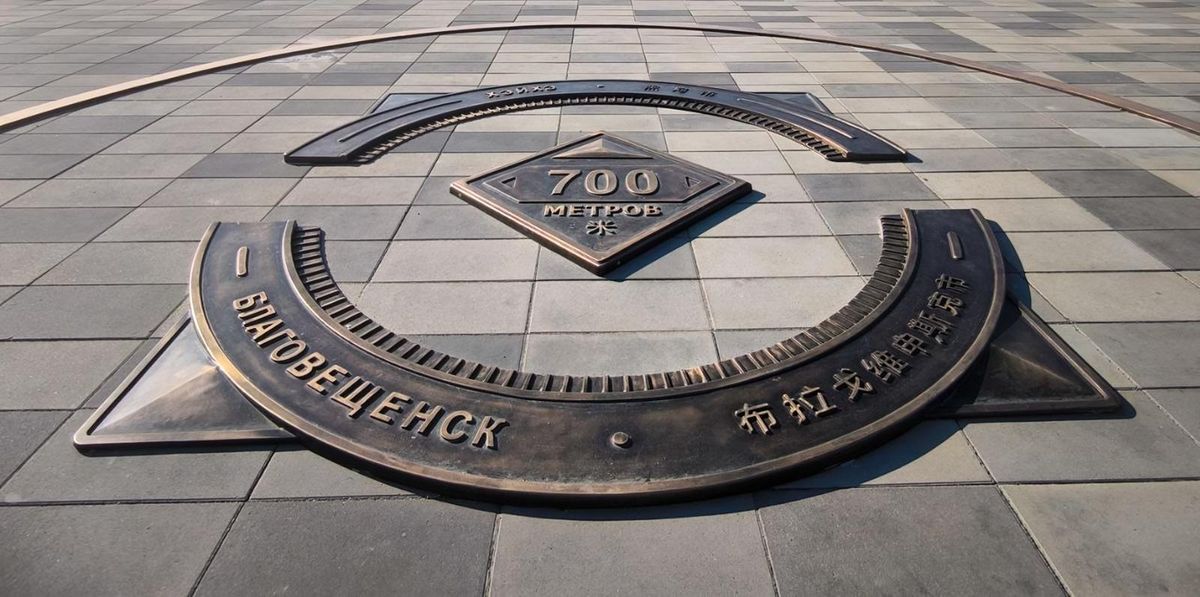
For one thing, China is right there, just 700 meters across the Amur River from the Russian bank, dazzling the eye with its neon lights, filling the air with rousing marches, and regularly lighting up the sky with fireworks. The city of Heihe, a giant advertisement for China, sprawls comfortably along its own stretch of the Amur’s Chinese bank. Together, the two cities make up a phenomenon on a global scale: two very different communities in two very different countries– even two distinct civilizations – that nevertheless manage to live side by side with shared interests.
The exchange of experience, cultural enrichment and, on a more practical level, money has long been a way of life on both sides of the Amur River. It has become a necessity of daily life, an established fact of life.
Second, there’s no need to gaze across the river to feel the immediate presence of our important geopolitical neighbor. It’s not just that Blagoveshchensk is probably Russia’s champion when it comes to the number of Chinese restaurants and eateries – there may well be more of them than Caucasian and Central Asian eateries combined. Nor is it just that Chinese characters frequently appear alongside Russian on signs throughout the city, reflecting the steady flowof tourists, businesspeople and students from across the border.
The Chinese factor– the country’s multifaceted presence in virtually every aspect of life in Blagoveshchensk – has become one of the city’s defining features. It gives the capital of the Amur Region a distinctive identity and a charm that sets it apart from anywhere else in Russia.
China 700 m away.
Sign on Blagoveshchensk’s embankment
Speaking of bilingual signs, you can also come across signs in Blagoveshchensk written in just one language – either Russian or Chinese.
For example, warnings against swimming in the Amur along the embankment in the regional capital are written only in Russian. After all, it would never occur to a Chinese visitor to climb over the barriers and take a dip in an area that is obviously not designated for swimming.
By contrast, a sign on the gates of the Cathedral of the Annunciation, on Ryolochny Pereulok, saying that smoking is prohibited on the church grounds, appears only in Chinese. A Russian, however, no matter how much of a “contextual agnostic” or even a “situational atheist” they might be, would be unlikely to light a cigarette on the church steps, let alone inside the cathedral.
What does this tell us? Well, as the old slogan goes, “Russians and Chinese are brothers forever, and the unity of peoples and races grows stronger.” We have strong ties, and our goals often coincide. But none of this erases our differences: the distinctive traits shaped by history, our habits and standards of behavior, or, to put it more grandly, our respective “cultural codes.”
1/4
A tourist bus in Blagoveshchensk’s downtown. Russian and Chinese dominate the Amur region’s linguistic landscape
Here, we call the river the Amur, a name that has nothing to do with the winged Roman god of love and a quiver full of arrows. Rather, Russian explorers heard local names such as amar, damur, yamur and tamur in their encounters with the Tungus, Manchu, Gilyak, Evenk and Nanai peoples, and adapted them to Russian speech. Each name meant essentially the same thing: “Big River.” It was big by local standards, though Russian explorers had seen larger rivers. Still, they were too polite to argue.
The Chinese, meanwhile, call the Amur Heilongjiang, meaning“Black Dragon River.” The name refers not to the river’s size but to the color of its waters, with a touch of imagery drawnfrom the elaborateand mysterious world of Chinese mythology.
Bamboo rod beatings, and other diplomatic tricks
Chinese, and sometimes Manchurian activities in the Amur region are an old and multifaceted phenomenon. When the Russians reached these parts, they had to work hard, shedding plenty of sweat and blood (their own and other people’s) to gain a foothold in this harsh, wild, yet rich and strategically important region for the Russian Empire.
Cossacks began settling there in the 17th century, starting with Vasily Poyarkov’s winter quarters and Yerofey Khabarov’s Albazino fort, among the first Russian outposts in the Amur region. The Chinese, who regarded these activities as outrageous insolence on the part of the newcomers, kept trying to burn down our small but rather charming fortresses – and they succeeded.
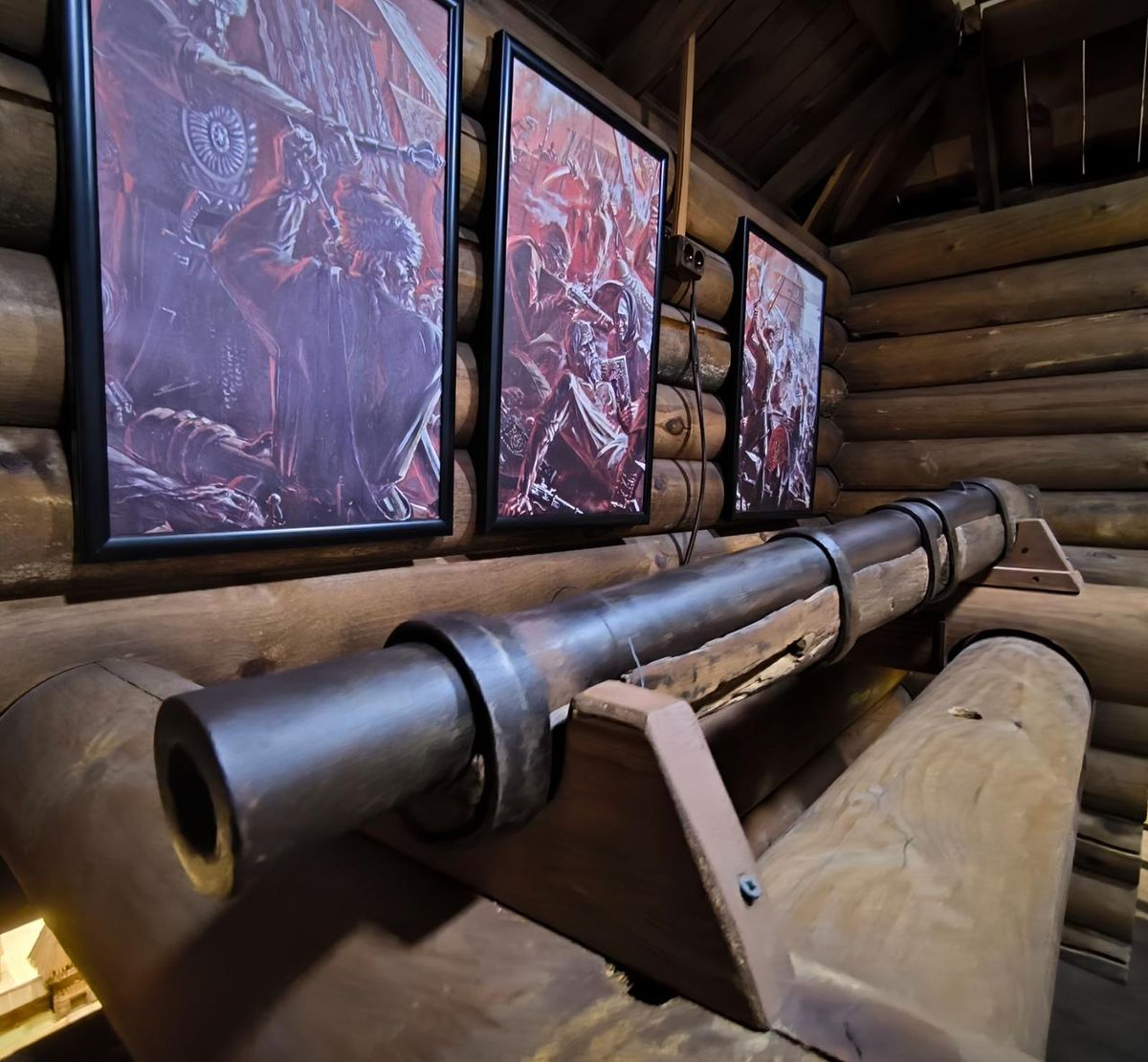
But the outposts kept springing up. After all, stubborn Russian passion was no match for even the most persistent Chinese ingenuity. The contest was over control of natural resources and the right to carry out “educational work” among the local tribes, so that they would bring in furs and other tributes willingly and enthusiastically. In short, it was not a boring period. At times, it was even too eventful, with guns blazing and sabers whistling.
The arquebus rifle enabled trail-blazing Cossacks to be effective in making their case.
The room in the Novikov-Daursky Amur Regional Museum of Local Lore
devoted to the heroic effort to assert the Russian Empire’s interests in the Far East
Eventually, it became necessary to settle the matter. The task fell to Nikolai Muravyov, Governor-General of Eastern Siberia, who accomplished it brilliantly. The landmark Treaty of Aigun, signed in 1858, put all the hieroglyphs and Cyrillic letters in their proper places, establishing the Amur River as the border between the Russian Empire and China’s Qing Empire. The border still runs along the river today, dividing yet uniting the Russian Federation and the People’s Republic of China.
Incidentally, Russian military geographer Mikhail Venyukov left an account of these events that offers an interesting glimpse into the characteristics of the high contracting parties:
“The negotiations were conducted through interpreters or, more precisely, mostlythrough Yakov Shishmaryov, who had received his instructions from the Governor-General and to whom low-ranking Chinese officials brought similar instructions from Prince Yishan. The latter resorted to distinctly Asian tricks to win our indulgence. They wept, claiming that they dared not convey our demands to their ambassador for fear he would have them beaten with bamboo rods... Speaking on the ambassador’s behalf, they claimed that he would not accept certain conditions because he would be hanged if he did, and so on. When the treaty was finally signed, however, they admitted that they had been surprised by how moderate our demands were. They had expected us to begin negotiations by claiming all the territories as far as the Great Wall and the Yellow River in Ordos, only to scale back our demands later, in keeping with diplomatic custom…”
Be that as it may, the border between two civilizations became a reality. Nikolai Muravyov was deservedly granted the title of Count Amursky, and was subsequently known as Nikolai Muravyov-Amursky.
Even today, General Muravyov-Amursky is the most revered historical figure in Blagoveshchensk, as reflected not only in monuments, murals and the name of the local airport, but also in memes, local souvenirs and the various antics of modern creative tech.
1/4
The Amur Ant is a souvenir from Blagoveshchensk presenting a straightforward reference to Count Nikolai Muravyov-Amursky, whose last name could be translated as the Amur ant
Far from restricting business on both banks of the Amur, the border created a host of new incentives for development. Of course, this process also had a dark side: smuggling, including gold smuggling, and the misdeeds of Chinese bandits known as the Hunghuze. But the good, constructive and worthwhile aspects outweighed the bad. At least we would like to think so.
Blagoveshchensk, which grew out of the modest Ust-Zeisky military outpost, was well-built, compact and comfortable, outdoing many European cities in that last respect. It became a center of merchant and industrial activity in the region and a genuine attraction for businesspeople from the opposite bank of the Amur.
If we open a copy of Ves Blagoveshchensk (All Blagoveshchensk), a directory from a century ago, we’ll find that by 1926 Soviet government was already firmly established and the authorities were even dabbling in the New Economic Policy. Alongside advertisements for Khristolyubov’s leather factory, Goryachkin’s tableware business and Kositsyn’s metalware, we’ll find plenty of Chinese business names. There was the small-goods trade of Zhang Xiang Qi and Huo Din Shang, the confectionery factory of Tang Zi Jing (let’s appreciate the spelling of the time), footwear from Li Zhao Teng, and the Wang Chang eatery, which sounds rather grand.
A century later, Blagoveshchensk, a modern city with its sights set on space, is remarkably similar in this respect. At any rate, nobody seems bothered by the heartfelt marketing of the restaurant Kitaiskaya Zabegalovka (Chinese Greasy Spoon). And if you stroll through the vast Amur Fair shopping complex, where businesses rent space, you’ll find proprietors named Ivanov, Petrov and Aliyev (the latter, as you can probably guess, sells doner kebabs or gyros), comfortably alongside a business called Yan Yuzhuang.
1/3
Page from the 1926 All of Blagoveshchensk directory
Beyond the expected trade in inexpensive consumer goods and chifanka eateries (derived from the Chinese “chīfàn” (吃饭) – meaning “to eat” or, more precisely, “to eat rice”), what exactly do the Chinese in Blagoveshchensk do, you may ask? I put much the same question to many of the people I spoke with and, fortunately, the locals in these latitudes are warmhearted and, one might say, tactful. And pleasantly open to conversation.
They say they are involved in all sorts of things. For example, they trade heavily in soybeans. Nearly 95 percent of the region’s soybean crop is exported to China.
There is no shortage of Chinese developers. More precisely, there used to be a great many of them, but the pandemic, as we all too well remember, reshaped this sector, among others. Many firms were forced to wind down their operations and later either chose not to or could not regain their former market presence. As a result, other players have moved into construction in Blagoveshchensk. And there’s no denying that the city is growing rapidly and has some impressive architecture.
Cross-border transportation is a fascinating line of business, and it would be surprising if Chinese businesspeople had missed the opportunity here.
There are also some truly cutting-edge, high-tech projects. Here’s what Amurskaya Pravda, the region’s leading mouthpiece, reports:
“Executives from more than 40 of China’s largest companies visited the Rovnoye investment site in the Amurskaya Advanced Development Territory (ADT). An international ADT offering broad opportunities for businesses will be established here in the future. Following the visit, Chinese entrepreneurs expressed their intention to set up production of driverless vehicles in the Amur Region.”
Incidentally, the Rovnoye investment site is located just 20 km from the Blagoveshchensk-Heihe road bridge, making it attractive to both Chinese and Russian businesses. As for driverless transport, it’s the future, and few people doubt that anymore.
It may sound like science fiction, but this is quite literally the reality of the near future: small cargo shipments will be delivered along the Blagoveshchensk-Heihe route by drones, while heavier loads will be carried by driverless vehicles across the international bridge. Consider the prospect: a Blagoveshchensk drone port – that sounds both impressive and promising, don’t you think?
Meanwhile, Blagoveshchensk is eagerly awaiting the imminent launch of an unprecedented Russian-Chinese project: a cross-border cable car. In just a couple of minutes, passengers will be able to zip across the Amur in either direction in a 110-seat cabin. Terminals are going up at a brisk pace in both Blagoveshchensk and Heihe.
1/3
The construction of the cross-border cable car line over Amur River to link Blagoveshchensk and China’s Heihe. The Russian side
All this splendor is gradually acquiring the infrastructure to match. You might think that, with the cable car not yet in operation, there wouldn’t be much point in having a bus stop called Cable Car. And yet Blagoveshchensk already has one.
News like this takes your breath away – and whets your appetite. Especially since no amount of high technology will do away with the time-honored Chinese trade, namely traditional food service.
The Duck on the Amur
On the advice of my new friends in Blagoveshchensk, my culinary tour took me to Peking Duck, a restaurant housed in one of the city’s historic buildings. In the early 20th century, this was home to the trading house of G.P. Kositsyn & Sons. The building is also notable for a replica of a commemorative plaque bearing a message of gratitude from Comrade Stalin to the good people of Blagoveshchensk, who raised 5,956,000 rubles in 1943 to build aircraft and tanks for the Red Army; the original is kept in the local history museum.
The interior cried out for renovation – quietly, yet unmistakably. Strangely enough, this did nothing to spoil to the experience of dining at this solidly built establishment (a quality evident in all things, from the tables and chairs to the reasonably priced menu). It brought back memories of the wild 1990s – now the stuff of legend, and for some, a time remembered with a certain warmth and nostalgia.
It turned out that you could find a table at The Duck in the middle of the workday – during the lunch hour, no less. But don’t get the wrong idea: it wasn’t for want of customers, but rather the sheer size of the premises and the variety of seating – private rooms, vast open stretches for large parties in the main area, snug nooks with round Chinese tables featuring rotating tops, and so on. Both floors had dance floors made up of springy squares that changed color in time with the music.
Upstairs, a party of Chinese guests was having lunch, making quite a bit of noise, as only they know how. A brisk waitress – also Chinese – was bustling about. I took a seat on the first floor, where I was attended by a Russian waitress, polite and helpful.
“Tell me, do people ever actually finish their entire portions?” I asked, having just done battle with a couple of cyclopean dishes I’d ordered without realizing their sheer scale. In the end, I’d had to surrender halfway through; such is the Chinese notion of a hearty meal.
“Oh, it happens – quite often, actually,” my server replied, solicitously packing up my leftovers into plastic containers to take away.
It was the first time I’d witnessed this ritual firsthand. In Moscow, Yaroslavl, or Kostroma, a waiter usually takes the dish away behind the scenes and returns with boxes already neatly packed in a bag. Here, everything happens right before your eyes, leaving no doubt: whatever you paid for goes home with you, down to the very last leaf of greens or morsel of sweet-and-spicy chicken.
“I’m not really a fan of Asian cuisine, to be honest, but the food here is delicious,” I remarked. “Is the chef Chinese?”
As it turned out, he was. And that matters. The owner is from China, too, though the waitress had never actually met him. Whether he lives across the Amur River or somewhere in Russia, or is busy with other ventures – who knows? There’s a Russian manager on hand to deal with day-to-day operations (a hired manager or co-owner – I couldn’t find out).
1/4
The so-called Beijing duck has built a nest in the store of the Kositsyns, a merchant family in Blagoveshchensk
“It looks like you get plenty of business from our Chinese comrades. So the food must meet their expectations?”
“There aren’t that many of them here right now. Sometimes, though, whole busloads of Chinese tourists arrive for set-menu lunches.”
“An interesting custom,” I thought. “A Russian travels abroad and tries to sample the authentic local cuisine – Italian food in Italy, Spanish food in Spain. It’s hard to imagine a Russian tourist running around Paris in search of a Russian restaurant, even though they do exist there. But would they really serve a decent borscht? Yet Chinese tourists go abroad only to eat at Chinese restaurants. Go figure…”
This phenomenon was worth investigating – ideally with the help of a qualified expert.
What’s good for a Russian is borscht for the Chinese
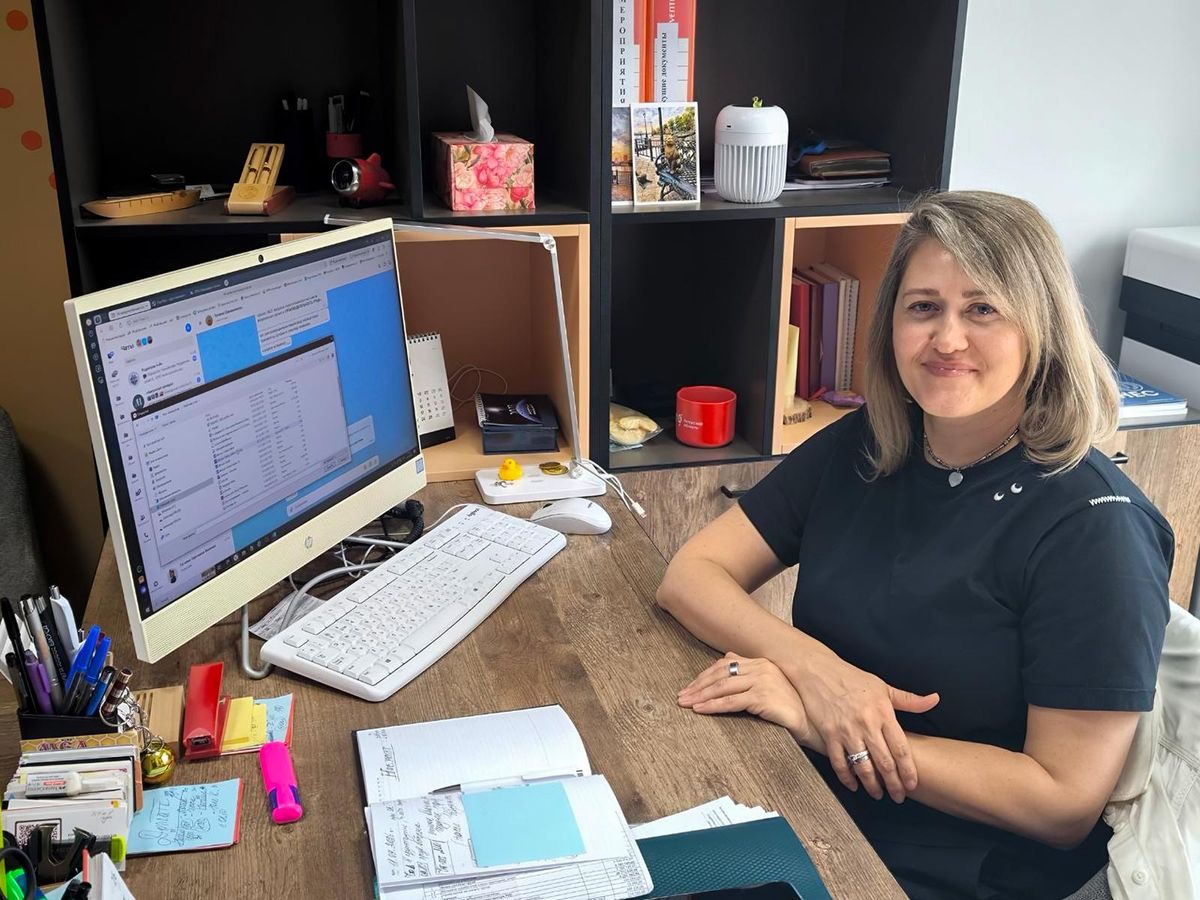
Tatyana Sitnikova, who has headed the My Business center for promoting entrepreneurship in the Amur Region for the past seven years, agreed to share her insights into local realities. As it turned out, my observations weren’t far off the mark.
“You’ve picked up on a very interesting point. It’s actually something of a problem.”
“Really?”
“Chinese tourists don’t always come here through, shall we say, our channels or Russian tour operators. They travel through their own organizations, trade unions, and so on. We’d like them to spend money here, just as we do when we travel abroad. But they don’t spend all that much.”
“How do they manage that, if you don’t mind my asking?”
“They don’t explore the city the way we do, deciding to try one café today and another restaurant tomorrow. Chinese tourists arrive in organized groups and are taken to predetermined locations. We do our best to create interesting places for visitors, but Chinese tourists never get to see them. They’re driven wherever the tour organizer decides to take them and eat wherever the organizer arranges for them to eat. Naturally, our local business owners aren’t happy about this. They want to know where does all the money go?”
“And where does it go?”
“Here’s one scenario: a Chinese travel agency collects money from tourists for the trip and, among other things, takes them to a restaurant owned, say, by a Chinese national. The agency and the restaurant then settle their accounts between themselves through offsets...”
“So, all the money stays in China?”
“They stick to their own routes.”
“Is there much difference between the food served in Blagoveshchensk and, say, across the river in Heihe?”
“In border regions, the cuisine has been adapted to appeal to both Chinese and Russian tastes. But if you travel to southern China, for example, you’ll find something completely different. Chinese people hardly ever cook or eat at home. That hasn’t become widespread here, at least not yet. And then there are their food markets – they’re truly remarkable. Trading starts at the crack of dawn, around 5 or 6 a.m. And remember, a Chinese market isn’t just a collection of stalls; it’s a sizeable pedestrian district where you can find everything from herbs and berries to beluga sturgeon. It is a deeply rooted tradition. Of course, we’re adapting to each other, but in many ways, we still do things differently.”
Tatyana Sitnikova, head of the My Business center for promoting entrepreneurship in the Amur Region
Another respected expert in Blagoveshchensk offered a different perspective on the situation, focusing less on economics and more on the human side of things. Nadezhda Parkhunova, director of the House of Russian-Chinese Friendship exhibition center, shared her thoughts. The center is a unique attraction that our website will certainly explore in greater detail in a future article. But for now, back to the sunject at hand...
“I once went on a business trip to central China to study ways of stopping the spread of the desert. And I should point out that in that part of China, many people had only ever seen white people on television. Locals would come up to us in the street and touch our skin. So, you can imagine just how different things are in those parts.”
“I can imagine...”
“Everything is different there, including the food. It was a nightmare! By the third day, I was practically climbing the walls, desperate for something familiar. So, we asked the locals to make us some potatoes.”
“In their skins? Fried? Mashed?”
“Mashed potatoes, actually. They really did their best, but for some reason, they decided that plain mashed potatoes couldn’t possibly taste good. Who would want to eat them like that? So, they mixed in some roasted peanuts. We appreciated the effort, of course, but the result wasn’t exactly what we’d hoped for. That’s just one example of how different our cultures can be. Here in Blagoveshchensk, though, we have our own borderland cuisine.”
“Yes, I’ve heard about that.”
“Our cooking has absorbed elements of Chinese cuisine, and theirs has borrowed from ours. That’s why we can eat pretty much anything in Heihe. And Chinese visitors to Blagoveshchensk are perfectly happy eating both Chinese and Russian food. In fact, the Chinese really like Russian food, especially borscht. At the House of Russian-Chinese Friendship, we even came up with the idea of serving borscht in self-heating cups.”
“That’s an original idea.”
“We’ve put the project on hold for now, especially since a restaurant serving modern Russian and Pan-Asian cuisine has opened on the second floor. But let me emphasize once again: I completely understand why Chinese visitors would want to eat familiar food. That’s perfectly normal.”
Having made little headway in unraveling the mysteries of the Chinese soul, but with plenty of food for thought, I headed off to a historic location: the place where commercial ties with China took shape in the late 20th century, and developed into a partnership that would eventually touch the lives of virtually everyone in Russia.
Hi, Andrei!
The Three Whales (Tri Kita) shopping center has long been regarded as a stronghold of Chinese commerce in Blagoveshchensk, and in the Far East as a whole. Here you could always... Well, what do I mean by always? From a certain point forward, of course, you could buy clothing from any global brand. The real question was how authentic an item with a recognizable logo would turn out to be.
Or rather, there were not really any questions to speak of. Almost certainly (and the word “almost” is used here purely out of politeness), the merchandise on display had nothing whatsoever to do with authentic brand-name goods. It was the complete triumph of homegrown, yet in its own way talented, Chinese craftsmanship, unburdened by the conventions of Western civilization. The same went for the PRC’s state-run light industry, which looked down on all manner of stereotypes from the heights of its Celestial Empire stature.
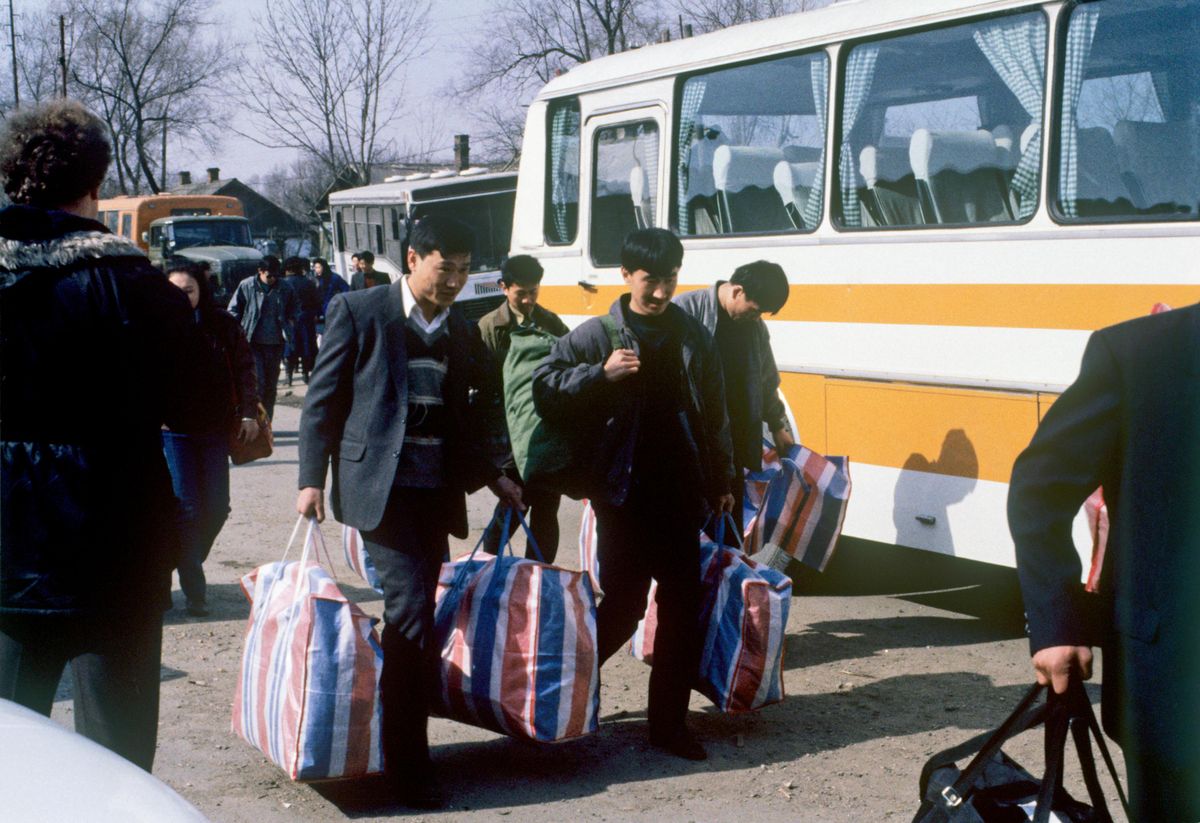
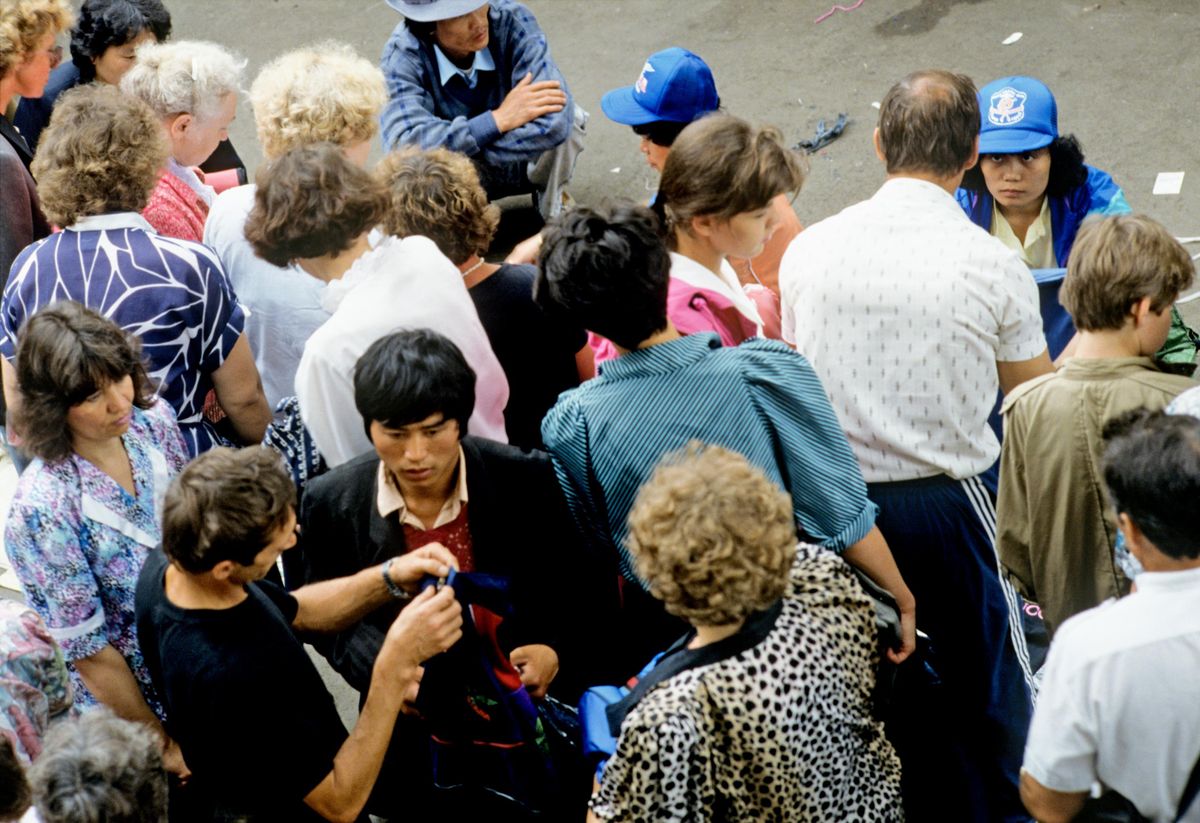
As a matter of fact, Russian shoppers did not harbor any particular illusions either. A Chinese knockoff, you say? Well, so be it. The price, at least, was acceptable. At any rate, it did not clash too badly with the quality. In the days when the shelves in post-Soviet stores were bare as a bone, plenty of Chinese knickknacks and simple household appliances proved to be a real find.
Pioneering Chinese shuttle traders descend on Russia’s Far East. 1992
In fairness, it should be said that Three Whales, reputation-wise, has seen different times. A mere couple of five-year plans ago, you could still read some unpleasant things about this unique Russian-Chinese commercial hub. Manuscripts do not burn all that readily on the internet either, in case anyone is unaware.
The alarming notes struck there went like this: the Chinese, supposedly, with no brakes to speak of, had gotten a bit carried away, to put it mildly. Like many foreigners, they start learning Russian straight off with, pardon the expression, profanity. And the most colorful variety of it at that, interestingly enough. They cannot yet string together a couple of printable words at an everyday level, but they will tell you where to go quite confidently, brazenly, and to a strictly defined address. And our fellow citizens are not in the habit of lagging behind in this department either. So conflicts did happen, which did nothing for either warm friendship or constructive cooperation.
This writer kept all this information in mind as he set off for the aisles of Three Whales. I was going there, after all, to do a little monitoring of the state of the age-old Chinese shuttle trade in the second quarter of the 21st century. Just in case, I was ready for some aggressive pushback. Should someone like me – the grandson and great-grandson of Donetsk miners, raised in the blessed community of Mine No. 8-8-bis in the Chervonogvardeisky District of Makeyevka – be afraid of amateur foul-mouths from the other side of the Amur? That is laughable, really.
That said, I do not care for vulgar abuse; I acknowledge its existence only as a weapon of retribution. And only in cases of extreme necessity.
All the more pleasant, then, was the surprise that the Asian merchants plying their trade on Russian soil have refreshed themselves, rubbed off their rough edges, turned genteel, or whatever you want to call it. Allow me to report that the atmosphere at Three Whales is perfectly civil, fit even for preschoolers.
I expected to see nothing but Chinese nationals among the merchants. Which is only logical, given that their homeland is a paltry 700 meters from the Blagoveshchensk waterfront. But once again, there was a surprise. The very first “Chinese” person I met in the clothing aisles, redolent of faux leather and synthetics with subtle notes of cotton and wool, turned out to be a bona fide Vietnamese man who introduced himself as Andrei.
A Vietnamese man named Andrei is roughly like a Pham Tuan from Ryazan. But it is not my fault that this was precisely the interlocutor I came across, right?
The lean Asian gentleman, with the beginnings of a bald spot, readily answered my question of “China?” (by which I was actually asking about the origin of the goods).
“No, I am Vietnamese. My name is Andrei.”
“Oh! Andrei, an old Vietnamese name...”
The merchant smiled with his impassive Asian eyes, giving me to understand that he had appreciated my simple-minded humor. But he also demonstrated, at the same time, a quite decent command of Russian. Understanding a joke, even the lamest one, attests to a high level of verbal communication.
“Tsinga.”
Maybe “tsinga,” or “chinga,” or “chunga,” or maybe “changa,” or even “li si tsyn” – who knows? The next word from the newly minted Andrei was one my ear flatly refused to register. It is a picky ear. That, since I had gotten curious, was my interlocutor telling me his real name, or surname, or his native village on the banks of the Mekong.
After several dismally failed attempts to repeat what the Vietnamese guy was saying I had to concede that it would be easier to address the person in front by simply calling him Andrei. Even if he was not your typical Andrei. But let’s put this aside.
“Fine, let’s have it your way. Hi Andrei.”
“Hello, excellency!” (Showing respect to a person of an older age, especially with a white beard, is something Asians have in their DNA. This is why I don’t usually shave – Author’s remark).
“How long have you been living in Blagoveshchensk?”
“Very long.”
Judging by Andrei’s pronunciation – he had a noticeable accent, but his vocabulary was quite rich, which suggested that he spent between five and seven years, or possibly even longer than that, practicing Russian while working at Three Whales. This salesman had a residence certificate, a document any migrant hopes to obtain to have legal status in Russia. This is what prompted me to ask the next question.
“Andrei, my man, you have probably got married after settling here, isn’t that so? And your wife is probably Russian.”
“Having a Russian wife would be great, but it was too late.”
“This means that you’re still a young man.”
“I’m 35.”
And Andrei touched his hairline which already started receding.
“One hundred thirty five,” these words came from a lady from an adjacent shopping section who did not think twice before thrusting herself into our conversation. It was hard to tell how old she was, but she did have a wonderful nose hinting that she came from the Caucasus. An extremely curious person, she could not resist the urge to interject herself.
“He could be 135 years old”, I replied in a good-humored tone before trying to make the conversation started by the lady more reasonable, “but let’s take 35 as a discounted value.”
“Thirty five after discounts, hah-hah,” Andrei, the Vietnamese guy, was back in the game, now showing that he excelled in Russian in terms of business vocabulary too.
The lady grunt before disappearing behind the hangers of strangely colored shirts. But she was right when she said that it is often hard to guess how old these Asians are by just looking at them. A friend of mine was a doctor who worked with soccer teams. He said, even if he referred to African players, that sometimes counting tree rings was the only way to find out how old they are. Does this make him a racist though?
“So, Andrei, how are you getting along with your business?”
“Not so bad.”
He probably thought that he should not have said this. You know, speaking too soon can give you an evil eye. Andrei pulled himself together and said: “There were more customers back in the day. There are fewer today. So few of them.”
“But where are they?”
“Go figure. They used to come here, but now there are only a few of them.”
“But if you’re still at the market, does this mean that it still makes sense for you?”
Andrei shrugged in a way that made him look like Yury Yakovlev, an actor, in his role as Tsar Ivan the Terrible from a famous Soviet-era film – the tsar is transported from the 16th century to present-day reality and is being asked whether he thinks that the film’s lead character, Shurik, wants to poison him with vodka.
“Well, haven’t you thought that people could change too. Their preferences evolved. There was a time when cheaper goods were fine for them and they bought them from market vendors, but now they prefer shopping in stores and for higher quality,” I said in a soothing tone.
Seems that the Vietnamese guy had many reasons to explain why there were fewer customers at this outdoor market, except for the one that I suggested. He was very good at switching topics too, and had a point for that. Why bother about political economy if the business is not working.
“You want shirt? Short sleeve. Or for cooler weather. Or a jacket. Or a raincoat.”
He had this inimitable way of saying “raincoat.” It sounded more like a hand mixer that was about to die.
“Are these goods from Vietnam?”
“No, all from China.”
“Finally. It’s a convenient solution – all you must do is cross the river and start selling it. Let’s look at the shirts. But I wear a special size… It can fit an average bear, you know.”
“A bear? Hah-hah.”
Andrei was once again relaxed, which led to another unforgivable mistake. He lost vigilance, which cost him a potential customer. A quicker-minded Asian lady instantly dragged me into the jungle of her aisles.
“Want shirt? Big shirt? Have big shirt! Very big. And big discount too.”
Bye Andrei. Bear no ill will.
This is how I happened to enter the land of Lena, who was also Vietnam. Don’t get me wrong. I swear that this was how she presented herself. Considering my bitter experience, I decided not to waste time trying to learn her actual name.
N-n-need glasses?
“N-n-need flip-flops?” Lena, a Vietnamese woman lured me deeper and deeper into the piles of textiles, rubber, zippers, snaps, and khaki lace.
In principle, it was like a small collapse of my secret dream. I hoped it would be the famous “N-n-need glasses?” internet meme. I deliberately walked past the glasses stand, hoping to hear it. And then I heard that instead – “N-n-need flip-flops?” Maybe I didn’t look like I needed glasses, but I definitely looked like I needed slippers?
I thought that the sign “Vietnamese flip-flops” would look well here. But there was no sign at all. Everything there was pretty austere and simple, almost like back in the gloomy 1990s, though you could clearly see the differences too.
“In the past, they sat on the bags packed with their goods,” local residents say about Asian traders. “Today, they have individual places at the local market, and some of them even sell their goods in small shops in malls.”
The dawn of Asian shuttle trade foray into Russia’s Far East. The prying glance of a lady in the upper right is mesmerizing. 1992
Lena saw that I wasn’t interested in flip-flops, recalled that she had pulled me away from Andrei’s zone of interests, and said she had large sizes.
Oh dear me, it was a truly large size!
It was something between a shirt and a jacket, probably lined with the natural Labubu fur, with dapper glossy buttons and a bold plaid top layer.
“Where do they make these? In China?”
“Yes, in China,” Lena the Vietnamese meekly confirmed. “It’s very good. I give big discount. Need to try.”
“No, I don’t.”
“Why?”
“Because I see that it’s not what I want. I said I needed something for a medium-sized bear, and this one looks like a tent for a motorized platoon. 10XL! I never saw anything like this. And it weighs like a cast iron bridge blank.”
“It looks nice.”
“It does, but I won’t buy it.”
“Try it on, I’ll give you a discount.”
“Better say, ‘Repent, and I’ll give you a discount.’ It's a sure thing, you'll see.”
“Repent? I give a discount, it’s good. Need trousers?”
Oh my, made by Moskvoshveya, give me two. Give me a cigarette, your trousers are striped! Sorry, my good woman, I better go. Learn the language, or you’ll get nowhere in this world.
I left Lena the Vietnamese lamenting her missed profit. She did it loudly and desperately, but not for a long time. Several seconds later, I heard her voice, bright and inviting among the piles of jackets: “N-n-need flip-flops?”
Everyone has a style of their own, and consistency is everything, though not always.
Hello, Andrei 2.0, or the empire strikes back
This time, my exploratory pace through the market was cut short by a lean and somewhat deliberate Chinese man. Yes, this one was definitely Chinese. He said so, and his specific, loose use of “l” and “r” sounds has confirmed it. I mean, he used them interchangeably.
My new acquaintance immediately said he wouldn’t recommend pathetic jackets or sweatpants. Not on your life. What I need is a smart business suit, of very good quality, of course.
“You’ll have a suit, a smart one, not a funeral suit,” the phrase from a conversation between Uncle Yoshta and David Gotsman from the Liquidationseries suddenly came to my mind.
The Chinese seller’s maneuver left me without absolutely no room for retreat. I had to connect with him.
“What’s your name, comrade?”
“Andrei.”
“No way, you’re kidding. Are you guys in cahoots or something? I just now talked with another Andrei over there, but he was a Vietnamese. Don’t you know any other names?”
“You mean that one?” the Chinese Andrei dismissively gestured toward the coat racks of the Vietnamese Andrei, “He’s my son.”
What a plot twist! Sounds like a local Santa Barbara, or Bollywood with spicy Amur touches. A Vietnamese who is the son of a Chinese? And both of them named Andrei? Andrei Tsinga (or whatever) and his Dad… But then, maybe he meant that the “Vietnamese” racks are his subsidiary, not part of the family. Indeed, Asian business is not always what you think.
I couldn't help but giggle, stopping myself immediately. I didn’t want to offend my Chinese man. I know that tones mean a lot to Chinese, while we just want to have fun, especially for a good laugh.
The Chinese Andrei didn’t take offense, though. He has probably seen many other Russians with their strange displays of a boisterous national spirit. Besides, business comes first.
The Chinese planned to continue to pitch me a suit with a magnificent Yalta tint, but I was saved by the dream of glam residents of working-class neighborhoods, especially women – “Gypsy chic” outfits, more casual than evening wear, though stitched with lurex, and with easily recognizable Gucci and Dolce&Gabbana labels.
“Wow!” I gasped. “They must cost a fortune.”
“They do cost, but not a fortune,” Andrei Sr. said. “I’ll give you a discount.”
“Made in China?”
“No, these and those ones were not made in China.” He pointed to four of the millions of hangers of clothes with “branded” labels.
“In Italy then?”
“Why Italy? They were made in Russia.”
“You are full of surprises! Where exactly in Russia?”
“In Moscow. Franchise. We ordered them, they made them, and delivered them here.”
“How much the world has changed! It’s a real business revolution. Do you sell them in China, by any chance?”
“I can deliver them. Name the price.”
Andrei narrowed his eyes, suspecting I had a commercial interest, probably on a grand scale. He’s a cunning Chinese merchant, you can't help it.
A Frris wheel on Amur’s Chinese bank serving as a huge billboard
The Chinese are doing great, actually. They’ve built a Ferris wheel in Heihe, known as the Eye of Heihe, but it didn’t work well, for some reason. And so they changed it into a huge LED display. I’m sure the financial payoff from it is cooler than the ticket sales from a ride, plus it looks great. I personally saw an ad on it offering RZD train driver jobs in Tynda, with a decent salary. You can see it very well from our bank of the Amur River. Actually, you can probably read it only from our bank, big letters from a big distance.
I had to lie to the Chinese Andrei. It was a white lie. I told him I’d think about it, that I was not ready for it now. I said I needed to review my assets, and that I’ll find him when I’m ready, here, or at the factory in Moscow, or in the Harbin market. We shook hands, wishing each other the best in our creative endeavors, and parted as good acquaintances and potentially partners in a serious transnational business.
The resident’s fate and the chomping thinkers
I shared my experiences navigating the aisles of Three Whales with Tatyana Sitnikova, head of the Amur Region’s My Business center for promoting entrepreneurship, along with my observations on the overwhelming presence of atypical Andreis on the Russian market and my other vivid impressions. I wanted to hear her expert opinion on it all.
“Tatyana, why do visiting merchants adopt Russian names – to make things easier for us, or what?”
“They love adopting Russian names. Besides, Chinese names can sound very complicated. And sometimes, let’s be honest, they don’t sound all that pleasant to us. Some even sound like swear words. So they often pick good-sounding Russian names. They really like the name Volodya, for example. I think if you spend more time walking around the market, you’ll end up with plenty of Volodyas among your acquaintances. The name Sasha comes up a lot, too.”
“I was so hoping to hear the proverbial Glasses n-need? But it wasn’t meant to be. Alas, that meme didn’t catch on.”
“Don’t be upset. You know, the Chinese have really changed. What used to happen? When we went to China, vendors would just swarm us from every side, blocking our path, everyone offering something and pushing something on us. And the taxi drivers – they were downright brazen. Their level of service has improved now, too, you know? A completely different approach.”
“So they’re learning from their mistakes and drawing conclusions?”
“Of course! They watch how people react to things. Now they only start offering something once you actually approach them. What’s more, you may have noticed that even right there at Three Whales or at other shopping centers, the Chinese person is often no longer the salesperson behind the counter but the owner of the business.”
“I did notice! More often than not, that’s exactly how it is.”
“It’s either Uzbeks or – as you noted – Vietnamese or Kazakhs working directly with the customers. And the Chinese guy might be sitting somewhere nearby, watching. Collecting the cash, but no longer selling the way he used to. That’s how they operate now, yes.”
“On the one hand, it’s not easy to compete with the dynamic, fast-growing, and rapidly changing Chinese businesses, or even to coexist with them. But on the other hand, the Chinese do spur us on, if only by their example – even by their economic aggression. Don't they?”
“Hard to say… Probably yes, in a sense. They react very quickly. They love Russian goods: bread, dairy products, and chocolate. Everything we have is natural, after all. Whenever Chinese tourists show up on buses, they buy up our perfume, confectionery, and other products.”
“Don’t they have those back home”?
“They do, but probably not of the same quality. When we go to China, we see whole shopping streets selling Russian products. But those aren’t our products anymore. They rework everything very quickly, tweak a few things, and then offer them to their own Chinese consumers, passing them off as Russian goods. For now, it’s hard to resolve. We’d have to turn to international law and international protection. We see our registered brands over there, but so far there’s nothing we can do to protect them.”
“A long time ago, on a trip abroad, I suddenly realized that the unhappiest people in the world are Chinese tourists.”
“Why is that?”
“They travel all over the planet, and from everywhere they bring home fridge magnets made in China.”
“In principle, yes, there’s a certain irony to that.”
“In the Amur Region, I saw lots of original, very interesting locally made souvenirs. So it would seem you’ve managed, at least to some extent, to edge out our Chinese comrades in this field?”
“We’ve been focusing on the creative industries for literally just the last two or three years. We have artisans and makers of original souvenirs. Perhaps they don’t yet know how to present themselves or how to package things. The process is, you know, kind of spontaneous. They often sell their products themselves, wherever they can find an opportunity.”
“On the Blagoveshchensk waterfront, for example?”
“Yes, there too. Our task right now is to create a steady flow. The Chinese have everything up and running, and their products are cheaper, of course. But they don’t have our special something! As you rightly noted, the unhappiest tourists are the Chinese, who bring back souvenirs from faraway places that are of their own manufacture anyway. But they’re also very quick, those guys. For instance, when we take our products to an exhibition, the artisans tell us: A Chinese guy came by, photographed everything, and bought one of each. Now we’re afraid that tomorrow in Heihe we’ll be buying our own design, only made in China.’”
“That’s quite possible. So what’s to be done?”
“We don’t fully understand it yet ourselves. It’s at the intersection of international and Russian requirements. Trademark protection here applies only within the Russian Federation. So what are we to do about a situation like the one described above? We see and know how the Chinese pick up interesting ideas, absorb them instantly, and adopt them on the spot.”
“Tell me, can a Chinese entrepreneur come to your center for help? Say, to get help legalizing his status and working in Russia?”
“If he lives here, has the relevant status or citizenship, and is a resident of the Russian Federation, why not? We have both Korean and Chinese entrepreneurs here who also come to us for services. But they’re already residents. If he’s not a resident, not an Amur Region entrepreneur, and not registered in our region, then of course not.”
A t-shirt symbolizing Russia-China friendship while referring to the Soviet-era friendship and mutual cooperation. Panda with a penny trumpet and a brown bear with a balalaika.
Made in Blagoveshchensk
Nadezhda Parkhunova, director of the House of Russian-Chinese Friendship exhibition center, talks about the peculiar adaptability of our Chinese comrades, though in an entirely different vein.
“We’re friends with the world’s leading economy,” she says, “and, it seems to me, we’re the only ones who truly realize that fact.”
“Could you explain that, please?”
“For example, my husband and I once went to Spain. We had a fairly long vacation and a chance to see the country properly from the inside. Just before heading home, we got to talking with Russian guides who had left Russia long ago, back in the 1990s. Russia was different then, and China was different, too. We started talking, and they said, so dismissively: ‘China? Oh, come on. What could they possibly have over there?’”
“You mean like savagery and barbarism?”
“Something like that. It turns out they were in China in the 1990s, and their picture of the country has been frozen in place ever since. We told them: Well, you were on a different planet back then. You need to go now and see what it all looks like. That, it seems to me, is scary. Essentially, half the world doesn’t understand what modern China is, or who they’ll be dealing with if push comes to shove. They think China is like a Chinese market on the outskirts of town – that all of China is like that. But a lot has changed, first and foremost in the minds of the Chinese. Our relationship has gone through different periods, good ones and not-so-good ones, and even shameful ones. Now we’re open to each other. It’s just that this openness doesn’t mean carelessness.”
“Do the Chinese learn lessons from history, both their own and other peoples?”
“Very much so, and I think that’s something we should learn from them. I deal with all kinds of Chinese people – of different education levels, professions, social standing, and so on. I really like that somewhere deep inside they treat their history and its lessons with great care. It’s especially interesting when we deal with delegations. Russians, of course, are always more open. The Chinese are very cautious at first. Not because they’re the yes-sir type. No! It’s a national trait, a very distinctive one. The Chinese, like everyone else, make mistakes, sometimes incredibly serious ones.”
“Such as?”
“Like the notorious story about the extermination of sparrows, for example. But they learn their lessons. Today, before doing anything, they’ll think it over very carefully. Their patience and their silence are worth a lot.”
“Aren’t we like that?”
“We have this in our national character: ‘Come on, let’s try it, let’s just do it. Then, if need be, we’ll sort it out somehow.’”
“I know what you mean.”
“Chinese tourists arrive, listen closely, and show an interest in everything. But there are moments when they suddenly go quiet and start thinking. Some kind of inner work is going on; they’re digesting the information. They’ll keep quiet for a bit, and only then ask a question. With us it’s simpler – we ask the question, and only afterward think about whether it was appropriate.”
“Well, honestly, that happens too… We call it being ‘quick to make decisions.’”
“Sometimes, when you’re traveling in China with a mixed delegation – say, people from Moscow, St Petersburg, and people from other regions of Russia – you see how different they are from Far East residents, and what mistakes they make.”
“Could you give an example?”
“For example, they might commit some breach of tact that we, as Far East residents, wouldn’t allow ourselves to make. Because we know it’s not done in China. We explain how things work.”
“And the response is”: ‘What’s the big deal?’”
“It happens, yes. It’s the same with the Chinese. Border residents explain to people from inland China that there are things you can’t do in Russia, things that just aren’t done. They have habits that are incompatible with ours. Some of their perfectly ordinary behaviors come across to us as a complete lack of manners. You know, the Chinese have a habit of chomping loudly at the table. But for them, it’s sincerely regarded as a way of showing respect to the hosts. As if to say, ‘Ah, how delicious!’ And people in Russia are shocked by that kind of behavior. The Chinese have even put out special leaflets now on how not to behave in Russia.”
“Do they actually write, ‘Don’t chomp when you eat’”?
“Yes. They say that if you’re eating in Russia, you shouldn’t chomp, spit, or blow your nose. It’s considered very uncultured. But for them, it’s the norm.”
A celestial attraction
It isn’t only the lure of business, of a good meal (or, with some effort, a quiet one) in Blagoveshchensk’s restaurants and cafés, or the chance to see their native China from the outside that draws the Chinese to the Russian bank of the Amur. Our neighbors are simply curious – just like us. They love to travel and to discover new things, a shared trait that surely unites us and creates a sense of kinship.
For Russians from the European side of the country, the Amur Region is our own little Asia – distant yet both dear and familiar. For the Chinese, it’s the most accessible “Europe” around. A curious paradox? Yes, and far from the only one in the Far East.
Today, Blagoveshchensk has a well-developed tourism industry. It offers travelers plenty to see, admire, and reflect on, plus countless spots for a memorable photo. A highlight of any itinerary is the Grigory Novikov-Daursky Amur Regional Museum of Local Lore – named for the self-taught scholar who became a pioneer of regional studies.
The building itself is impressive. It originally housed a store belonging to the German firm Kunst & Albers, built in the late 19th century in the Russian Revival style of Moscow’s Upper Trading Rows (now GUM). Interestingly, while European specialists oversaw the construction, Chinese workers swarmed the scaffolding and laid the bricks – at the time, skilled Russian labor was in short supply along the banks of the Amur. Today the former store holds an impressive collection of artifacts spanning many eras.
Naturally, one wonders what, amid all this historical variety, most appeals to the Chinese visitors who step beneath these venerable vaults.
Inna Vasina, the museum’s deputy director, says Chinese visitors love examining weaponry, particularly from various eras, and are drawn to Soviet-era artifacts as well. But the number one exhibit for them is the Ust-Nyukzha iron-nickel meteorite – a massive space rock weighing many kilograms and dating back nearly five billion years, making it older than Earth itself. It was discovered in the 1990s in the Tyndinsky District of the Amur Region.
The Ust-Nyukzha Meteorite has an aura of mystery to it.
From the collection of the Novikov-Daursky Amur Regional Museum of Local Lore
Chinese visitors are absolutely captivated by it. And do you know why? They hold a deep reverence for anything that radiates energy – in the broad, philosophical sense of the word.
“So, does the meteorite actually radiate energy?” I ask Inna Vasina.
“We didn’t exactly conduct a formal study – we were just having a bit of fun with it… But, you know, clocks actually slow down when they’re near it.”
She says it matter-of-factly – the way you’d remark on the weather.
This Far Eastern land is full of wonders – even miracles. There is so much more to discuss and to study. But for now, we must pause – not with a full stop, of course, but with an ellipsis…
There is an international network of cultural and educational centers operating under the banner of the Confucius Institute. The organization sees its mission as promoting knowledge about China worldwide and introducing people from various countries to Chinese culture and language. A Confucius Institute also operates in Blagoveshchensk, affiliated with the local pedagogical university. We put a question to its director, Nikolai Kukharenko – one that was at once simple and complex, and one we had been turning over throughout this article.
So what exactly are the similarities and differences between Russians and Chinese people? In very general terms, without getting into the details.
Nikolai Kukharenko replied:
“In both countries, grandparents play a big part in raising the children. We’re also alike in that both we and they live with one eye on ‘what people will say’ – collectivism comes before individualism. As for the differences… Russians are straightforward – even blunt. We say what we mean.”
An interesting take – especially from such a qualified expert. It certainly gives you something to chew on.