10:00 18.09.2026
An open-air museum. Eco-project head details cleanup efforts in the North

© Russian Arctic and Far East Development
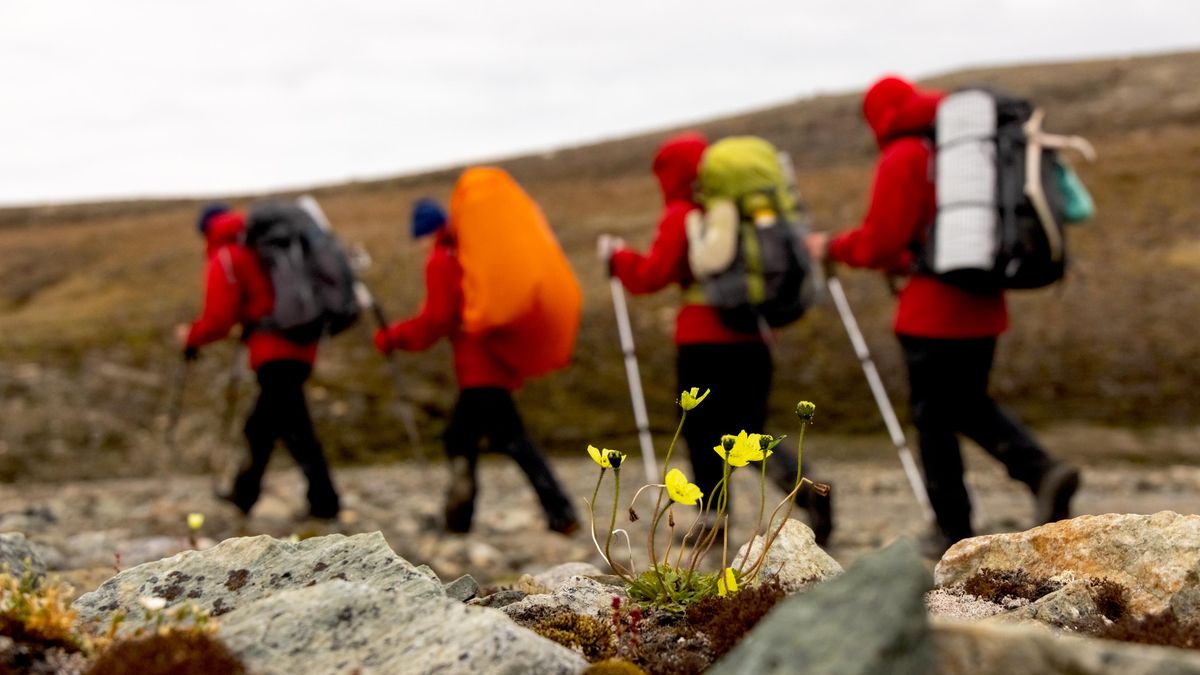
For five years now, volunteers with the Clean Arctic initiative – an environmental project dedicated to clearing northern territories of accumulated waste – have been working throughout the Extreme North. Over this period, nearly 10,000 volunteers have participated, collecting over 22,000 tons of waste and rehabilitating 1,101 hectares of land. Today, Clean Arctic participants are developing a specialized methodology to ensure that cleanup operations remain safe for these fragile ecosystems.
Andrei Nagibin, head of the Clean Arctic project, spoke with Arctic.ru about who is eligible to participate in Arctic cleanup efforts, as well as the artifacts – - witnesses of the past – that volunteers encounter amid the debris.
Andrei Nagibin is a former ship handler on northern sea routes and a deep-sea navigator. He has firsthand knowledge of the severe environmental situation facing the North. Andrei recalls that during the Northern Supply Haul season – when essential goods must be delivered punctually to Arctic port cities – thousands of barrels of fuel used to be transported into the Arctic zone.
“We hauled an especially large amount of fuel. Back then, there were those massive Soviet two-hundred-liter barrels – we would fill entire cargo holds, a thousand tons at a time. Imagine: a vessel with a 4,000-ton displacement, packed to the brim with barrels,” Andrei Nagibin recalls.
From there, as the project head recounts, vessels would depart in ballast, or, as seafarers put it, “empty.” Meanwhile, in the Arctic, in addition to the barrels, equipment and numerous items of gear belonging to geologists and military personnel who had worked in the North were left behind.
“All of this was shipped in over the course of – get this – 90 years! Naturally, we fully understand the condition in which the Arctic now finds itself as a result,” says Andrei Nagibin.
How to Clean Up the Arctic?
Discussions regarding the removal of accumulated waste have been ongoing for quite some time, but the mechanisms to implement these ideas remain insufficient, the head of Clean Arctic emphasizes. He proposes addressing this issue through a mechanism known as “northern removal,” which resembles the concept of back freight, or backhaul cargo transportation.
“But back freight implies paying for a vessel traveling from one port to another – say, from Tiksi to Vladivostok. Northern removal, on the other hand, is when a vessel is loaded, travels to the Arctic, and then returns from there. Everything is already paid for. The shipowner or charterer of that voyage must be incentivized to call at a port and collect a portion of the prepared scrap metal and municipal solid waste that needs to be removed from the Arctic,” Andrei Nagibin explains.
Clarifying the northern removal mechanism, Nagibin offers a straightforward analogy: as a child, you would turn in glass kefir bottles – receive a few kopecks, and buy candy. The head of Clean Arctic proposes that a similar incentive system be embedded in legislation for shipowners, such as quotas granting access to reduced freight rates.
Moreover, at Cape Chelyuskin, volunteers have tested a unique manual cleanup technology. Only helicopters are permitted as special-purpose equipment.
“Indeed, heavy machinery is not used in these cleanups: once you drive such a vehicle across the tundra, you leave behind a track that will take 80 years to heal. That is the major problem,” Nagibin noted.
Currently, volunteers are drafting recommendations based on this technology; to this end, they have reached out to the Ministry of Natural Resources and Environment as well as Ecology scientific research institute. There, together with specialists, they are developing cleanup standards for hard-to-access territories.
The Clean Arctic team plans to unveil this methodology around the beginning of next year. It will be deployable across the entire Russian Arctic territory.
“We have already worked out the process ourselves: you cut a barrel, remove the bottom, and pump the fuel into a separate tank. From a tractor, for example, you can cut off the wheels to allow it to be lifted by helicopter. Everything has been addressed, step by step,” emphasized Andrei Nagibin.
Their own Artek on Taimyr
This year, the Clean Arctic team managed to surprise everyone by finally reaching Spitsbergen, a goal they had pursued for three years. At Cape Chelyuskin, the volunteers have established their own base. According to Andrei Nagibin, its creation required three years.
“Now it is a place where you can comfortably spend the night, change clothes, take a shower, and prepare food. We call it Arctic Artek, or Arktek,” he noted.
According to the project head, the number of volunteers ready to participate in Arctic cleanup operations genuinely impresses him. Initially, the project targeted young people aged 18 and up from across Russia. However, Andrei Nagibin later observed that his own peers exhibited just as much interest in Clean Arctic.
“We are exactly that generation that never fully experienced student construction brigades and wants to work together. So we “dilute” the young folks with seasoned adults. For example, right now at Cape Chelyuskin, a renowned cardiologist and a cosmonaut, a Hero of Russia, have volunteered,” recounts Andrei Nagibin.
Together, they not only work but also share kitchen duty shifts, and upon returning, keep in touch through group chats for years.
“Older participants, of course, are more responsible and take a protective attitude toward the younger volunteers. It seems to me that such a mix of “silver” and young volunteers works exceptionally well,” observed Andrei Nagibin.
Historians and museum professionals also join these volunteer expeditions. Today, according to Andrei Nagibin, many objects of interest to specialists remain scattered throughout the Arctic: the remains of a 1934 NATI-3 half-track vehicle, a fragment of the armored hull of a T-37 tank, equipment and household items used by hydrometeorological workers, or the sturdy Soviet barrels that even a gas cutter sometimes cannot cut through.
“Naturally, these must be preserved. I believe the ratio right now is 70 to 30: 70 percent is refuse, and 30 percent comprises those very artifacts under the open sky that are worth keeping,” he says.
The project head plans to establish dedicated trails, pathways, and informational stands within these territories, enabling expeditions for school students. Funding is already secured – the team has won a grant from the Presidential Foundation for Nature.
“If a log house built back during the Papanin expedition is still standing – do not touch it. It is already an artifact, a site that must be visited. That is why the Arctic must be cleaned up locally: where communities exist, where our military personnel are stationed, and where the Federal Service for Hydrometeorology and Environmental Monitoring and research laboratories operate. However, this must be accomplished gradually, with monitoring of what is present on the ground,” Andrei Nagibin believes.