10:00 19.05.2026
Four Twos-Zero. How Russia’s Most Advanced Icebreakers Are Built and Operated

© Atomflot
Project 22220 all-purpose nuclear-powered icebreakers surpass vessels of this class in Russia in many respects. No comparable ships are built anywhere else in the world. They are the largest, the most powerful, the most technologically advanced, and the most capable of navigating heavy ice.
The Development of the Arctic and Far East website team visited the Baltic Shipyard of the United Shipbuilding Corporation and GlavSevmorput’s Marine Operations Headquarters to learn how Russia’s most advanced nuclear-powered vessels are built and where they serve.
Chukotka in the Fog
The outline of the Chukotka at the fitting-out quay of the Baltic Shipyard was barely visible through the fog drifting in from the Gulf of Finland. The vessel, as tall as an 18-story building, could scarcely be seen, yet it was impossible not to hear the sounds of metal cutting, welding, hammering and generators merge into one continuous roar.
This is the fifth nuclear-powered vessel under construction under the project and the fourth serially produced ship. Before it, Sibir, Ural and Yakutia had left the shipyard quay. Arktika, which entered service in 2020, is regarded as the lead vessel.
In figures, the Project 22220 all-purpose nuclear-powered icebreaker - also known as the LK-60Ya - measures over 170 meters in length and nearly 60 meters in height, with a variable draught ranging from 9 to 10.5 meters depending on operating conditions. It is equipped with two RITM-200 nuclear reactors delivering 60 MW of power to the propellers - or, as specialists say, to the vessel’s propulsion system - and is capable of breaking through ice up to 2.8 meters thick.
Chukotka was launched in November 2024 and, by the start of 2026, following the installation of the wheelhouse and mast, had fully acquired its hull structure. At present, both externally and internally, it remains bare metal entwined with scaffolding, cables, hoses and ventilation ducts. Yet within a few months shipbuilders plan to complete testing of all systems, finish equipping the vessel, and send the icebreaker for sea trials before handing it over to the client.


1/7
The Project 22220 nuclear-powered icebreaker Chukotka at the finishing dock of the United Shipbuilding Corporation Baltic Shipyard
© Russian Arctic and Far East Development
2/7
The Project 22220 nuclear-powered icebreaker Chukotka at the finishing dock of the United Shipbuilding Corporation Baltic Shipyard
© Russian Arctic and Far East Development
3/7
Work on the Project 22220 nuclear-powered icebreaker Chukotka
© Russian Arctic and Far East Development
4/7
Work on the Project 22220 nuclear-powered icebreaker Chukotka
© Russian Arctic and Far East Development
5/7
Work on the Project 22220 nuclear-powered icebreaker Chukotka
© Russian Arctic and Far East Development
6/7
The Project 22220 nuclear-powered icebreaker Chukotka at the finishing dock of the United Shipbuilding Corporation Baltic Shipyard
© Russian Arctic and Far East Development
7/7
The hull of the Project 22220 nuclear-powered icebreaker Leningrad on the construction slipway at the United Shipbuilding Corporation Baltic Shipyard
© Russian Arctic and Far East Development
“Final finishing works are already under way on this vessel. Mooring trials are being conducted - meaning that all mechanisms and systems are being started up and tested under operational conditions for their intended purposes. The vessel is being prepared for the start-up of its nuclear reactors,” says Project Manager for Nuclear Icebreaker Construction at the Baltic Shipyard of USC Ivan Brattsev.
Meanwhile, on the shipyard’s 350-meter slipway - the largest in Russia - two more nuclear-powered vessels in the series, Leningrad and Stalingrad - are gradually being built.
The keel-laying ceremony for Leningrad took place in January 2024, and the vessel is currently in the hull assembly stage: the central section of the icebreaker is already complete, while the bow and stern are still under construction. Just over 200 days remain before launch, as indicated by a countdown clock mounted on the wall of a neighboring workshop.
Stalingrad, laid down in November 2025, currently consists of only a single central section, and according to plans it will not leave the slipway until 2028.
A Park of Shipbuilding Art
According to Ivan Brattsev, the entire process of creating an icebreaker consists of several main stages: keel laying - effectively the birth of the project - hull assembly on the slipway and preparation for launch, after which the vessel is transferred to the fitting-out quay where all systems and equipment are installed and interior finishing and painting are carried out.
This is followed by nuclear fuel loading, reactor start-up and testing, then mooring and sea trials, another inspection of all systems and mechanisms, and finally the raising of the flag and delivery to the client.
Yet this dry verbal description in reality represents years of work by hundreds and thousands of people, along with tens of thousands of tonnes of metal transformed into countless ship components.


1/6
The assembly and welding shop at the United Shipbuilding Corporation Baltic Shipyard
© Russian Arctic and Far East Development
2/6
The assembly and welding shop at the United Shipbuilding Corporation Baltic Shipyard
© Russian Arctic and Far East Development
3/6
A foreman in the assembly and welding shop at the United Shipbuilding Corporation Baltic Shipyard
© Russian Arctic and Far East Development
4/6
The assembly and welding shop at the United Shipbuilding Corporation Baltic Shipyard
© Russian Arctic and Far East Development
5/6
A foreman in the assembly and welding shop at the United Shipbuilding Corporation Baltic Shipyard
© Russian Arctic and Far East Development
6/6
The assembly and welding shop at the United Shipbuilding Corporation Baltic Shipyard
© Russian Arctic and Far East Development
The project’s life cycle begins even before the icebreaker is laid down, in the hull-processing workshop where steel is cut and the first components are manufactured. Sometasks are performed automatically, others manually.
The components are then moved along wide conveyors to the assembly and welding workshop, where they are assembled into larger elements: flat sections, volumetric sections and entire blocks - until the structure no longer fits beneath the workshop roof.
Each production area has a schedule specifying what must be produced, in what quantity and by what deadline. Afterwards, all components are checked to ensure compliance with the required parameters.
Leaving the workshop on special platforms, the sections and blocks are either sent directly to the slipway or await their turn in the spaces between workshops. As a result, parts of the shipyard resemble a park of contemporary shipbuilding art, filled with massive installations made from different sections of the icebreaker: hull components, superstructure elements, and Leningrad’s icebreaking tooth, which is displayed on a separate pedestal.


1/3
The grounds of the United Shipbuilding Corporation Baltic Shipyard
© Russian Arctic and Far East Development
2/3
The grounds of the United Shipbuilding Corporation Baltic Shipyard
© Russian Arctic and Far East Development
3/3
The grounds of the United Shipbuilding Corporation Baltic Shipyard
© Russian Arctic and Far East Development
Among the variety of icebreaker components, a Mi-8 helicopter parked next to the fitting-out quay particularly stands out. It turns out to be a full-scale mock-up that is lifted by crane and tested on an almost completed icebreaker whenever doubts arise over whether the rotorcraft will fit comfortably on the helicopter deck.
Despite the similarity of the icebreakers built under the standard design, each vessel is unique in some respect. This is not due to manufacturing tolerances, but rather because with every successive nuclear-powered ship, technologies, documentation, equipment and systems are revised and improved.
“After each vessel - after the third, after the fourth - absolutely anything can show up, especially once the icebreaker is operating in the harsh conditions that can be found only in the Arctic. We always review things, make adjustments, eliminate issues and improve designs so that the next icebreaker will not face the same problems,” Brattsev said.
According to him, the entire vessel construction cycle takes years, but through streamlining production technologies and as workers gain experience, the timeframe can be significantly reduced. While Arktika took around seven years to build, each subsequent vessel has been delivered approximately six months faster, and Chukotka is expected to be completed within five years.
Naturally, over such a long period the vessel becomes almost like family to everyone at the shipyard, especially the project manager. And even after the construction ends, they continue following its fate.
“Without a question, it’s like a child you’re releasing into adult life. When the vessel has spent five, six or seven years here on the slipway and at the quay, and then later you watch it sailing somewhere in the Kara Sea, the Laptev Sea, or perhaps even in the Far East - of course, that’s incredibly fascinating,” Brattsev said.
Icebreakers on Schedule
The nuclear-powered vessels are also closely monitored at GlavSevmorput’s Marine Operations Headquarters. Employees’ screens display maps showing everything taking place in the waters, such as hydrometeorological conditions, the locations of all nuclear and diesel icebreakers, and other vessels.
Early spring on the Northern Sea Route, when ice reaches its greatest thickness, is the most challenging period. At present, all activity is concentrated in the Kara Sea, the Gulf of Ob and the Yenisei Gulf, where intensive extraction of natural resources is underway. Up to 50 vessels may simultaneously be operating there or awaiting escort.
According to Head of the Marine Operations Headquarters Vladimir Arutyunyan, every move within the waters is incorporated into a master schedule that is drafted in advance.
“Before navigation begins, we receive data on vessels and check whether they can pass under the current ice conditions. We then plan icebreaker escort operations assigning icebreakers to vessels to ensure movement is as rapid and efficient as possible.”
The positions of all icebreakers in the relevant sectors are also taken into account, and sometimes, in order to streamline operations, a vessel may be transferred from one icebreaker to another while en route.
This schedule is planned several months ahead, since the Northern Sea Route has two navigation periods: summer-fall and winter-spring. According to Deputy Head of GlavSevmorput for Navigation Support Svyatoslav Stepchenkov, most icebreaker operations take place during winter, while in summer they remain on standby only in areas of sea that have not fully thawed.
“Russia’s northern coastline is essentially made up of rivers flowing into the four seas of the Russian Arctic: the Kara Sea, the Laptev Sea, the East Siberian Sea, and the Chukchi Sea. These rivers are also made ice-free, and some are navigable, so the first type of navigation is, let us say, coastal and semi-riverine. If we are speaking about passage from West to East and back, then depending on the vessel, August-September is considered the best period. It is also known as the period of minimal Arctic sea ice,” Stepchenkov said.
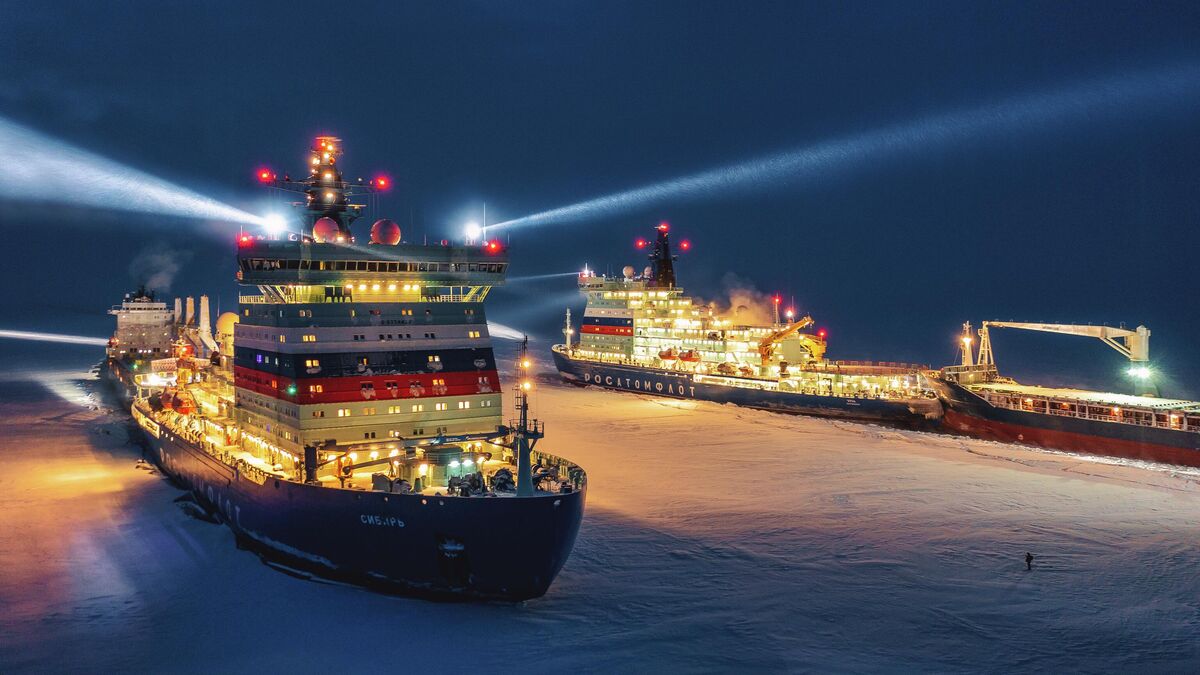
The overwhelming majority of Northern Sea Route voyages, including international commercial shipping, take place during the summer-fall period, as do active operations in its eastern sector, including northern supply deliveries. In winter, the nuclear-powered vessels focus on northern Siberia. Thus, the image of icebreakers continuously escorting ships from one end of the Northern Sea Route to the other is more of a beautiful image than an everyday reality.
There are two reasons for this. The first one is the heavy workload of the icebreakers on major Russian projects. Technically, a latest-generation nuclear-powered vessel can traverse the entire Northern Sea Route at any time of year without difficulty, but during the harsh season all are needed in the Kara Sea. Last winter, for example, Sibir was dispatched to the Gulf of Finland, which had frozen due to unusually low temperatures.
“If there were a request right now to head east, we could do it. But in order to maintain navigation systematically, additional nuclear icebreakers are being built so that the current vessels can remain here providing support, while all the others can be assigned to take care of the eastern direction,” Svyatoslav Stepchenkov said.


1/5
Project 22220 nuclear-powered icebreaker Ural towing a vessel
© Atomflot
2/5
Nuclear-powered icebreakers in the ice
© Atomflot
3/5
The Project 22220 nuclear-powered icebreaker Sibir in the ice
© Atomflot
4/5
The Project 22220 nuclear-powered icebreaker Sibir in the ice
© Atomflot
5/5
The Project 22220 nuclear-powered icebreaker Sibir at sea
© Atomflot
The second reason is about economic practicality: icebreakers must remain busy at all times, while not all transport vessels are suited to the harsh Arctic winter. As specialists at the Marine Operations Headquarters explain, having the appropriate ice-class hull alone is insufficient - a vessel also needs a sufficiently powerful propulsion system to move through ice.
Ideally, there should be several such vessels at once. Although ice convoys - as commonly imagined, with a line of ships following an icebreaker - are in reality extremely rare and highly labor-intensive to organize.
“For vessels to follow in the wake of an icebreaker, they must be of the same ice class, and there should be no more than two vessels. Most likely, for eastern voyages we will use convoy navigation, but these would, for example, involve two LNG carriers with identical Arc7 ice class ratings - practically the highest one - and identical propulsion systems. In other words, we know that if one vessel has passed behind the icebreaker, another identical vessel will also pass through that channel, even if it narrows slightly,” Director General of GlavSevmorput Sergei Zybko said.
Nevertheless, despite these limitations, the Northern Sea Route is steadily being “broken in”, as they put it at the Marine Operations Headquarters. The number of voyages and the volume of cargo traffic continue to increase. In the eastern direction alone, cargo volume rose by 15 percent last year. Many countries engage in building civilian Arctic-class fleets, and the Headquarters is receiving an increasing number of transit applications from foreign shipowners.